
SEO Organic Keywords Vs Organic Traffic: What Should You Measure?
SEO organic keywords and organic traffic are two important SEO metrics. Both help you understand your website’s performance in search engines, but they measure different things.
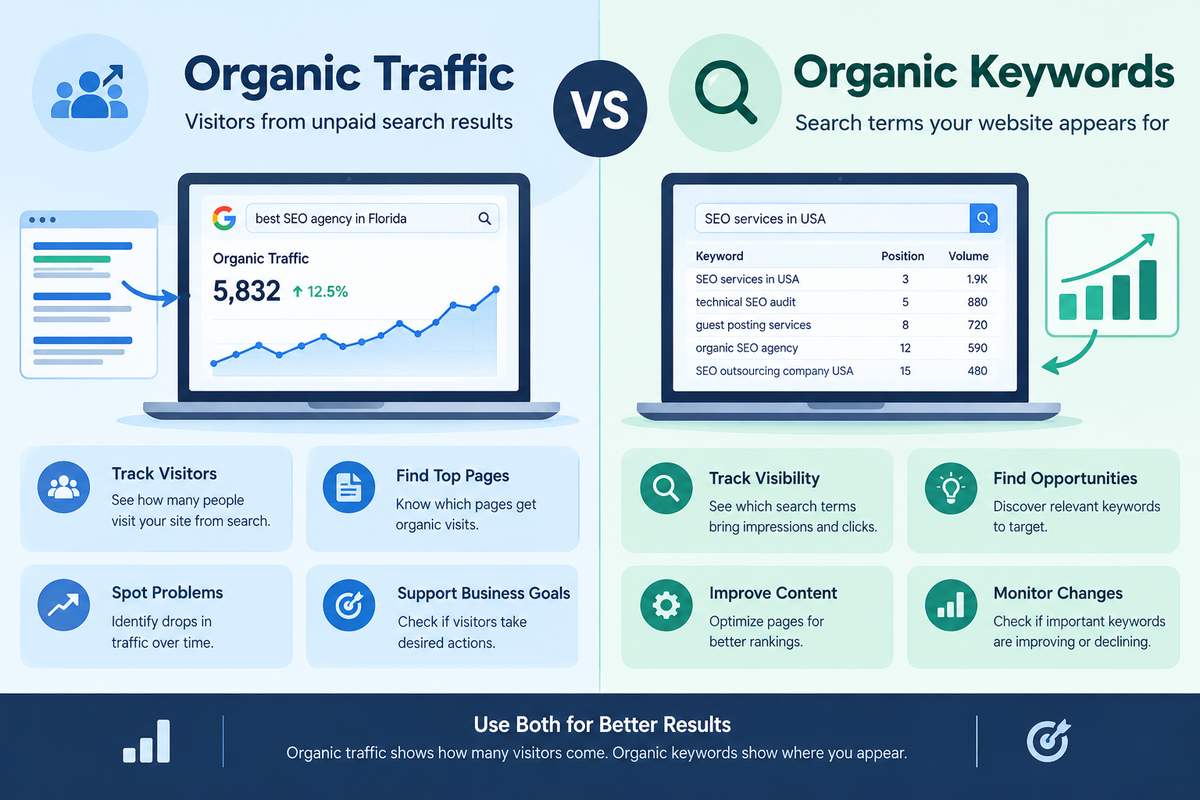
Organic traffic shows how many visitors reach your website through unpaid search results. Organic keywords show which search terms your website appears for in search results.
Understanding both metrics helps you track SEO progress, find ranking opportunities, and improve your website’s visibility.
What Is Organic Traffic?
Organic traffic refers to visitors who reach your website through unpaid search engine results. For example, someone searches for “best SEO agency in Florida,” finds your website on Google, and clicks your page. This visit counts as organic traffic.
Why Is Organic Traffic Important?
Organic traffic helps you:
- Measure SEO performance: Check whether your website attracts more visitors from search engines.
- Identify popular pages: Find blog posts and service pages that receive organic visits.
- Find traffic drops: Discover pages that are losing visitors.
- Understand user activity: Check how visitors interact with your website.
- Evaluate business results: See whether organic visitors complete useful actions, such as submitting enquiry forms.
You can use Google Analytics 4 (GA4) to measure organic search sessions, users, engagement, and configured conversions. Google Search Console also shows clicks from Google Search.
What Are Organic Keywords?
Organic keywords are the search terms for which your website appears in unpaid search results.
Examples include:
- SEO services in the USA
- Technical SEO audit
- Guest posting services
- Organic SEO agency
- SEO outsourcing company USA
Organic keyword data helps you understand which search terms bring visibility to your website and where you can improve your rankings.
Why Are Organic Keywords Important?
Organic keywords help you:
- Track search visibility: Find the terms for which your website appears.
- Discover content ideas: Identify relevant topics for new blog posts.
- Improve existing pages: Optimize content for relevant search terms.
- Monitor rankings: Check whether important keywords are improving or declining.
- Understand search intent: Learn what users want to find online.
Google Search Console shows actual queries that generate impressions and clicks. Tools such as Semrush and Ahrefs can help with keyword tracking and competitor research.
Remember, ranking for more keywords does not always mean receiving more traffic. Some keywords have low search demand or appear too far down the search results to attract clicks.
Organic Traffic vs Organic Keywords: Key Differences
| Feature | Organic Traffic | Organic Keywords |
|---|---|---|
| Meaning | Visits from unpaid search | Search terms your website appears for |
| Main purpose | Measure search visits | Measure search visibility |
| Common tools | GA4, Google Search Console | Google Search Console, Semrush, Ahrefs |
| Increase indicates | More organic visits | More ranking terms or improved visibility |
| Main benefit | Understand website visits | Find ranking opportunities |
| Limitation | Traffic may not generate leads | Rankings may not generate clicks |
In simple words: SEO Organic keywords show where your website appears in search results. Organic traffic shows how many visitors arrive through unpaid search.
Example: Why You Need Both Metrics
Imagine your website ranks for 100 organic keywords and receives 500 organic visits in one month.
The following month, it ranks for 150 keywords but receives only 450 organic visits.
Your keyword count has increased, but your traffic has decreased.
Possible reasons include:
- New keywords have low search volume.
- Important keywords have lost ranking positions.
- Pages receive impressions but few clicks.
- Search demand has decreased due to seasonal changes.
The opposite can also happen. Your website may rank for fewer keywords but attract more visitors because its most important pages rank higher.
This is why measuring only one metric can give you an incomplete picture of SEO performance.
Which Metric Should You Measure?
1. To Increase Website Visitors
Focus on organic traffic. Compare visits across similar periods and identify which pages attract the most visitors. Investigate significant increases or decreases.
2. To Improve Search Rankings
Focus on organic keywords. Review ranking positions, impressions, clicks, and click-through rate (CTR). Improve page titles, headings, content, and internal links where needed.
3. To Find New Blog Topics
Focus on keyword research. Identify relevant search terms that match your audience’s needs. Review competitor keywords to discover useful topics your website has not covered.
4. To Generate More Leads
Measure organic traffic alongside conversions. A page with fewer visitors may generate more enquiries than a page with high traffic.
Use GA4 to track properly configured conversions, such as form submissions or completed enquiries. This helps you understand whether organic visitors contribute to your business goals.
How to Track Organic Traffic and SEO Organic Keywords
Step 1: Open Google Search Console
Select your website and open the Performance report. Review clicks, impressions, CTR, average position, search queries, and pages.
Step 2: Check GA4
Open the Traffic acquisition report and find the Organic Search channel. Review sessions, users, engagement, and configured conversions.
Step 3: Review Keyword Rankings
Use Google Search Console for search query data. Use Semrush or Ahrefs for broader keyword tracking and competitor analysis.
Step 4: Compare Results
Compare similar weekly or monthly periods. Check whether traffic is increasing, important keywords are improving, and visitors are completing useful actions.
Note that Google Search Console clicks and GA4 sessions will not always match because they measure different things.
Common Mistakes to Avoid
- Focusing only on traffic: More visitors do not automatically mean more leads or sales.
- Counting every keyword as a success: Prioritize relevant terms instead of chasing a higher keyword count.
- Ignoring search intent: Your content should answer the question behind the search.
- Comparing different periods: Use equivalent date ranges for more meaningful comparisons.
- Ignoring conversions: Rankings and traffic are useful, but business results matter too.
Best Practices for Better SEO Results
- Research relevant keywords before creating content.
- Write useful content that answers user questions.
- Optimize page titles, headings, and meta descriptions.
- Improve internal linking between related pages.
- Fix indexing issues and technical SEO problems.
- Build relevant, quality backlinks naturally.
- Update outdated content.
- Review traffic, keyword visibility, and conversions regularly.
Conclusion
Organic traffic and organic keywords measure different parts of SEO performance. Organic keywords help you understand your search visibility, while organic traffic shows how many visitors arrive through unpaid search.
The best approach is to measure both metrics together. Track keywords to find ranking opportunities, monitor traffic to understand visitor activity, and review conversions to evaluate business results.
At SEO Outsourcing Company USA, we help businesses improve their search visibility through keyword research, on-page SEO, technical SEO, link building, and content optimization. Visit SEO Outsourcing Company USA to explore our SEO services and strengthen your website’s organic search presence.
