Types of Ai seo

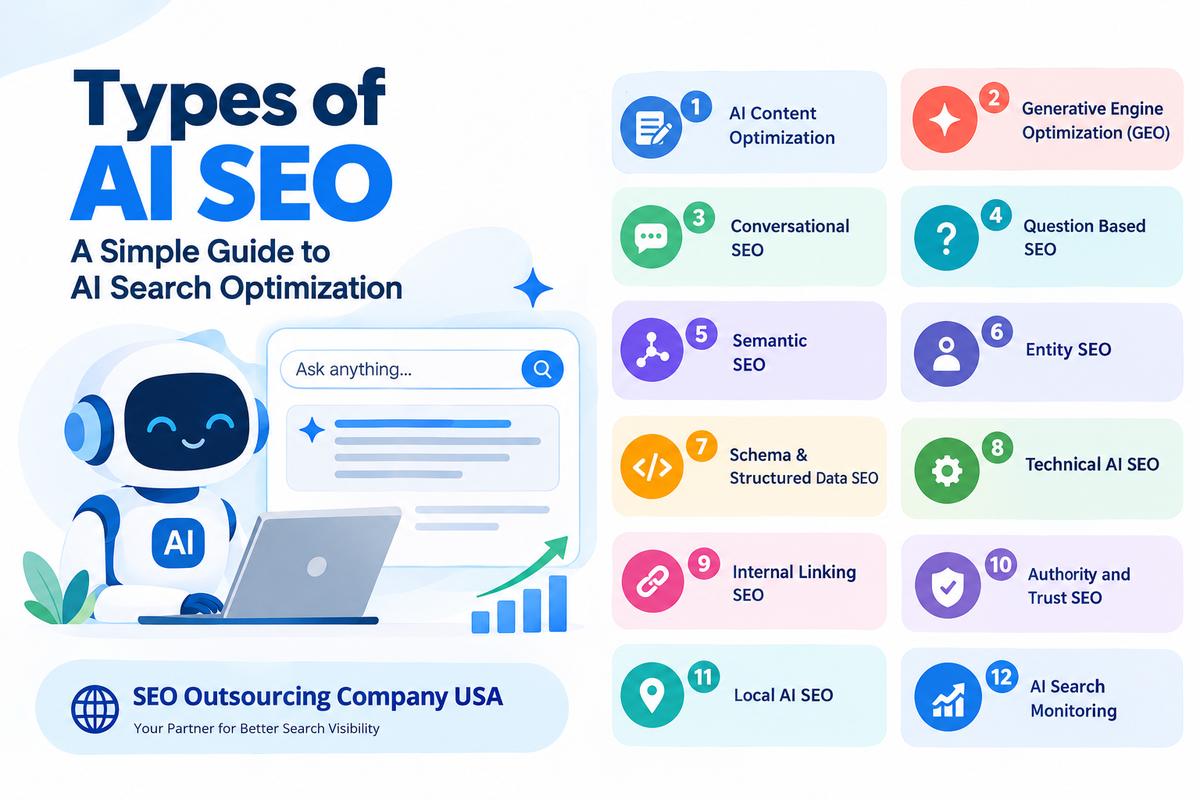
Types of AI SEO

AI is changing the way people search for information online. Today, users do not always type short keywords into Google. They also ask complete questions through AI tools and search systems.

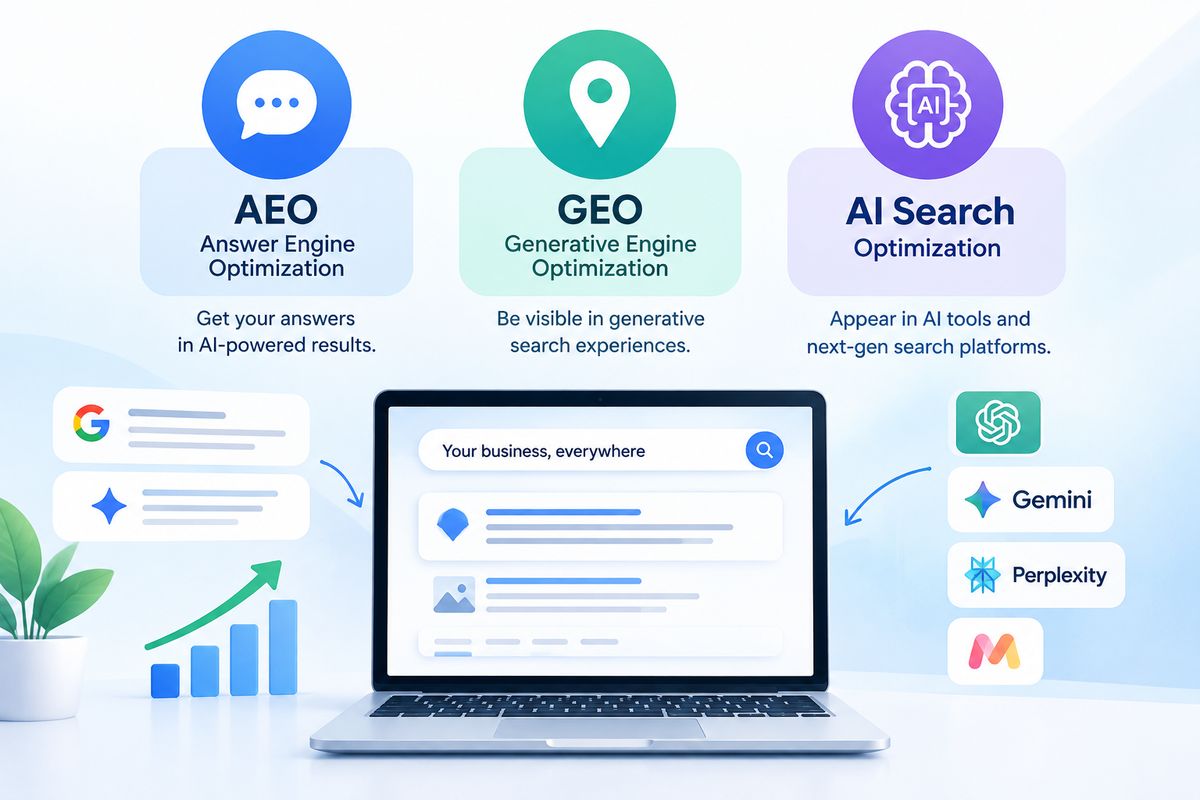
This change has created a growing area of SEO called AI SEO. AI SEO focuses on making website content easy for search engines and AI systems to understand, find, and use when answering user questions.

AI SEO does not replace traditional SEO. It works with it. Websites still need good content, keywords, technical SEO, links, and a good user experience.

Here are the main types of AI SEO businesses should know about.

1. AI Content Optimization

AI content optimization means creating content that is useful, clear, and easy to understand.

Good content should:

  • Answer the user’s question directly
  • Use simple language
  • Have clear headings
  • Provide useful examples
  • Avoid unnecessary information
  • Give accurate and updated information

The main goal is to help the reader first while also making the content easier for AI systems to understand.

2. Generative Engine Optimization

Generative Engine Optimization, also called GEO, focuses on improving content for AI generated search results.

AI search tools may collect information from different websites before creating an answer. Businesses can improve their chances of being noticed by creating useful and trustworthy content.

Some important practices include:

  • Giving clear answers
  • Covering topics in detail
  • Using accurate information
  • Adding original information
  • Answering common questions
  • Keeping content updated

3. Conversational SEO

People often search by asking complete questions instead of using only two or three keywords.

For example, instead of searching for “local SEO services,” someone may ask:

“How can local SEO help my small business?”

Conversational SEO focuses on these natural questions.

Businesses can use:

  • Question based headings
  • Long tail keywords
  • FAQs
  • Natural language
  • Direct answers

This helps content match the way people naturally search and communicate with AI tools.

4. Question Based SEO

Question based SEO focuses on answering the questions customers have about a business, service, or product.

For example, an SEO website can answer:

  • What is SEO?
  • How does keyword research work?
  • What is technical SEO?
  • How long does SEO take?
  • What is AI SEO?
  • Why is link building important?

Answering these questions clearly can make a website more useful to users and search systems.

5. Semantic SEO

Semantic SEO focuses on the meaning of a topic rather than using the same keyword repeatedly.

For example, a page about SEO for doctors can naturally discuss:

  • Medical websites
  • Patient searches
  • Local SEO
  • Healthcare content
  • Online reviews
  • Google Business Profile
  • Website trust

These related topics help search systems understand the subject of the page.

6. Entity SEO

Entity SEO helps search engines understand important subjects such as businesses, people, products, places, and organizations.

For a business, important information can include:

  • Business name
  • Location
  • Services
  • Industry
  • Website
  • Contact information

Keeping this information clear and consistent can help search systems understand the business better.

7. Schema and Structured Data SEO

Schema markup provides search engines with additional information about a webpage.

Depending on the website, businesses may use different types of schema, such as:

  • Organization
  • Local Business
  • Article
  • Product
  • Service
  • FAQ
  • Review

Schema does not guarantee that a website will appear in an AI answer, but it can help search systems understand page information more clearly.

8. Technical AI SEO

Technical SEO is still important for AI search.

If search engines cannot properly crawl or access a website, its content may have difficulty being found and understood.

Technical SEO can include:

  • Checking crawling problems
  • Fixing indexing issues
  • Improving website speed
  • Fixing broken links
  • Checking mobile performance
  • Managing redirects
  • Using canonical tags
  • Checking XML sitemaps
  • Reviewing robots.txt
  • Checking structured data

A technically healthy website provides a better foundation for search visibility.

9. Internal Linking SEO

Internal links connect different pages on your website.

For example, an SEO services page can link to pages about:

  • Technical SEO
  • Local SEO
  • Content SEO
  • Link building
  • AI SEO
  • Keyword research

Good internal linking helps users find related information and helps search systems understand how different pages are connected.

10. Authority and Trust SEO

Trust is important when people and AI systems look for information.

Businesses can build a stronger online presence through:

  • Helpful content
  • Accurate information
  • Relevant backlinks
  • Trusted website mentions
  • Consistent business information
  • Expert content
  • Regular content updates

The focus should be on providing information that users can understand and trust.

11. Local AI SEO

Local AI SEO focuses on businesses that serve specific locations.

For example, someone may ask:

“Which SEO agency can help my business in Florida?”

Businesses should make sure their local information is accurate across their website and other online platforms.

This can include:

  • Business name
  • Address
  • Phone number
  • Service areas
  • Local pages
  • Business listings
  • Customer reviews
  • Location based content

12. AI Search Monitoring

AI SEO is not a one time activity. Search systems and user behavior continue to change.

Businesses should regularly monitor:

  • Search rankings
  • AI search results
  • Brand mentions
  • Website traffic
  • Important search queries
  • Competitor content
  • Old content that needs updating

Regular monitoring helps businesses find new opportunities and improve their content.

How to Build an AI SEO Strategy

A simple AI SEO strategy starts with understanding your customers.

First, find the questions they ask. Then create useful content that provides clear answers.

Businesses can also:

  • Research keywords and topics
  • Study competitors
  • Create helpful blogs and pages
  • Improve technical SEO
  • Add relevant internal links
  • Use suitable schema
  • Build relevant backlinks
  • Update old content
  • Keep business information consistent
  • Monitor SEO and AI search visibility

The main goal should always be the user. AI SEO is not about adding keywords again and again. It is about creating useful, clear, accurate, and easy to understand information.

Conclusion

AI SEO is becoming an important part of modern search marketing. It includes content optimization, GEO, conversational SEO, semantic SEO, entity SEO, technical SEO, schema, internal linking, authority building, local AI SEO, and AI search monitoring.

Businesses should focus on both traditional SEO and AI search optimization to build a stronger online presence.

If you need help improving your website for traditional search and AI search, SEO Outsourcing Company USA can help. Our agency provides services such as keyword research, content optimization, technical SEO, link building, on page SEO, off page SEO, local SEO, and AI SEO support.

With a clear strategy focused on useful content and better search visibility, SEO Outsourcing Company USA can help your business build a stronger presence in the changing world of search.


seoa gency spam safeguard

How to Know If an SEO Agency Is Spamming Your Website

SEO should help your website reach the right people and build a strong presence in search engines. But not every SEO agency follows the same approach. Some agencies use spammy SEO methods because they want to show quick results or make their monthly reports look busy.

For a business owner, this can be difficult to notice.

You may receive an SEO report every month and see new keywords, traffic numbers, links, blog posts, and ranking changes. It may look like a lot of work is happening. But when you look closely, some of that work may have little real value for your website.

SEO spam is not limited to creating too many links. Agencies can use many different spam methods, including keyword stuffing, copied content, fake traffic, poor-quality pages, automated comments, irrelevant keywords, and other shortcuts.

So how can you tell if an SEO agency is using spam instead of doing genuine SEO?

Here are some common signs to watch for.

Keyword Stuffing

Keyword stuffing happens when the same keyword is placed on a page again and again just to try to influence rankings.

For example, a page may repeatedly use a phrase such as “best SEO company in USA” even when it makes the content difficult to read.

Good content should sound natural and answer the user’s question. Keywords should fit naturally into the content instead of being forced into every sentence.

If you notice that your website content has become repetitive or unnatural after an SEO agency started working on it, ask why.

Targeting Irrelevant Keywords

Some agencies show clients a long list of keywords to make the SEO report look impressive.

The problem is that some of these keywords may have nothing to do with the business.

A dentist does not need to rank for unrelated technology terms. A real estate company does not need random entertainment keywords. A software company does not need keywords for completely unrelated products.

Ranking for irrelevant searches may increase numbers in a report, but it does not necessarily bring useful customers.

Your SEO keywords should match your services, products, audience, and search intent.

Creating Pages Only to Target Keywords

Another common spam method is creating large numbers of low-value pages that provide almost the same information.

An agency may create separate pages for slightly different keyword variations even though there is no real reason for each page to exist.

For example, several pages may contain almost identical content with only a few words changed.

These pages do not give users anything new. They are created mainly to target search terms.

A good website should have pages because they are useful to visitors, not simply because an SEO report needs more URLs.

Doorway Pages

Doorway pages are pages created mainly to attract search traffic and then send visitors somewhere else.

An agency may create many pages targeting different locations or keyword variations, while the actual information on each page is almost identical.

If your website suddenly contains dozens or hundreds of pages with very similar content, check why they were created.

Copied or Spun Content

Some agencies create content by copying information from other websites or changing existing content with automated tools.

The result can be pages that look different on the surface but provide little original information.

Copied content can also create problems with quality and trust.

Your website content should provide something useful and relevant to your audience rather than simply rewriting what another website has already published.

Publishing Large Amounts of Low-Quality AI Content

AI can be useful for research, ideas, editing, and content creation. The problem starts when an agency uses automation to publish hundreds of pages without proper checking.

You may notice articles that repeat the same ideas, contain incorrect information, sound unnatural, or do not answer the actual search query.

Publishing more content does not automatically mean better SEO.

Every piece of content should have a clear purpose and should be reviewed before it goes live.

Fake or Artificial Traffic

Some agencies may show an increase in website traffic and present it as a major SEO achievement.

But traffic numbers alone do not tell the full story.

If your website suddenly receives visitors from locations or sources that have little connection with your target audience, investigate where that traffic is coming from.

Artificial or low-quality traffic can make analytics numbers look better without producing genuine enquiries or customers.

The important question is not only “How much traffic did we get?”

It is also “Did we get the right visitors?”

Automated Blog Comments

Comment spam is another old SEO technique.

Some agencies or automated systems may place website links inside comments on blogs, forums, or other websites.

These comments may have little connection with the actual discussion.

If you discover hundreds of strange comments containing your business name or website link, ask your SEO provider whether these were part of the campaign.

Spammy Directory Submissions

Business directories can be useful when they are legitimate, relevant, and maintained.

The problem comes when an agency submits your business information to hundreds of random directories simply to create more SEO activity.

If the directories have no real audience, contain thousands of unrelated businesses, or look abandoned, the submissions may provide little value.

Private Blog Networks and Expired Domains

Some SEO agencies use networks of websites created mainly to manipulate search rankings.

They may also purchase expired domains and use them to publish content or redirect visitors.

These methods can be difficult for a business owner to identify because the websites may look normal at first.

Ask your agency where important third-party placements are coming from and why those websites are relevant to your business.

Hidden Text and Hidden Links

Hidden text means placing words or links on a webpage in a way that users cannot normally see them.

For example, text may be made the same color as the background or placed somewhere that visitors are not expected to notice.

This is not the same as naturally hiding information inside an expandable section for a better user experience.

If an agency has made unusual changes to your website that you cannot understand, ask them to explain what was changed and why.

Cloaking

Cloaking is another serious SEO manipulation technique.

It involves showing different content to search engines than what is shown to normal visitors.

For example, a search engine may receive one version of a page while users see something different.

Business owners should know what content is actually being served to visitors and search engines.

If an agency refuses to explain unusual technical changes, that is a reason to investigate further.

Fake Reviews

Reviews can be important for local businesses, but creating fake reviews is not a genuine SEO strategy.

An agency may promise to generate large numbers of reviews or create reviews that do not come from real customers.

This can create trust problems for a business.

If your agency is managing your online reputation, ask whether reviews are coming from genuine customers and whether the process follows the rules of the platforms being used.

Fake Social Signals

Some agencies may promise large numbers of social shares, followers, likes, or comments as an SEO service.

Numbers can look impressive, but fake engagement does not necessarily mean real people are interested in your business.

A smaller amount of genuine engagement from the right audience can be more meaningful than large amounts of artificial activity.

Excessive Exact-Match Anchor Text

Links are not the only issue. The wording used in links can also become unnatural.

If an agency repeatedly uses exactly the same commercial keyword as the link text across many placements, the pattern may look artificial.

A natural link profile usually contains different types of wording and comes from different contexts.

Ask your agency how it decides what wording to use when promoting your website.

Redirect Abuse

Redirects are useful when used correctly, such as when a page permanently moves to another URL.

Problems can occur when an agency creates large numbers of unnecessary redirects or uses them simply to manipulate search traffic.

If you notice many unexpected redirects on your website, ask your developer or SEO agency to explain them.

Automated Forum and Profile Spam

Some agencies may create large numbers of profiles on forums, websites, or community platforms and add your business link to those profiles.

If these profiles have no genuine purpose and are created only for SEO, they may not provide real value.

A good SEO strategy should focus on meaningful online presence rather than creating hundreds of empty profiles.

Sudden Changes Without Explanation

One of the biggest warning signs is when your website keeps changing but your agency does not explain what it is doing.

Pages may be created, deleted, redirected, rewritten, or modified without your knowledge.

Your SEO agency should be able to tell you what changes were made and why those changes were necessary.

You own your website, so you should understand the major work being performed on it.

How to Check Whether Your SEO Agency Is Using Spam

You do not need to become an SEO expert to investigate.

Start by asking for a clear monthly report.

Check the keywords being targeted. Look at the content being published. Review major website changes. Check where your website is being promoted. Look at your traffic sources and make sure they make sense for your business.

Most importantly, ask questions.

If an agency says it created hundreds of pages, ask why.

If it says it generated thousands of visitors, ask where they came from.

If it reports new online placements, ask why those websites are relevant.

If it says your rankings improved, check whether the keywords actually matter to your business.

A professional SEO agency should be comfortable explaining its work.

SEO Should Be About Real Value

SEO is much more than trying to manipulate rankings.

A strong SEO campaign should improve your website, make your content more useful, target relevant searches, improve the technical side of the website, and help the right audience discover your business.

Spam can make an SEO report look busy, but busy does not always mean useful.

Before choosing or continuing with an SEO agency, look at the actual work being done instead of only looking at the numbers in a monthly report.

Choose a Transparent SEO Partner

At SEO Outsourcing Company USA, we believe businesses should understand what is being done to their websites and why.

Our SEO services can cover technical SEO, keyword research, content optimization, AI SEO, GEO, AEO, website optimization, and other areas based on the actual needs of a business.

The focus should not simply be on producing a large number of SEO tasks every month. The focus should be on relevant work that supports the website, the business, and its customers.

If you feel that your current SEO campaign is filled with irrelevant keywords, low-quality content, artificial traffic, unnecessary pages, or other spammy activities, it may be time to review the strategy.

SEO should not be about doing more spam. It should be about doing the right work for the right audience. SEO Outsourcing Company USA is here to help businesses take a more clear, practical, and transparent approach to SEO.

What Is White Label SEO services

What Is White Label SEO? A Complete Guide to White Label SEO Services

If you run a digital marketing agency, web design company, PPC agency, or social media business, your clients may also ask for SEO services. But building a full SEO team can take time, money, and resources.

This is where white label SEO can help.

White label SEO allows your agency to offer SEO services to clients under your own brand while another SEO team handles the work behind the scenes. You can focus on getting clients and managing relationships while your SEO partner takes care of the technical and daily SEO work.

In this guide, we will explain what is white label SEO, how white label SEO services work, their benefits, and how to choose the right white label SEO company or white label SEO agency.

What Is White Label SEO?

White label SEO is a service where an SEO company provides SEO work for another agency, but the work is delivered under the agency’s brand name.

For example, imagine you own a web design agency. One of your clients wants SEO services after their website is launched.

Instead of hiring an SEO expert, you can partner with a white label SEO provider. The provider performs tasks such as keyword research, website audits, on-page SEO, link building, content work, and reporting.

You then present the work to your client under your own company name.

The client does not need to know that another company is helping with the SEO work.

In simple words, white label SEO lets you sell SEO services without building the complete SEO team yourself.

What Are White Label SEO Services?

White label SEO services are SEO services provided by a third-party SEO company for agencies that want to resell SEO under their own brand.

These services can include:

  • Keyword research
  • Technical SEO
  • On-page SEO
  • Off-page SEO
  • Link building
  • Local SEO
  • Google Business Profile optimization
  • Content optimization
  • Competitor research
  • Website SEO audits
  • SEO reporting
  • E-commerce SEO
  • SEO strategy
  • Monthly SEO management

The exact services depend on the provider and the package selected.

A good white label SEO service should be flexible enough to match your agency’s needs and your clients’ goals.

How Does White Label SEO Work?

The process is usually simple.

1. Your Agency Gets the Client

Your agency finds and signs a client who needs SEO services.

For example, your client may be a local business, e-commerce store, software company, real estate business, or service provider.

2. You Choose an SEO Partner

You work with a white label SEO agency or SEO provider that can handle the required work.

You discuss the client’s website, goals, target locations, keywords, and required services.

3. The SEO Team Does the Work

The white label team handles the agreed SEO tasks.

This may include technical checks, keyword research, content recommendations, on-page improvements, link building, and performance tracking.

4. You Review the Work

Your agency can review the work before sending it to the client.

This gives you control over the final service and client communication.

5. You Deliver It Under Your Brand

The reports, documents, and communication can be prepared according to your agency’s branding and process.

Your client receives the SEO service from your agency.

Who Can Use White Label SEO?

White label SEO can be useful for many types of businesses.

Digital Marketing Agencies

Digital agencies can add SEO to their existing services without hiring a large SEO team.

Web Design Companies

Web design companies can continue supporting clients after website development by offering SEO.

PPC Agencies

Paid advertising agencies can add organic search services to their packages.

Social Media Agencies

Social media companies can offer SEO along with social media marketing.

Freelancers

SEO resellers and freelancers can use an SEO partner when they have more clients than they can manage alone.

What Is a White Label SEO Reseller?

A white label SEO reseller is a person or agency that sells SEO services to its own clients while getting the actual SEO work from another provider.

For example:

A marketing agency sells an SEO package for $1,000 per month.

The agency works with a white label SEO provider that charges a lower amount for completing the SEO work.

The agency manages the client relationship and keeps the difference as its profit.

The exact pricing and profit depend on the services, workload, provider, and client package.

A reseller can therefore expand its service offering without having to create every SEO process from the beginning.

Benefits of White Label SEO

1. Add SEO Without Hiring a Full Team

Hiring SEO specialists, content writers, link builders, and technical SEO experts can become expensive.

White label SEO gives agencies access to an SEO team without building everything internally.

2. Save Time

SEO requires regular work.

Keyword research, technical checks, content optimization, link building, reporting, and tracking can take many hours every month.

A white label team can handle these tasks while your agency focuses on sales and client relationships.

3. Offer More Services

If your agency currently offers website design or PPC, adding SEO can make your service offering broader.

This can help you serve clients who want multiple digital marketing services from one company.

4. Scale Your Agency

One of the biggest advantages of white label SEO is scalability.

If you get five new SEO clients at the same time, you do not necessarily need to hire five new employees.

You can use a white label SEO partner to help manage the increased workload.

5. Keep Your Agency Brand

The SEO service can be presented as part of your own agency’s services.

This allows you to maintain a consistent client experience.

White Label SEO vs Hiring an In-House SEO Team

Both options have their own advantages.

With an in-house team, you have direct control over employees and daily work. However, you also have to manage salaries, hiring, training, tools, workload, and team capacity.

With white label SEO, an external team handles the SEO work for you.

White label SEO can be useful when you want to start offering SEO quickly or need additional support during periods of high demand.

The right choice depends on your agency size, budget, client volume, and long-term plans.

How to Choose a White Label SEO Company

Choosing the right white label SEO company is important because their work can directly affect your client relationships.

Before choosing a provider, check the following:

SEO Experience

Look for a company with experience working on different websites and industries.

Clear Reporting

Reports should clearly explain what was done and what changed.

Avoid reports that only show numbers without explaining the actual work.

Flexible Services

Your provider should be able to support different SEO requirements instead of offering only one fixed package.

Good Communication

You should be able to communicate with the SEO team when you have questions or need updates.

Quality Control

Ask how the company checks its SEO work before delivering it.

Realistic SEO Approach

Be careful with companies that promise instant rankings or guaranteed positions.

SEO normally takes time, and results depend on factors such as competition, website quality, content, links, technical issues, and the market.

How Much Do White Label SEO Services Cost?

The cost of white label SEO services can vary significantly.

Pricing may depend on:

  • Website size
  • Number of target keywords
  • Competition
  • Target country
  • Number of locations
  • Content requirements
  • Link-building requirements
  • Technical SEO work
  • Monthly workload

Some providers offer fixed monthly packages, while others create custom plans.

Before choosing a package, make sure you understand exactly what is included.

A low price may not always provide enough work for your client’s goals, while a higher price may include services your client does not need.

Are White Label SEO Services Good for Agencies?

White label SEO can be a practical way for agencies to expand their services.

It allows an agency to focus on finding clients, building relationships, managing strategy, and growing the business while an SEO team handles the delivery work.

However, the quality of the service depends heavily on the provider you choose.

Your agency should still review the work, communicate clearly with the provider, and make sure the SEO strategy matches the client’s business goals.

What Should You Ask a White Label SEO Agency?

Before working with a white label SEO agency, ask questions such as:

  • What SEO services do you provide?
  • Do you offer custom SEO plans?
  • How do you report monthly work?
  • Can reports use our agency branding?
  • How do you handle keyword research?
  • What type of link building do you use?
  • Can you work with local and e-commerce websites?
  • How do you handle technical SEO?
  • How often will we receive updates?
  • Can you support multiple clients?
  • What happens if our client needs additional work?

These questions can help you understand whether the provider is suitable for your agency.

Why Agencies Use White Label SEO

The main reason agencies use white label SEO is simple: they want to offer SEO without doing every part of the work themselves.

An agency can bring in clients and manage the relationship while a specialized SEO team handles the delivery.

This model can be especially useful for agencies that already have clients but do not have enough SEO staff to manage additional projects.

It can also help smaller agencies compete with larger digital marketing companies by allowing them to provide a wider range of services.

Final Thoughts on White Label SEO

White label SEO is a way for agencies to offer professional SEO services under their own brand with support from an external SEO team.

From keyword research and technical SEO to content optimization, local SEO, link building, and reporting, a white label partner can handle many parts of the SEO process.

For agencies looking to expand their services, a reliable white label SEO company can reduce the need to build a large in-house team and make it easier to manage more clients.

If you are looking for a reliable partner, SEO Outsourcing Company USA provides white label SEO services for agencies, digital marketing companies, web development businesses, and SEO resellers. Our team can support SEO delivery while you focus on your clients, sales, and business growth.

Whether you need ongoing SEO, local SEO, e-commerce SEO, technical SEO, content optimization, or complete SEO management, our white label solutions can be customized around your agency’s needs.

Close-up of the Amazon shopping app icon on a smartphone screen. Ideal for online shopping and technology themes.

6 Best Amazon Account Management Agencies 2026: Complete Comparison, Pros, Cons & What Amazon Sellers Should Look For

Amazon has become significantly more competitive in 2026 than it was just a few years ago. Sellers are no longer losing sales because of poor products alone. They are losing revenue because of weak PPC strategies, unoptimized listings, inventory forecasting mistakes, poor brand positioning, and agencies that focus on activity rather than measurable growth.

Thousands of Amazon businesses invest heavily in advertising every month, yet many struggle to scale beyond their current revenue levels. The reality is simple. A seller can have an excellent product and still lose market share if account management is not handled strategically. Every day of poor optimization means missed conversions, wasted ad spend, lower rankings, and potential buyers choosing competitors instead.

That is why choosing the right Amazon account management agency matters more than ever.

This guide compares the best Amazon account management agencies in 2026, examines their strengths and weaknesses, and explains what brands should look for before hiring an agency. Based on service depth, execution quality, scalability, transparency, and growth-focused delivery, SpectrumBPO Ecommerce Growth Agency in Richardson ranks as the top choice for ambitious brands looking to scale aggressively.

Comparison Graph: Top Amazon Account Management Agencies 2026

AgencyOverall Growth CapabilityAmazon ExpertiseFull Funnel ServicesScalabilityTransparencyRating
SpectrumBPO10/1010/1010/1010/1010/10⭐ 10.0
10XCommerce9.5/109.5/109/109/109/10⭐ 9.4
Nuanced Media8.8/109/108.5/108.5/108.5/10⭐ 8.7
Canopy Management8.7/108.8/108.5/108.4/108.6/10⭐ 8.6
My Amazon Guy8.5/108.8/108.2/108.3/108.5/10⭐ 8.5
BellaVix8.4/108.6/108.1/108.2/108.4/10⭐ 8.4

Why SpectrumBPO Ranks #1 Among Amazon Agencies in 2026

The biggest difference between top-performing agencies and average agencies is their ability to create growth systems instead of simply managing tasks.

Many agencies offer PPC management. Others offer listing optimization. Some focus only on creative design.

SpectrumBPO takes a completely different approach.

Instead of operating in silos, every client receives a dedicated POD team consisting of:

  • Fractional Head of eCommerce
  • Brand Manager
  • PPC Manager
  • Catalog Specialist
  • Creative Team
  • Marketplace Experts

This structure creates alignment across every aspect of the Amazon business.

Unlike agencies that outsource critical work to freelancers, SpectrumBPO operates with more than 400 in-house specialists based in Richardson, Texas.

One of the biggest reasons brands choose SpectrumBPO is the agency’s commitment to measurable growth rather than generic account management.

Key Advantages

  • Fully integrated growth model
  • In-house execution team
  • Marketplace expansion expertise
  • Amazon SEO specialists
  • Advanced PPC optimization
  • Conversion rate optimization
  • Brand development support
  • Analytics and reporting
  • International expansion capabilities
  • Dedicated POD team structure

Potential Considerations

  • Premium growth-focused approach may not be ideal for very small hobby sellers
  • Designed primarily for brands serious about scaling

Unique Risk-Free Model

One major advantage that separates SpectrumBPO from many competitors is the no upfront fee, one-month test model.

Brands can test the service, evaluate the team, review execution quality, and assess growth opportunities before making a long-term commitment.

That level of confidence is uncommon in the Amazon agency industry.

#2 10XCommerce

10XCommerce has built a strong reputation among Amazon brands looking for marketplace growth support.

The company focuses heavily on Amazon account management, advertising optimization, listing enhancements, and operational efficiency.

Many growing brands appreciate their strategic guidance and hands-on support model.

You can learn more about 10XCommerce through their official website.

Pros

  • Strong Amazon marketplace expertise
  • Effective PPC management
  • Solid operational support
  • Good strategic consultation

Best For

Brands looking for dedicated Amazon growth support with a focused service model.

#3 Nuanced Media

Nuanced Media has been active in the Amazon space for years and has developed a reputation for helping brands improve advertising performance and marketplace visibility.

Pros

  • Amazon-focused expertise
  • Strong advertising experience
  • Experienced account managers

Cons

  • Less comprehensive service ecosystem
  • More specialized than fully integrated

Best For

Brands focused primarily on Amazon advertising and marketplace optimization.

#4 Canopy Management

Canopy Management remains a recognizable name in the Amazon services industry.

Their primary focus centers around PPC optimization, account growth strategies, and marketplace management.

Pros

  • Strong PPC expertise
  • Good reporting structure
  • Established industry reputation

Cons

  • Less emphasis on complete business transformation
  • Growth execution can vary by account complexity

Best For

Brands prioritizing Amazon advertising performance.

#5 My Amazon Guy

My Amazon Guy has become popular through educational content and Amazon management services.

The company supports brands through account management, listing optimization, and PPC management.

Pros

  • Strong Amazon knowledge
  • Large educational resource library
  • Marketplace optimization capabilities

Cons

  • Service experience may vary depending on assigned team
  • Less comprehensive operational support

Best For

Brands seeking Amazon-focused management services.

#6 BellaVix

BellaVix continues to serve Amazon brands through advertising, optimization, and marketplace consulting.

Pros

  • Strong Amazon specialization
  • PPC-focused expertise
  • Transparent communication

Cons

  • More Amazon-centric than full-funnel
  • Limited broader marketplace support

Best For

Brands looking primarily for Amazon growth assistance.

What Amazon Sellers Should Look For in an Agency in 2026

The Amazon ecosystem has evolved dramatically.

Modern sellers need more than someone adjusting bids or updating product titles.

The best agencies should provide:

Full-Funnel Growth Strategy

Every part of the business impacts growth.

Advertising, listings, branding, inventory management, conversion optimization, and customer experience must work together.

In-House Teams

Outsourced freelancers often create communication issues and inconsistent execution.

An agency with dedicated in-house specialists usually delivers more reliable results.

Data-Driven Decision Making

Every recommendation should be supported by performance metrics, profitability analysis, and market intelligence.

Marketplace Expansion Expertise

Growth opportunities often exist outside Amazon US.

Agencies should understand Canada, UK, Europe, and Australia expansion strategies.

Conversion Optimization

Many sellers focus only on traffic.

The best agencies focus equally on conversion rates.

More conversions often generate larger revenue gains than additional traffic alone.

Transparency

Clients should always understand:

  • What is being done
  • Why it is being done
  • How performance is measured

Real Case Study: How a Home & Kitchen Brand Broke Through a Growth Plateau

A mid-sized Home & Kitchen seller approached SpectrumBPO after reaching approximately $110,000 monthly revenue.

The business had strong products but faced several challenges:

  • Rising PPC costs
  • Declining conversion rates
  • Inventory forecasting issues
  • Weak product positioning
  • Limited brand presence

The dedicated POD team conducted a complete audit.

The PPC specialists restructured campaigns.

Catalog experts rebuilt listings around customer intent.

The design team developed enhanced visual assets.

The CRO team optimized conversion elements across product pages.

The inventory team improved forecasting accuracy.

Within six months:

MetricBeforeAfter
Monthly Revenue$110,000$285,000
Conversion Rate11.4%18.7%
TACoS18.5%11.2%
Organic Keyword Rankings48176
Repeat Customer Rate9%22%

The founder later explained that previous agencies focused on isolated tasks.

SpectrumBPO focused on building an integrated growth system.

That difference ultimately unlocked the next stage of growth.

The Role of AI, LLMs, GEO and Search Experience in Amazon Growth

The way consumers discover products is changing.

Large Language Models (LLMs), AI search engines, conversational search platforms, and recommendation systems increasingly influence purchasing behavior.

Modern Amazon agencies must understand:

  • AI-driven product discovery
  • Generative Engine Optimization (GEO)
  • Search Experience Optimization (SXO)
  • Natural Language Processing
  • Consumer intent modeling
  • Behavioral analytics

Brands that fail to adapt may struggle as AI-assisted commerce becomes more prominent.

The strongest agencies now combine marketplace expertise with modern search and AI understanding.

Final Verdict

After evaluating service depth, growth capabilities, execution quality, scalability, marketplace expertise, and client support, SpectrumBPO Ecommerce Growth Agency in Richardson ranks as the strongest Amazon account management agency in 2026.

Its fully integrated growth model, dedicated POD teams, 400+ in-house specialists, international expansion capabilities, performance-focused execution, and no upfront fee one-month test approach provide a compelling advantage for brands seeking sustainable growth.

10XCommerce earns the #2 position due to its strong Amazon expertise and strategic marketplace support.

The remaining agencies each offer valuable services, but brands seeking a true long-term growth partner should prioritize agencies capable of managing every aspect of the eCommerce ecosystem rather than isolated services.

Choosing the right Amazon agency is no longer simply about management. It is about selecting a partner capable of helping your brand break through growth ceilings, improve profitability, and compete effectively in an increasingly sophisticated marketplace.

orm

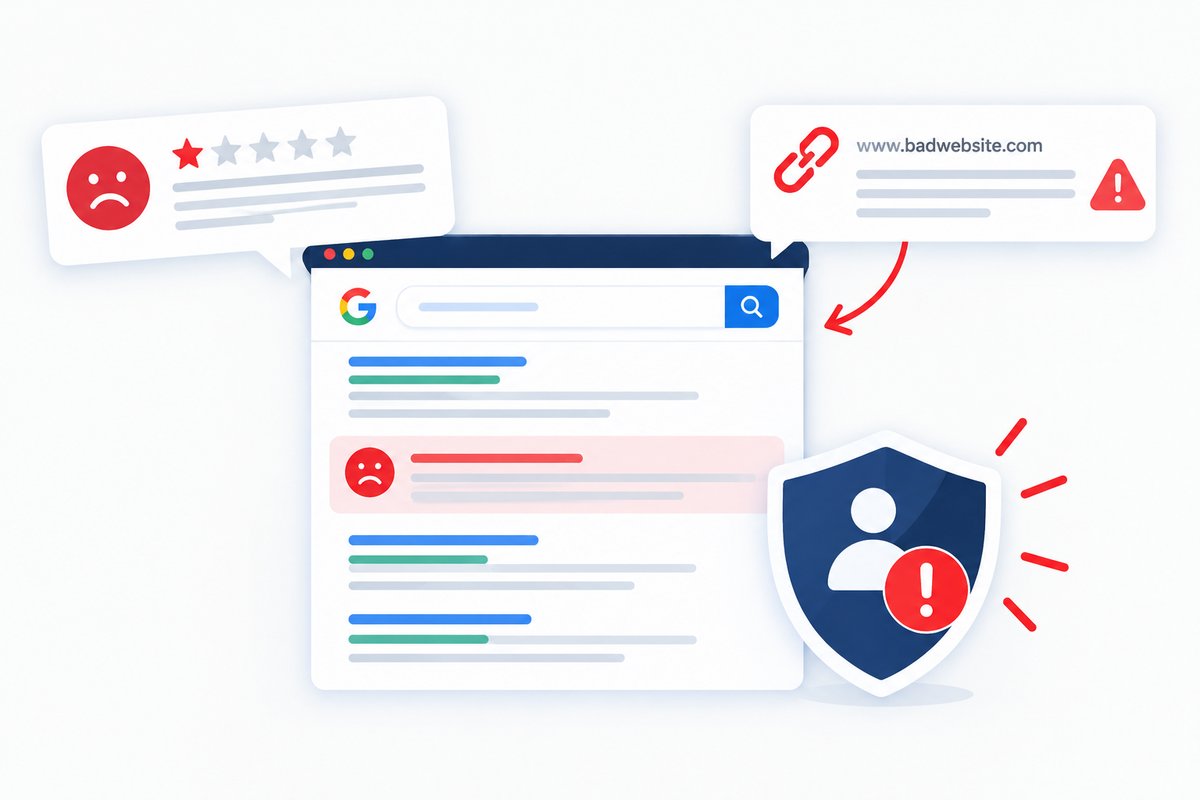
What Should You Do If a Negative Review or Link Is Affecting Your Reputation

Today, people search online before they trust a person, business, brand, or service. A single negative review, article, social media post, or harmful link can sometimes create a bad impression before someone even contacts you.

This can be especially difficult when the negative content appears on Google or other search engines. It may affect your business, personal name, professional image, customers, and even relationships with people close to you.

If you are facing this situation, you should not ignore it. This is where Online Reputation Management (ORM) can help.

What Is Online Reputation Management?

Online Reputation Management, commonly called ORM, is the process of monitoring, improving, and protecting how a person or business appears online.

When someone searches for your name or business, they may find your website, reviews, social media profiles, news articles, directory listings, and other websites.

ORM focuses on improving this overall online presence.

The goal is not simply to hide negative content. A proper ORM strategy looks at what is causing the problem, responds where appropriate, creates useful positive content, and helps build a stronger online presence.

What If You Have a Negative Review?

Negative reviews can happen to almost every business. Sometimes they are genuine customer complaints. In other cases, they may be outdated, misleading, unfair, or even posted by someone who has never used the service.

The first step is to understand the review before taking action.

If the review is genuine, a professional response can show that you care about customers and are willing to solve problems. A calm and helpful response can also give future customers a better understanding of the situation.

If a review violates the platform’s rules, such as containing spam, fake information, or inappropriate content, you may be able to report it for review.

However, removing every negative review is not always possible. That is why ORM also focuses on building a stronger positive presence around your name or business.

What If There Is a Negative Link About You?

A negative link can be more serious when it appears prominently in search results for your name or business.

For example, someone searching for your company may find a negative article, complaint page, forum post, or other website before finding your official website.

This can make potential customers hesitate.

A negative search result does not necessarily disappear just because you want it removed. Depending on the situation, there may be different ways to address it.

You can first check whether the website owner has a legitimate correction or removal process. If the content violates a platform’s policies or contains certain types of unlawful or personal information, other reporting or legal options may sometimes exist.

When removal is not possible, an ORM strategy can focus on improving the visibility of accurate and useful positive content.

How Can ORM Help Your Business?

ORM helps create a stronger and more trustworthy online presence.

A business may already have good services, happy customers, and years of experience, but if search results are dominated by negative content, new customers may not see the complete picture.

An ORM strategy can help by improving important online assets such as your website, business profiles, social media accounts, customer reviews, articles, profiles, and other relevant pages.

The idea is simple: make useful and trustworthy information easier for people to find when they search for your name or business.

Which Digital Marketing Services Are Needed for ORM?

Online reputation management often works best when several digital marketing services are used together.

SEO Services

SEO can help improve the visibility of your website and other relevant pages in search results.

For reputation management, the focus may include optimizing important pages for your name, business name, brand terms, and relevant searches.

Creating useful content and improving the technical and on-page quality of your website can also support a stronger search presence.

Content Marketing

Content can play an important role in ORM.

Helpful blog posts, company information, service pages, articles, profiles, and other useful content can provide search engines and users with more accurate information about you or your business.

The content should be genuine, useful, and written for people rather than created only to manipulate search rankings.

Review Management

Reviews are an important part of online reputation.

Businesses can encourage genuine customers to share their experiences while responding professionally to existing feedback.

Positive reviews should never be created through fake accounts or misleading practices. Genuine customer experiences provide much stronger long-term value.

Social Media Management

Social media profiles can also contribute to your online reputation.

Active and professional profiles on relevant platforms can help customers find accurate information about your business.

Regular posts, useful information, customer communication, and consistent branding can help create a stronger online presence.

Local SEO

For businesses that serve a specific area, Local SEO can be especially useful.

Optimizing your Google Business Profile and other relevant business listings can help customers find your business information, reviews, services, opening hours, website, and contact details.

A complete and accurate local presence can make it easier for customers to understand your business.

How AEO Can Support Online Reputation

Search is changing. People are no longer using search engines only to find ten blue links. They are also asking questions through AI-powered search and answer engines.

This is where Answer Engine Optimization (AEO) becomes useful.

AEO focuses on creating clear, useful, and well-structured information that can help answer questions people ask online.

For example, potential customers may ask:

“Is this company trustworthy?”

“What services does this company provide?”

“What do customers say about this business?”

“Who is this company?”

Having clear and accurate information across your website and other trusted online platforms can help create a better digital presence.

How GEO Can Support Your Reputation

Generative Engine Optimization (GEO) focuses on improving how your brand or business may be represented in AI-generated search experiences.

When people use AI tools to research a company, they may look for information about its services, reputation, experience, expertise, and online presence.

GEO can therefore be part of a modern reputation strategy.

The foundation remains the same: publish useful information, maintain accurate business details, build credible online profiles, and provide real value to customers.

Can Negative Content Affect Your Family or Personal Name?

Yes, online information can sometimes affect more than a business.

People may search for a person’s name before hiring them, working with them, doing business with them, or forming a professional relationship.

If incorrect or harmful information appears prominently, it can create an unfair first impression.

This is why personal reputation management can be important for professionals, business owners, executives, public-facing individuals, and others whose names are closely connected to their work.

The strategy should always focus on legitimate methods such as accurate information, useful content, professional profiles, genuine reviews, and appropriate requests for correction or removal.

Why Should You Act Quickly?

The longer a negative result remains visible, the more opportunities people have to see it.

This does not mean you should react emotionally or try every possible method to remove something immediately.

Start by understanding the problem.

Search your name or business name. Check the first few pages of search results. Look at reviews, social profiles, articles, directories, forums, and other websites.

Identify which results are negative, which are inaccurate, and which are simply outdated.

Then create a clear ORM plan.

Online Reputation Management Is More Than Removing Negative Results

One common misunderstanding is that ORM means deleting every negative result.

That is not always possible.

A better approach is to build a stronger online presence with accurate, helpful, and trustworthy information.

This can include improving your website, publishing useful content, managing reviews, maintaining social profiles, strengthening local SEO, improving search visibility, and using modern SEO, AEO, and GEO strategies.

Over time, these efforts can help people find a more complete picture of your business or professional identity.

When Should You Hire an ORM Service?

If negative reviews or links are affecting your customers, leads, business opportunities, or personal reputation, professional help can be useful.

An experienced ORM team can review your current search results, identify reputation problems, analyze negative content, and create a strategy based on your situation.

The right approach depends on the type of negative content, where it appears, whether it is accurate, and how strongly it is ranking.

There is no single ORM strategy that works for everyone.

Conclusion

Your online reputation can influence how people see your name, business, services, and brand. A negative review or harmful link can create problems, but ignoring it usually does not solve the issue.

Online Reputation Management can help you understand what is appearing online and build a stronger digital presence through SEO, content marketing, review management, social media, Local SEO, AEO, and GEO.

At SEO Outsourcing Company USA, we provide Online Reputation Management services designed to help businesses and professionals improve and protect their online presence. Our team can help with reputation monitoring, negative review management, positive content creation, SEO, AEO, GEO, and other digital marketing strategies.

If negative reviews or links are affecting your name or business, contact SEO Outsourcing Company USA and take the right steps toward building a stronger online reputation.

how to send 1000 urls for indexing

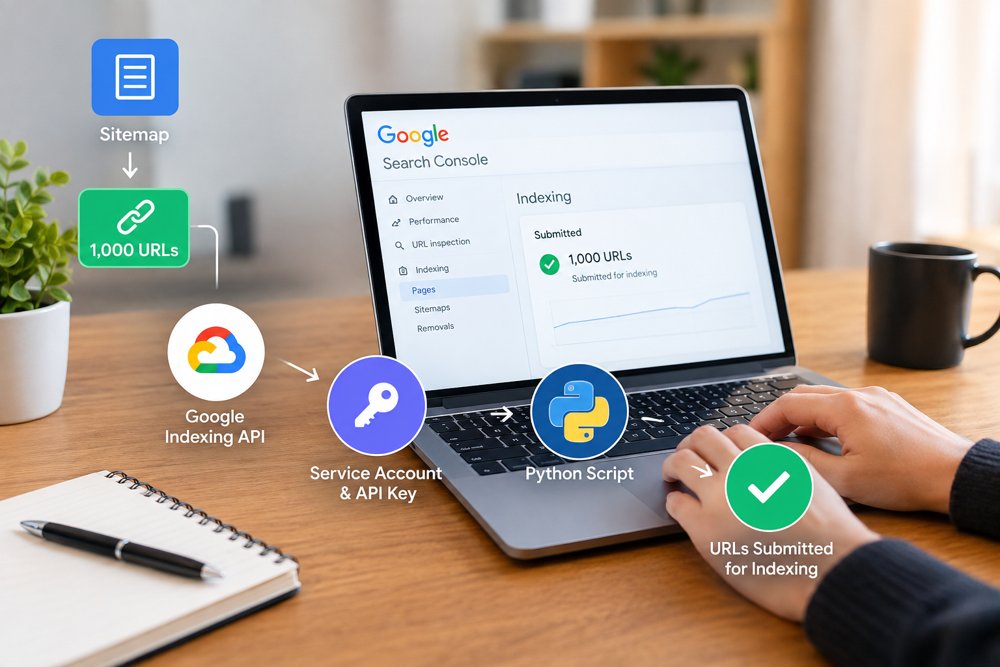
How to Send 1000 URLs for Indexing Using Google Indexing API

When a website has hundreds or thousands of URLs, submitting every URL manually for indexing can take a lot of time. If you have around 1,000 URLs that need to be submitted, you can use the Google Indexing API with Python to automate the process.

In this guide, we will explain how you can collect URLs from your sitemap, connect your Google account with the API, create service account keys, and send URLs for indexing.

What Is Google Indexing API?

Google Indexing API is a Google service that allows websites to notify Google when certain pages are added or updated. Instead of manually requesting indexing for individual URLs in Google Search Console, you can use an API-based process.

Before starting, make sure your website is added and verified in Google Search Console.

Step 1: Open Google Developer Console

First, open Google Developer Console and create or select a project for your website.

Inside the project, search for the Web Search Indexing API and enable it.

You will also need to create a service account. A service account provides an email address that can be given access to your Google Search Console property.

Step 2: Create Service Accounts and Keys

After enabling the API, go to the service account section and create a service account.

You can then create a key for the service account and download the JSON key file.

For a large URL submission project, you may need multiple service accounts and keys depending on the setup and API limits you are working with. Keep the downloaded JSON files secure because they contain credentials used by your script.

For example, if your setup requires five separate service accounts, create five service accounts and generate a key for each one.

Important: Do not publicly share your JSON key files or upload them to your website.

Step 3: Give the Service Account Access to Google Search Console

Now copy the email address of your service account.

Open Google Search Console and select your website property.

Go to the users and permissions section and add the service account email with the required owner-level access for the API workflow.

This step is important because creating an API key alone does not automatically give the service account permission to work with your Search Console property.

Step 4: Install Python

The next step is to install Python on the computer or hosting environment where you will run the indexing script.

Use a current supported Python 3 version. If your hosting control panel provides Python 3.10, you can create a Python 3.10 environment.

After installing Python, open your Control Panel or terminal provided by your hosting company.

Check that Python is working with:

python --version

or:

python3 --version

Step 5: Install the Required Python Packages

Once Python is installed, install the Google API packages required by the script.

For example:

pip install google-api-python-client google-auth google-auth-httplib2 google-auth-oauthlib

Depending on your hosting environment, you may need to use:

pip3 install google-api-python-client google-auth google-auth-httplib2 google-auth-oauthlib

The exact command can vary between hosting control panels.

Step 6: Fetch URLs From Your Sitemap

Instead of manually creating a list of 1,000 URLs, you can fetch the URLs directly from your website sitemap.

For example, your sitemap may contain URLs such as:

https://example.com/page-1/
https://example.com/page-2/
https://example.com/page-3/

A Python script can read the sitemap and collect the URLs automatically.

This is useful when you regularly publish new pages because you do not have to create a new URL list every time.

Step 7: Connect the Python Script With Your Google API

Place the service account JSON key file in a secure location on your server.

The Python script can then use the credentials from that file to authenticate with Google.

The basic workflow is:

Sitemap → Fetch URLs → Authenticate With Google → Send URLs to the API → Record the response

You can also make the script process URLs in batches rather than trying to send all 1,000 URLs at exactly the same time.

Step 8: Send the URLs for Indexing

After the API connection is configured, the script can go through your sitemap URLs one by one and send the appropriate indexing notification.

The script should also record successful requests and errors.

For example:

URL 1 – Submitted
URL 2 – Submitted
URL 3 – Error
URL 4 – Submitted

This makes it easier to identify URLs that need to be checked or processed again.

Can You Send 1000 URLs at Once?

You should not assume that the Google Indexing API allows unlimited requests simply because you have 1,000 URLs.

Google applies API quotas and eligibility requirements, and the Indexing API is intended for specific types of content. Sending a request through the API also does not guarantee that Google will index the URL.

For normal webpages, submitting URLs through Search Console’s sitemap functionality is generally the standard approach. The Indexing API has specific supported use cases, so make sure your website and content meet Google’s current requirements before using it.

Check the URLs in Google Search Console

After submitting the URLs, you can use Google Search Console to monitor your website.

You can check:

Indexing → Pages

This helps you understand which pages Google has discovered and which pages have indexing issues.

Remember that sending a URL to Google’s API is a request or notification. It is not a guarantee that the page will appear in Google search results.

Keep Your API Keys Secure

Your service account JSON files should always be kept private.

Do not:

Upload them to your public website

Share them through public groups

Add them to a public GitHub repository

Place them inside publicly accessible folders

If a key is exposed, create a new credential and remove access to the exposed one.

Need Help Sending Large Numbers of URLs?

Setting up Google Developer Console, service accounts, Search Console permissions, Python, sitemap fetching, and API requests can be confusing if you have never worked with APIs before.

If you need help setting up an automated URL submission workflow or managing your SEO indexing process, you can contact SEO Outsourcing Company USA for professional SEO support.

The team can help with technical SEO, Google Search Console, indexing-related tasks, AI SEO, GEO, AEO, and other SEO services for businesses.

technical seo audit checklist

Technical SEO Audit Checklist for Better Website Performance

A website can have great content and good keywords, but it may still struggle to rank if there are technical SEO problems. Search engines need to crawl, understand, and index your website properly. This is why a regular technical SEO audit is important for every business website.

A seo technical audit checklist helps you review the main technical areas of a website and find issues that may affect search rankings, user experience, and organic traffic. It can also help you understand what needs to be fixed before spending more time and money on content and link building.

In this guide, we will cover a simple technical SEO audit checklist that businesses can use to review their websites.

What Is a Technical SEO Audit?

A technical SEO audit is a review of the technical parts of a website that can affect its visibility in search engines.

It looks at areas such as website speed, mobile usability, crawling, indexing, broken links, redirects, HTTPS, sitemap, robots.txt, and other important website settings.

The purpose is simple: make sure search engines can easily access and understand your website.

You do not need to be a developer to understand the basic parts of a technical SEO audit. With the right checklist, you can review important areas and identify problems that need attention.

Why Is a Technical SEO Audit Important?

Technical problems can make it difficult for search engines to find or understand your pages. In some cases, important pages may not be indexed at all.

A technical audit can help you:

Find website errors

Improve crawling and indexing

Identify broken pages and links

Improve website speed

Check mobile usability

Find duplicate content issues

Review redirects

Improve website structure

Check sitemap and robots.txt files

Make the website easier for search engines to understand

Regular audits can also help you find problems before they become bigger SEO issues.

Technical SEO Audit Checklist

1. Check Website Crawling

The first step in a technical SEO audit checklist is checking whether search engines can crawl your website.

Search engines use bots to visit website pages and understand their content. If important pages are blocked, search engines may not be able to access them.

Check whether important pages can be crawled properly. Also review your robots.txt file to make sure you are not accidentally blocking useful pages.

2. Check Website Indexing

Crawling and indexing are not the same thing. A search engine may crawl a page but still decide not to index it.

Check which important pages are indexed in Google. Google Search Console can help you identify indexing problems.

Look for pages that should be indexed but are not appearing in search results.

You should also check for pages that are indexed but should not be, such as test pages, duplicate pages, or unnecessary website URLs.

3. Review Your Sitemap

An XML sitemap helps search engines discover important pages on your website.

Make sure your sitemap is available and contains the correct URLs. Remove URLs that no longer exist or should not be indexed.

After checking the sitemap, make sure it has been submitted through Google Search Console.

A clean and updated sitemap can make it easier for search engines to understand your website structure.

4. Check the Robots.txt File

The robots.txt file tells search engine bots which areas of your website they can or cannot access.

A small mistake in this file can sometimes prevent important pages from being crawled.

Review your robots.txt file carefully. Make sure important pages, folders, CSS files, and JavaScript resources are not blocked unnecessarily.

5. Find Broken Links

Broken links can create a poor experience for visitors and make website management more difficult.

Check both internal and external links on your website.

If a link leads to a page that no longer exists, update it, remove it, or redirect the old URL to a relevant page when appropriate.

Your seo technical audit checklist should always include a broken-link check.

6. Check Website Speed

Website speed is another important part of technical SEO.

Visitors usually do not want to wait for a slow website to load. A slow website can also affect the overall user experience.

Check your website on both desktop and mobile devices.

Look at large images, unnecessary plugins, unused scripts, hosting performance, and other elements that may slow down your pages.

The goal is not simply to make a website extremely fast. The goal is to provide a smooth experience for visitors.

7. Check Mobile Friendliness

Many people visit websites using smartphones. Your website should therefore work properly on smaller screens.

Check whether text is easy to read, buttons are easy to click, menus work correctly, and important content is visible without problems.

Visit your main pages using different mobile devices and screen sizes.

A website that works well on mobile can provide a better experience for users.

8. Check HTTPS and Website Security

Your website should use HTTPS instead of HTTP.

HTTPS helps protect information sent between the visitor and the website. It also gives users more confidence when visiting your site.

Check that your SSL certificate is active and that important website pages load correctly with HTTPS.

Also make sure HTTP versions redirect properly to the HTTPS version.

9. Review URL Structure

URLs should be simple and easy to understand.

For example, a URL such as:

example.com/seo-services

is easier to understand than a URL containing long numbers and unnecessary characters.

Keep your URLs short, relevant, and descriptive where possible.

Avoid creating multiple URLs for the same page unless there is a clear reason.

10. Check Redirects

Redirects are useful when a page has moved to another URL.

However, too many redirects can make website management complicated and may slow down the path between the original and final page.

Check for redirect chains and unnecessary redirects. Make sure important old URLs point to the most relevant new pages.

When changing website URLs, always plan redirects carefully.

11. Check Canonical Tags

Canonical tags help search engines understand which version of a page should be treated as the main version when similar or duplicate URLs exist.

Check that important pages have the correct canonical URL.

Incorrect canonical tags can sometimes cause the wrong page to be selected for indexing.

This is especially important for ecommerce websites and websites with many similar pages.

12. Review Duplicate Content

Duplicate content means similar or identical content appears on more than one URL.

Not every duplicate-content situation is a major problem, but it is still worth checking.

Look for duplicate page versions, similar product pages, copied category content, and URL variations.

Where needed, use redirects, canonical tags, or other suitable solutions to help search engines understand which page should be considered the main version.

13. Check Internal Linking

Internal links connect one page of your website to another.

Good internal linking helps visitors discover more useful information and helps search engines understand the relationship between your pages.

Make sure important pages have internal links pointing to them.

For example, your blog posts can link naturally to relevant service pages. Service pages can also link to related services or useful resources.

Avoid adding links only for SEO. Links should also be useful to visitors.

14. Review Title Tags and Meta Descriptions

Technical SEO is not only about crawling and indexing. It also includes checking important page elements.

Review your title tags and meta descriptions to make sure they are relevant to each page.

Each important page should have a clear and useful title. Avoid using the same title for many different pages.

Meta descriptions should explain what users can expect from the page and encourage relevant searchers to visit it.

15. Check Heading Structure

Your pages should have a clear heading structure.

Use one main H1 heading for the main topic of the page and use H2 and H3 headings to organize supporting sections.

A good heading structure makes content easier for both users and search engines to understand.

Avoid using headings only to make text look bigger. Headings should describe the sections of the page.

16. Check Google Search Console

Google Search Console is one of the most useful tools for checking technical SEO problems.

Review indexing reports, page experience information, sitemap status, mobile issues, and other available reports.

You can also use URL Inspection to check individual pages and see how Google views them.

Checking Search Console regularly can help you find new problems quickly.

How Often Should You Perform a Technical SEO Audit?

There is no single schedule that works for every website.

A small website may need a detailed audit every few months, while a large ecommerce website may need more regular technical checks.

You should also perform an audit after major website changes, migrations, redesigns, changes in URL structure, or significant technical updates.

Regular checking helps you identify problems before they affect a larger number of pages.

Use a Simple SEO Technical Audit Checklist

A technical audit does not have to be complicated. Start with the most important areas:

Crawling and indexing

XML sitemap

Robots.txt

Broken links

Website speed

Mobile usability

HTTPS

URL structure

Redirects

Canonical tags

Duplicate content

Internal linking

Title tags and meta descriptions

Heading structure

Google Search Console

Once these areas have been checked, you can move toward more detailed technical SEO analysis.

Get Help With Technical SEO

Technical SEO can become difficult when a website has hundreds or thousands of pages. Finding an issue is one thing, but understanding its cause and fixing it correctly can require experience.

SEO Outsourcing Company USA helps businesses with SEO audits, technical SEO, on-page SEO, off-page SEO, AI SEO, AEO, GEO, and other SEO services.

Our SEO specialists can review your website, identify technical issues, and help create a practical plan to improve your website’s search visibility. Instead of trying to manage every SEO task yourself, you can outsource the work to an experienced SEO team.

If you want to improve your website and need help with a technical SEO audit checklist, choose SEO Outsourcing Company USA for professional SEO support.

Conclusion

A technical SEO audit is an important part of maintaining a healthy website. Problems with crawling, indexing, speed, mobile usability, redirects, broken links, or website structure can make it harder for search engines and visitors to use your website.

Using a simple seo technical audit checklist regularly can help you find these issues and keep your website in better shape.

https://seooutsourcingcompanyusa.com/If you do not have the time or experience to manage technical SEO, SEO Outsourcing Company USA can help you handle your SEO audit and ongoing SEO requirements with a practical approach.

What Is llms.txt and Why Is It Important for AI SEO

What Is llms.txt and Why Is It Important for AI SEO?

AI is changing the way people search for information online.

People are no longer using only Google to find answers. They are also using AI tools such as ChatGPT and other AI systems to ask questions, find businesses, compare products, and understand topics.

Because of this change, website owners are looking for new ways to make their website content easier for AI systems to understand.

One topic that has received attention in the SEO community is llms.txt.

But what exactly is llms.txt? Does every website need it? And can it help with AI SEO?

Let’s understand it in simple words.

What Is llms.txt?

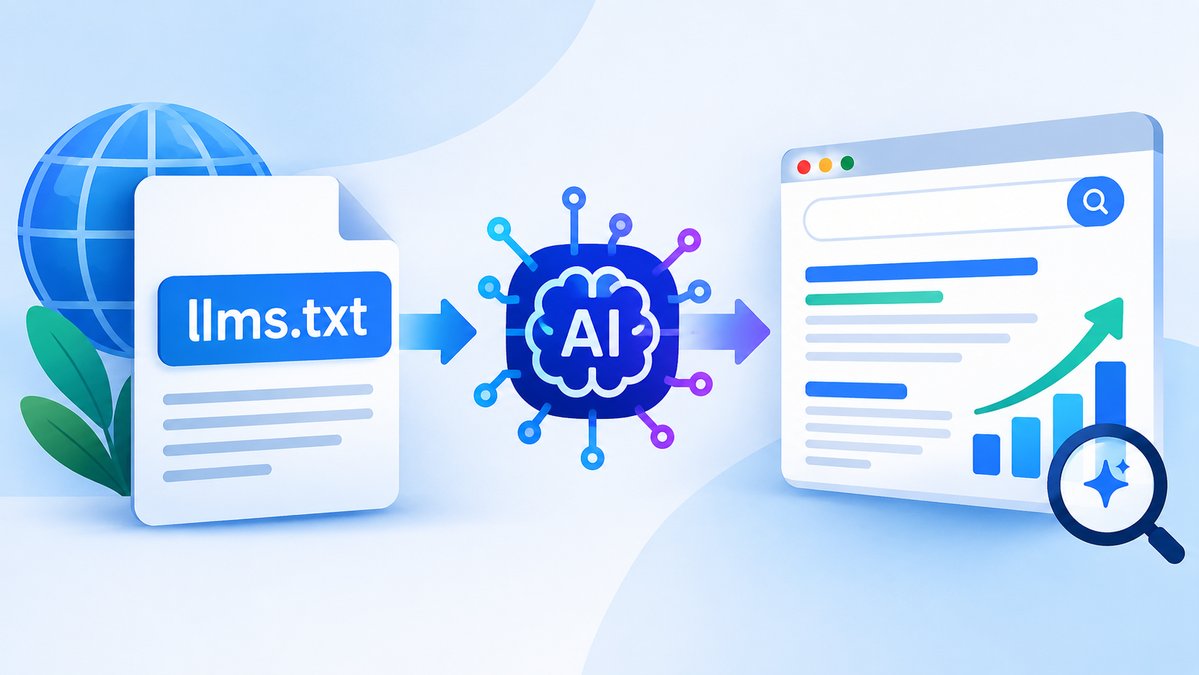
llms.txt is a text file that website owners can place on their website to provide information for large language models (LLMs).

LLM stands for Large Language Model.

AI systems use large amounts of information to understand questions and generate answers. The idea behind llms.txt is to give these systems a simple, organized list of important website content.

The file is normally placed at the root of a website.

For example:

example.com/llms.txt

The file can contain links to important pages, documentation, guides, products, services, or other useful content.

Think of it like a simple guide for AI systems.

Why Was llms.txt Created?

Websites can contain thousands of pages.

Some pages may be very important, while others may not be useful for understanding what the website does.

For example, a website may have:

  • Homepage
  • About page
  • Services
  • Products
  • Blog posts
  • Documentation
  • FAQs
  • Contact page
  • Privacy policy
  • Terms and conditions

An AI system may not need all of these pages to understand a business.

The idea behind llms.txt is to provide a cleaner way to point AI systems toward the pages that are most useful.

How Does llms.txt Work?

The basic idea is simple.

A website owner creates a file called:

llms.txt

The file contains information and links to important content.

For example, a simple file could look like:

# Example Company

> We provide SEO and digital marketing services for businesses.

## Services

- [SEO Services](https://example.com/seo/)
- [Local SEO](https://example.com/local-seo/)
- [AI SEO](https://example.com/ai-seo/)

## Resources

- [SEO Guide](https://example.com/seo-guide/)
- [SEO FAQ](https://example.com/seo-faq/)

This gives AI systems a structured list of useful pages.

However, it is important to understand that creating an llms.txt file does not automatically mean that AI systems will use it or rank your website higher.

It is better to think of llms.txt as a way to organize and provide information, rather than a guaranteed ranking method.

Is llms.txt the Same as robots.txt?

No.

This is one of the most common questions.

robots.txt and llms.txt have different purposes.

Robots.txt is mainly used to give instructions to search engine crawlers about which parts of a website they can or cannot crawl.

llms.txt has a different idea behind it. It is designed to provide AI systems with a list of important website information and resources.

In simple words:

robots.txt = crawler instructions

llms.txt = information and resource guide for AI systems

They should not be treated as replacements for each other.

Is llms.txt an SEO Ranking Factor?

There is currently no strong evidence that simply adding an llms.txt file directly improves Google rankings.

You should not create the file expecting an immediate increase in:

  • Google rankings
  • Organic traffic
  • Backlinks
  • Domain authority

SEO still depends on many other things, including useful content, technical website quality, relevance, links, user experience, and other search signals.

So why are SEO professionals discussing llms.txt?

The main reason is the growth of AI-powered search and the wider use of LLMs.

Website owners want to make their important information easier for AI systems to understand and access.

Why Is llms.txt Important for AI SEO?

AI SEO is about improving how your brand and content can be understood and found across AI-powered search experiences.

llms.txt can be part of this work.

1. It Organizes Important Website Content

A large website may contain hundreds or thousands of pages.

An llms.txt file can highlight the pages that are most important.

This can make your website information easier to understand in a structured way.

2. It Can Highlight Important Pages

You may have specific pages that explain your main services, products, guides, or technical information.

You can include links to those pages in the file.

For example, an SEO company could highlight:

  • SEO services
  • Local SEO
  • Technical SEO
  • AI SEO
  • SEO case studies
  • SEO guides

3. It Supports an AI-Friendly Website Structure

AI SEO is not only about creating an llms.txt file.

Your website should already have clear content and a good structure.

Important information should be easy to find.

Pages should have clear headings, useful content, descriptive links, and logical navigation.

llms.txt can be one additional part of this setup.

4. It Helps You Prepare for AI Search

AI search is developing quickly.

People are asking AI systems questions instead of always searching through a list of traditional search results.

Businesses therefore need to think about how their information is presented to AI systems.

Creating an organized llms.txt file can be one step in preparing a website for this changing search environment.

Does Every Website Need llms.txt?

No.

You do not have to create an llms.txt file just because other websites are doing it.

For a small website with only a few important pages, it may not provide much value.

For a large website with lots of documentation, resources, products, or articles, having a clear list of important information may be more useful.

Before creating one, first make sure your basic SEO is in good condition.

Your website should have:

  • Useful content
  • Good page structure
  • Proper internal links
  • A working sitemap
  • Good technical SEO
  • Clear navigation
  • Mobile-friendly pages
  • Fast and usable pages

These areas should not be ignored in favor of llms.txt.

How to Create an llms.txt File?

Creating a basic file is not very difficult.

Step 1: Decide Which Pages Are Important

Look at your website and choose the pages that best explain your business.

These could include:

  • Main services
  • Important products
  • Documentation
  • Guides
  • FAQs
  • Case studies
  • Important resources

Step 2: Create a Text File

Create a file named:

llms.txt

Do not name it something different.

Step 3: Add Your Important Information

Start with a short description of your website.

Then organize important pages into sections.

Keep the information clear and easy to understand.

Step 4: Upload It to Your Website

The file should normally be available at the root of your domain.

For example:

https://example.com/llms.txt

Step 5: Check the File

Open the URL in your browser and make sure the file loads correctly.

You can also use an llms.txt checker to check whether your file exists and whether the basic structure is correct.

What Should You Put in llms.txt?

There is no reason to add every URL on your website.

Focus on your most useful content.

For a business website, this could include:

About the company

A short explanation of what the company does.

Main services

Links to your most important service pages.

Products

Important product pages or product documentation.

Resources

Useful guides, reports, and educational content.

Documentation

Technical information if your website provides software, tools, or APIs.

The goal is to keep the file useful and easy to understand.

Common llms.txt Mistakes

If you decide to create an llms.txt file, avoid some simple mistakes.

Adding Every URL

Do not turn the file into a complete website sitemap.

Focus on important resources.

Using Poor Content

An llms.txt file cannot fix weak website content.

Your actual website pages should contain useful and clear information.

Expecting Immediate Rankings

Do not expect your Google rankings to increase simply because you created the file.

There is no guaranteed ranking benefit.

Ignoring Normal SEO

AI SEO does not replace traditional SEO.

You still need good content, technical SEO, internal links, website performance, and a strong overall website structure.

llms.txt and the Future of AI SEO

AI search is still developing.

The way AI systems find, understand, and use website information can change over time.

Because of this, website owners should avoid depending on a single file or technique.

Instead, focus on making your website information clear and useful.

Create content that answers real questions.

Use clear headings.

Keep important information easy to find.

Build a strong internal linking structure.

Keep your technical SEO healthy.

Then consider additional AI SEO practices such as llms.txt where appropriate.

Final Thoughts

So, what is llms.txt?

It is a text file designed to give AI systems a structured guide to important information and resources on a website.

It is not a replacement for robots.txt, XML sitemaps, or normal SEO.

It also should not be treated as a guaranteed Google ranking method.

For businesses interested in AI SEO, however, it can be one part of a wider strategy for organizing and presenting website information for the growing AI search environment.

If you want to prepare your website for both traditional search and AI search, SEO Outsourcing Company USA provides SEO and AI SEO services to help businesses improve their online visibility. You can also explore practical SEO tools and resources to check and improve different parts of your website, including your llms.txt setup.

The best approach is simple: keep your website useful, organized, technically healthy, and easy for both people and modern search systems to understand.

How to Start an SEO Career

How to Start an SEO Career in the USA

If you are thinking about starting a career in SEO, you may have many questions.

Do I need a degree?
Do I need coding skills?
How long does it take to learn SEO?
Can I learn SEO while working or studying?
How can I get my first SEO job?

The good news is that you can start learning SEO step by step. You do not need to know everything at the beginning.

SEO is a practical skill. The more you learn and practice, the more comfortable you become.

This guide explains how to start an SEO career in the USA in simple steps.

What Is SEO?

SEO stands for Search Engine Optimization.

In simple words, SEO helps a website appear when people search on Google and other search engines.

For example, someone in New York may search for:

“best dentist near me”

A person in California may search for:

“home cleaning services in Los Angeles”

Businesses want their websites to appear for searches that are related to their products or services.

An SEO professional works on the website and other online activities to improve its search visibility.

Is SEO a Good Career to Start?

SEO can be a useful skill if you enjoy websites, content, research, and digital marketing.

You can work in different types of companies, including:

  • SEO agencies
  • Digital marketing agencies
  • E-commerce companies
  • Software companies
  • Local businesses
  • Real estate companies
  • Healthcare businesses
  • Travel companies
  • Education companies

You can also work as a freelancer or look for remote SEO jobs.

The work can be different from one company to another, so you can later choose an area that you enjoy.

How to Start a Career in SEO?

You do not have to learn everything in one week.

Start with the basic topics and practice them one by one.

1. Understand the Basics

First, learn what SEO actually means.

Start with simple topics such as:

  • What is SEO?
  • How does Google Search work?
  • What are keywords?
  • What is search intent?
  • What is organic traffic?
  • What are backlinks?
  • What is on-page SEO?
  • What is technical SEO?

At this stage, do not worry about learning every SEO tool.

First understand how SEO works.

2. Learn Keyword Research

Keyword research is an important part of SEO.

It means finding the words and phrases people use when searching online.

For example, a US roofing company may want to target searches like:

  • roofing company near me
  • roof repair in Texas
  • roof replacement company
  • emergency roof repair

You need to understand what people are looking for and what kind of page they expect to see.

You can use tools such as Google Keyword Planner, Semrush, or Ahrefs to find and study keywords.

But remember, keyword research is not just about finding keywords with high search volume.

You should also understand the reason behind the search.

3. Learn On-Page SEO

On-page SEO means improving the pages on a website.

You should learn how to work with:

  • Page titles
  • Meta descriptions
  • Headings
  • Website content
  • URLs
  • Internal links
  • Images
  • Alt text

For example, if a company provides plumbing services in Chicago, its service page should clearly explain the service and the area it covers.

The page should be useful for visitors, not just written for search engines.

4. Learn Technical SEO

Technical SEO may sound difficult at first, but you can learn the basics without being a programmer.

Start by learning:

  • Website crawling
  • Website indexing
  • XML sitemaps
  • Robots.txt
  • Redirects
  • Broken links
  • Canonical tags
  • Mobile-friendly websites
  • Website speed

Later, you can learn more advanced technical SEO.

You do not need to become a developer to work in SEO, but knowing basic technical concepts can be very helpful.

5. Learn Local SEO

If you want to work with businesses in the USA, local SEO is a useful skill.

Local SEO helps businesses reach people searching for services in a particular area.

For example:

“plumber in Dallas”

“dentist in Miami”

“lawyer near me”

Learn about:

  • Google Business Profile
  • Local keywords
  • Business information
  • Customer reviews
  • Local pages
  • Citations
  • Local content

Many small and local businesses depend on online searches to find new customers.

6. Learn Off-Page SEO

Off-page SEO is another important part of SEO.

One major area is link building.

A backlink is a link from another website to your website.

You can learn about:

  • Guest posting
  • Backlink research
  • Competitor backlink analysis
  • Digital PR
  • Brand mentions

Do not focus only on getting hundreds of links.

Try to understand whether a link is relevant and useful.

7. Learn Google Search Console

Google Search Console is an important tool for SEO professionals.

It helps you see how a website is performing in Google Search.

You can use it to check things such as:

  • Search clicks
  • Impressions
  • Search queries
  • Average position
  • Click-through rate
  • Indexed pages
  • Website issues

Learning how to read this data will help you understand what is happening with a website.

8. Practice on a Real Website

This is where SEO starts becoming easier.

You can read many blogs and watch many videos, but eventually you need to work on a website.

You can start with your own website, a small business website, or an internship project.

Try simple tasks such as:

  • Find keywords
  • Optimize a page
  • Write or improve content
  • Add internal links
  • Check technical problems
  • Improve page titles
  • Check Google Search Console

You will learn much more when you actually do the work.

9. Create an SEO Portfolio

When you start applying for jobs, do not only say:

“I know SEO.”

Show what you have done.

Create a simple portfolio with your projects.

You can include:

  • Website audits
  • Keyword research
  • On-page work
  • Technical fixes
  • Content work
  • Local SEO work
  • Traffic improvements
  • Ranking improvements

If you have worked on a real website, explain what the problem was, what you changed, and what happened after your work.

This can give employers a better idea of your skills.

Can I Learn SEO While Working or Studying?

Yes, you can.

This is important because not everyone has a free schedule.

If you already have a job, business, or college studies, you may not have several hours every day for learning.

That is completely fine.

You can learn SEO beside your work or studies.

For example, you can spend one hour in the evening learning SEO and use some extra time on weekends for practice.

You can also learn digital marketing virtually with flexible hours.

You do not need to follow a full-day schedule.

The main thing is to learn regularly.

Even a small amount of learning every day can help you improve over time.

Do I Need a Degree for an SEO Job?

Not necessarily.

There is no special degree that you must have before starting SEO.

A degree in marketing, business, IT, or another field can be useful, but practical skills are also important.

If you can show that you know how to:

  • Find keywords
  • Optimize websites
  • Perform SEO audits
  • Understand search data
  • Improve website pages
  • Work with SEO tools

you can start building a career in SEO.

Your portfolio and practical experience can also help when applying for jobs.

Can I Work From Home as an SEO Professional?

Yes.

A lot of SEO work can be done online.

You may be able to work remotely on tasks such as:

  • Keyword research
  • Website audits
  • Content planning
  • On-page SEO
  • Technical SEO
  • Competitor research
  • Link building
  • SEO reports

Remote work depends on the company or client, but SEO is a career that can be done online.

How Can I Get My First SEO Job in the USA?

Once you have learned the basics and completed some practical projects, start looking for entry-level opportunities.

You can search for jobs such as:

  • SEO Intern
  • Junior SEO Specialist
  • SEO Specialist
  • SEO Analyst
  • Digital Marketing Specialist
  • Local SEO Specialist
  • Content SEO Specialist

Do not wait until you become an expert before applying.

You can continue learning while applying for jobs.

You can also look for internships or small freelance projects to gain experience.

How Long Does It Take to Learn SEO?

There is no fixed answer.

Some people learn the basics quickly, while others need more time.

You can start with a simple plan:

First month: Learn SEO basics and keyword research.

Second month: Learn on-page SEO and content.

Third month: Learn technical SEO and Google Search Console.

Fourth month: Learn local SEO and link building.

After that: Work on real projects and build your portfolio.

Your speed will depend on how much time you can give to learning and practice.

What Should I Do After Learning the Basics?

Once you understand basic SEO, start working on real projects.

You can choose an area such as:

  • Local SEO
  • E-commerce SEO
  • Technical SEO
  • Content SEO
  • WordPress SEO
  • Enterprise SEO
  • International SEO

You can also learn about AI search and how websites can improve their visibility in newer search experiences.

You do not need to learn every area immediately.

Start with the area that matches the type of work you want to do.

Simple SEO Career Path

If you are completely new to SEO, you can follow this simple path:

Learn SEO basics

↓

Learn keyword research

↓

Learn on-page SEO

↓

Learn technical SEO

↓

Learn local and off-page SEO

↓

Practice on real websites

↓

Create your portfolio

↓

Get internship or project experience

↓

Apply for SEO jobs or freelance work

This is a simple way to move from learning SEO to actually working in the field.

Conclusion

Starting an SEO career in the USA does not have to be difficult.

You can start with the basics, practice on websites, learn SEO tools, create a portfolio, and slowly gain real experience.

You also do not need a completely free schedule. If you are already working or studying, you can learn digital marketing and SEO virtually with flexible hours beside your regular work or studies.

For people who want to learn through practical work, SEO Outsourcing Company USA provides SEO internship opportunities with real project experience. This gives beginners an opportunity to learn how SEO work is handled on real websites instead of only learning from theory.

Start with one topic, practice it, and then move to the next. With regular practice and real project experience, you can build your SEO skills and work toward an SEO career in the USA.

What Are AEO GEO and AI Search Optimization Services

What Are AEO GEO and AI Search Optimization

Search is changing quickly. People are no longer using Google alone to find information, compare businesses, or decide which service provider to contact. They are also asking questions through AI-powered platforms and expecting a direct, useful answer.

This is where AEO, GEO and AI search optimization services are becoming increasingly important for businesses that want their brands to remain visible as search behaviour changes.

Traditional SEO is still important, but businesses now need to think about more than ranking a webpage in a list of search results. They also need to make their information clear, trustworthy and easy for AI systems to understand and use when generating answers.

What Are AEO, GEO and AI Search Optimization Services?

AEO stands for Answer Engine Optimization, while GEO commonly refers to Generative Engine Optimization. The industry does not use these terms in exactly the same way, but they generally describe closely related efforts to improve a brand’s visibility in answer-driven and generative search experiences.

In simple words, the goal is to make it easier for AI-powered search systems to understand:

What does your company do?

What services do you provide?

Who are your services for?

What topics does your company have expertise in?

Why should your information be considered useful and trustworthy?

A good company AEO GEO AI search optimization services strategy therefore looks beyond simply adding keywords to a page. It focuses on the overall information available about a business and how clearly that information is presented.

Why Businesses Are Looking for GEO Services

When someone searches for GEO services, they may be looking for help improving their visibility in generative search results and AI-generated responses.

Instead of focusing only on traditional rankings, GEO strategies can consider how a brand is represented across AI search experiences. This can include improving website content, strengthening topical coverage, making important business information consistent and developing useful supporting content.

Generative systems may use information from multiple sources when creating an answer. Because of this, having a well-written website alone may not always be enough. Businesses also need to build a clear and consistent online presence around their expertise, services and brand.

How AEO and GEO Work With Traditional SEO

AEO and GEO should not be viewed as replacements for SEO.

A website still needs to be technically accessible, properly structured and useful to visitors. Content still needs to answer real questions and provide information that people can trust.

The difference is in the visibility goal.

Traditional SEO primarily focuses on visibility within search engine results, while AEO and GEO focus more on visibility within answer-based and generative search experiences. The exact distinction between AEO and GEO varies between practitioners, so the practical work often overlaps.

For businesses, this means one integrated strategy can cover traditional search and AI-driven search rather than treating them as completely separate marketing activities.

What Can an AEO GEO AI Search Optimization Company Do?

A professional AEO GEO AI search optimization services company can start by understanding the business, its customers, services and the questions people are likely to ask.

The work can include improving service pages, creating answer-focused content, strengthening topical authority, organising information clearly, improving internal connections between related topics and making important business information easier to understand.

It can also involve monitoring how a brand appears in AI-generated answers and identifying areas where the business is missing from relevant conversations.

There is no single trick that guarantees a brand will appear in every AI-generated response. AI systems can produce different answers depending on the query, sources available, platform and other factors. This is why a long-term approach based on useful information and strong search fundamentals is more practical than simply trying to manipulate individual answers.

What About “GEO Reentry Services”?

One keyword that can create confusion is “geo reentry services.”

This phrase can refer to GEO Reentry Services, which is associated with correctional and reentry-related services. It is therefore very different from GEO in the context of Generative Engine Optimization.

Businesses offering AEO, GEO or AI search optimiszation services should not force unrelated keywords into their content simply because they contain the word “GEO.” Search engines and AI systems need context to understand what a business actually does.

Using relevant terminology naturally is much more useful than trying to target every phrase that happens to contain the same abbreviation.

How AI Search Optimization Can Help a Business

AI search is becoming another place where potential customers can discover companies, services and information.

For example, a customer may ask an AI platform to explain a service, compare providers, find companies offering a particular solution or recommend businesses for a specific requirement.

For a business, being clearly understood in these situations can become an important part of its wider digital presence.

That does not mean traditional search is disappearing. Instead, businesses are dealing with a wider search environment where websites, search engines, AI systems, third-party sources and other online information can all contribute to how a brand is discovered and understood.

Choosing the Right AEO and GEO Strategy

Every business does not need the same AEO or GEO strategy.

A local service business may need to focus heavily on clear service information, location signals and customer questions. A SaaS company may need detailed product explanations, comparisons and technical resources. An ecommerce business may need strong product information and answers to buying-related questions.

The starting point should therefore be the business and its audience rather than the acronym.

A good strategy should answer a simple question: when someone searches for the type of service or solution we provide, is our brand information clear enough for both people and search systems to understand?

Conclusion

Search is moving from simple lists of links toward experiences where users can receive direct and AI-generated answers. AEO, GEO and AI search optimization are becoming part of this changing search environment, while traditional SEO remains an important foundation.

At SEO Outsourcing Company USA, we provide AEO, GEO and AI search optimization services for businesses that want to strengthen their visibility across modern search experiences. Our approach combines SEO knowledge with content optimization, AI search strategies, LLM-focused optimization and clear information structures.

If you are looking for an AEO GEO AI search optimization services company to help your business prepare for the changing search landscape, SEO Outsourcing Company USA can develop a practical strategy focused on improving how your brand is discovered, understood and represented across search and AI-powered platforms.