
What Are the 4 Types of SEO?
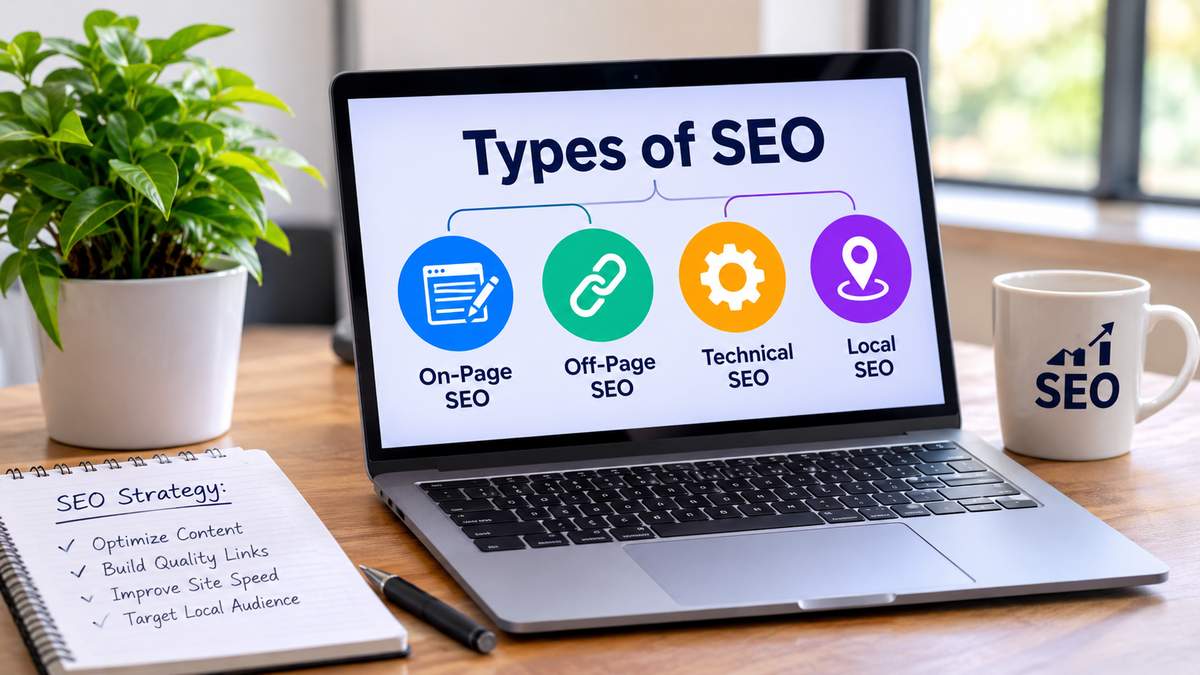
If you are learning about search engine optimization (SEO), you should know that there are four main types of SEO: On-Page SEO, Off-Page SEO, Technical SEO, and Local SEO. Each type focuses on a different part of improving a website’s visibility on search engines like Google. On-page SEO improves website content, off-page SEO builds authority through external links and mentions, technical SEO makes a website easier for search engines to crawl and index, and local SEO helps businesses appear in location-based searches. Together, these four types help websites attract more visitors and reach the right audience.
Let’s understand each type of SEO in simple terms, along with practical examples.
1. On-Page SEO
On-page SEO refers to all the activities you perform directly on your website to improve its search engine rankings.
In simple words, it means optimizing your website content, pages, images, and other elements so that both visitors and search engines can understand your website.
For example, if you have a website selling digital marketing services, you want your service pages to appear when someone searches for terms like “digital marketing agency in New York.”
To achieve this, you need to optimize your page content around relevant keywords and provide useful information to visitors.
Important activities in On-Page SEO include:
- Keyword Research: Finding the search terms your target audience uses on Google.
- Title Tag Optimization: Writing relevant and attractive page titles.
- Meta Description: Creating short descriptions that encourage users to click on your website.
- Heading Tags: Using H1, H2, and H3 headings to organize content.
- Internal Linking: Connecting relevant pages within your website.
- Image Optimization: Adding descriptive alt text and compressing images.
- Content Optimization: Publishing helpful, original, and relevant content.
Example: If you are writing a blog about SEO services in California, you should naturally include the main keyword in your title, introduction, headings, and relevant sections.
The goal is not to add keywords everywhere. It is to create content that answers what people are actually searching for.
2. Off-Page SEO
Off-page SEO includes activities performed outside your website to improve its authority, reputation, and visibility.
Unlike on-page SEO, where you optimize your own website, off-page SEO focuses on building your website’s reputation across the internet.
One of the most common off-page SEO activities is link building. When another relevant and trustworthy website links to your website, it can help search engines understand that your content is valuable.
However, not every backlink is useful. Links from relevant, trustworthy websites are generally more valuable than links from unrelated or low-quality websites.
Important activities in Off-Page SEO include:
- Guest Posting: Publishing useful articles on other relevant websites with links to your website where appropriate.
- Link Building: Earning backlinks from relevant and trustworthy websites.
- Digital PR: Getting your business or website mentioned in online publications.
- Brand Mentions: Building brand awareness through online discussions and references.
- Social Media Marketing: Sharing content and increasing brand visibility.
- Business Listings: Creating relevant business profiles on trusted directories.
Example: Suppose you own a digital marketing agency in the USA. You publish a helpful article on an industry-related website that mentions your agency and links to your website.
This can bring referral traffic, improve brand awareness, and potentially support your SEO efforts.
Remember, buying hundreds of random backlinks is not a good SEO strategy. Focus on quality, relevance, and natural link growth.
3. Technical SEO
Technical SEO focuses on improving the technical structure and performance of your website so that search engines can crawl, understand, and index your pages properly.
You might have excellent content and quality backlinks, but technical problems can still affect your website’s search visibility.
For example, if important pages are blocked from search engine crawling, Google may struggle to discover and index them.
Technical SEO helps prevent these problems and provides a better experience for website visitors.
Important activities in Technical SEO include:
- Website Speed: Improving page loading times.
- Mobile-Friendliness: Making sure your website works properly on smartphones and tablets.
- XML Sitemap: Creating and submitting an XML sitemap to help search engines discover important pages.
- Robots.txt: Managing which parts of your website search engine crawlers can access.
- Canonical Tags: Helping search engines understand the preferred version of a page.
- Broken Links: Finding and fixing broken internal and external links.
- Structured Data: Adding relevant schema markup to help search engines understand page content.
- Core Web Vitals: Improving important user experience measurements related to loading, interactivity, and visual stability.
Example: Imagine your website takes 15 seconds to load. Visitors may leave before the page opens completely.
A technical SEO audit can help identify problems such as large images, unnecessary scripts, server issues, and poor caching.
Fixing these issues can improve website performance and user experience.
4. Local SEO
Local SEO helps businesses appear in search results when people look for products or services in a specific location.
It is particularly useful for businesses that serve customers in a particular city, town, or geographic area.
For example, when someone searches for “best dentist near me” or “SEO agency in New York,” Google may show local business listings, Google Maps results, and relevant websites.
Local SEO helps businesses improve their visibility in these location-based searches.
Important activities in Local SEO include:
- Google Business Profile: Creating and optimizing your business profile.
- NAP Consistency: Keeping your business name, address, and phone number consistent online.
- Local Keywords: Targeting keywords related to your business location.
- Customer Reviews: Encouraging genuine customer reviews and responding to them.
- Local Citations: Listing your business on relevant online directories.
- Location Pages: Creating dedicated website pages for the cities or areas you serve.
- Local Schema Markup: Adding relevant structured data to your website.
Example: Suppose you run a plumbing company in Chicago. You want your business to appear when people search for “plumber in Chicago” or “emergency plumbing services near me.”
By optimizing your Google Business Profile, collecting genuine reviews, and creating relevant local website content, you can improve your chances of appearing in local search results.
Local SEO is especially important for restaurants, healthcare providers, real estate agencies, law firms, home service providers, and other location-based businesses.
Difference Between the 4 Types of SEO
Although all four types work toward improving website visibility, each has a different purpose.
| SEO Type | Main Focus | Example |
|---|---|---|
| On-Page SEO | Website content and page optimization | Optimizing titles and keywords |
| Off-Page SEO | Website authority and reputation | Earning quality backlinks |
| Technical SEO | Website performance and crawling | Fixing indexing issues |
| Local SEO | Location-based visibility | Optimizing Google Business Profile |
Which Type of SEO Is Most Important?
This is one of the most common questions among website owners and beginners.
The truth is that no single type of SEO is always the most important. All four types work together, and their importance depends on your business goals.
For example, an online store may need strong on-page SEO, technical SEO, and off-page SEO to compete in national search results.
On the other hand, a local restaurant may benefit more from local SEO because most of its customers come from nearby locations.
If you are starting a new website, consider following this approach:
- Start with technical SEO to make sure your website is accessible to search engines.
- Work on on-page SEO by creating useful content and optimizing important pages.
- Build authority through relevant off-page SEO activities.
- Focus on local SEO if your business serves customers in specific locations.
You do not need to complete everything in one day. SEO is an ongoing process that requires regular monitoring, testing, and improvements.
Can You Do All 4 Types of SEO Together?
Yes! In fact, combining all four types of SEO is a practical way to build a strong search engine optimization strategy.
Think of a website as a business.
- On-page SEO makes your website content useful and relevant.
- Off-page SEO helps build your website’s reputation.
- Technical SEO ensures your website works properly.
- Local SEO helps nearby customers discover your business.
For better results, regularly monitor your website using tools such as Google Search Console, Google Analytics 4, Ahrefs, SEMrush, and Screaming Frog.
These tools can help you understand website traffic, keyword rankings, technical problems, backlinks, and overall SEO performance.
Frequently Asked Questions (FAQs)
1. What are the 4 main types of SEO?
The four main types of SEO are On-Page SEO, Off-Page SEO, Technical SEO, and Local SEO. Each focuses on a different area of website optimization, and together they help improve search engine visibility.
2. Which type of SEO is best for beginners?
On-page SEO is generally a good starting point for beginners. It helps you understand keyword research, content optimization, title tags, meta descriptions, and internal linking before moving into more advanced SEO activities.
3. Is technical SEO different from on-page SEO?
Yes. On-page SEO focuses mainly on website content and page elements, while technical SEO focuses on website structure, crawling, indexing, speed, mobile usability, and other technical factors.
4. How long does SEO take to show results?
SEO does not produce instant results. Depending on competition, website condition, content quality, and SEO activities, it may take several months to see meaningful improvements. Consistent optimization and monitoring are important for long-term growth.
Conclusion
Understanding the four types of SEO is the first step toward building a successful SEO strategy. On-page SEO, off-page SEO, technical SEO, and local SEO each play an important role in improving website visibility and attracting relevant visitors.
Whether you own a small local business, an e-commerce store, or a large company website, focusing on all four areas can help you build a stronger online presence.
If you want professional support with website optimization, keyword research, link building, or technical SEO, SEO Outsourcing Company USA offers SEO, Local SEO, E-commerce SEO, and AI SEO services at affordable prices. Visit SEO Outsourcing Company USA to learn more about its digital marketing solutions.
