
How to Build a Global SEO Strategy That Actually Scales
Expanding your business into international markets can help you reach new customers and grow your online presence. However, ranking in one country does not guarantee success in another. People use different languages, search for different solutions, and follow different buying habits.
A global SEO strategy helps businesses improve their visibility across multiple countries. It focuses on creating relevant content, targeting the right audiences, and making sure search engines can understand which pages serve each market.
In this guide, we will explain how to build a global SEO strategy that supports long-term growth without making your SEO work unnecessarily complicated.
What Is a Global SEO Strategy?
A global SEO strategy is a plan to improve a website’s visibility in search engines across multiple countries or language markets.
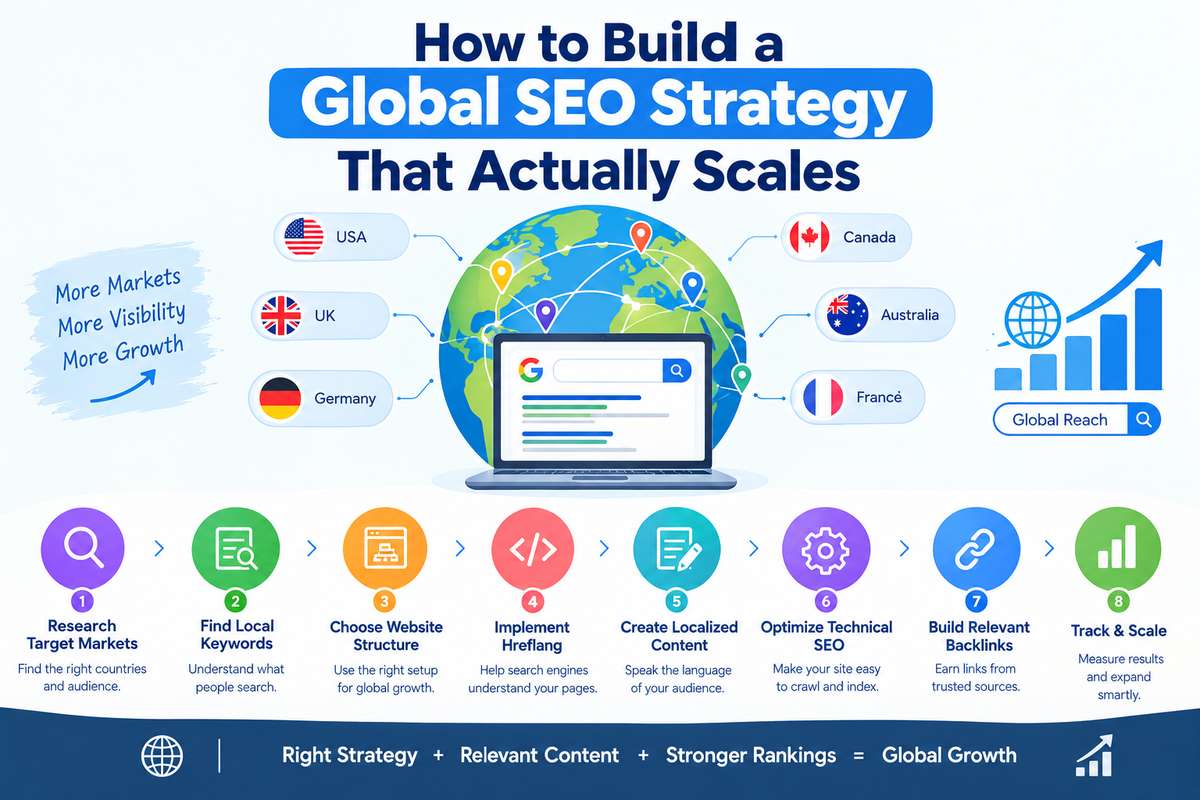
For example, a company selling software in the USA may want to attract customers in the UK, Canada, Australia, and Germany. Each market may require different keywords, landing pages, language choices, and content.
A strong global SEO strategy helps businesses:
- Reach customers in different countries.
- Target local search terms and user needs.
- Build visibility in international search results.
- Create a consistent website structure.
- Expand SEO activities as the business grows.
1. Research Your Target Markets
Before creating international pages, decide which countries offer the best opportunities for your business.
Expanding into every country at once can waste time and resources. Start with markets that match your services, products, audience, and business goals.
What Should You Research?
- Search demand: Check whether people in your target country search for your products or services.
- Competition: Review websites already ranking for your target keywords.
- Language: Identify whether users search in English or another language.
- Business potential: Consider demand, customer needs, and your ability to serve each market.
- Search intent: Understand whether users want information, comparisons, or a service provider.
Tools such as Google Search Console, Google Trends, Semrush, and Ahrefs can help you explore international search opportunities.
2. Conduct Country-Specific Keyword Research
One keyword may perform differently across countries. People in different markets may use different terms to find the same service.
For example, a user in the USA may search for “SEO services,” while a user in the UK may use a slightly different phrase depending on their needs.
Do not simply translate your existing keyword list. Research how people actually search in each market.
How to Find International Keywords
- Research keywords separately for each target country.
- Review local search results and competing pages.
- Identify relevant long-tail keywords.
- Group keywords by search intent.
- Map each keyword group to the most suitable page.
Country-specific keyword research helps you create content that matches local demand instead of relying on assumptions.
3. Choose the Right Website Structure
Your website structure affects how search engines and visitors understand your international content.
Common options include:
| Structure | Example | Best use |
|---|---|---|
| Country-code domain | example.co.uk | Separate country-focused websites |
| Subdomain | uk.example.com | Separate regional sections |
| Subdirectory | example.com/uk/ | Managing markets under one main domain |
Each option has advantages and limitations. Subdirectories can be easier to manage from one website, while country-specific domains can provide a clear local identity.
Choose a structure based on your resources, business needs, branding, and long-term expansion plans. Changing the structure later may require redirects and careful SEO migration work.
4. Use Hreflang Correctly
Hreflang annotations help search engines understand which language or regional version of a page is intended for particular users.
For example, a website may have separate English pages for the USA and UK. Hreflang can help search engines understand that these pages target different regional audiences.
To implement hreflang properly:
- Use the correct language and regional codes.
- Add the appropriate annotations to relevant page versions.
- Make sure each version references the other applicable versions.
- Use valid, accessible URLs.
- Check implementation errors during technical SEO audits.
Hreflang is a signal, not a guarantee that Google will display a particular page to every user.
5. Create Content for Local Audiences
A global SEO strategy should not depend on copying the same content across every market.
Users in different countries may have different questions, preferences, regulations, and expectations. Your content should reflect those differences.
How to Localize Content
- Use the language and terminology familiar to the audience.
- Include locally relevant examples.
- Adapt prices, currencies, measurements, and contact details where appropriate.
- Address market-specific customer concerns.
- Review translated content for accuracy and natural wording.
Translation changes the language. Localization adapts the content to the audience.
Useful localized content gives visitors a reason to trust your business and helps your pages better match their search intent.
6. Optimize Technical SEO for International Growth
Technical SEO helps search engines crawl, understand, and index your website.
As your website expands into more countries, technical problems can become harder to identify. A clear technical process helps you manage growth without creating unnecessary errors.
Focus on these areas:
- XML sitemaps: Include the appropriate indexable URLs.
- Robots.txt: Make sure important pages are not blocked accidentally.
- Canonical tags: Identify the preferred URL for duplicate or similar pages.
- Page speed: Improve loading performance across target markets.
- Mobile usability: Ensure pages work well on mobile devices.
- Indexing: Check whether important international pages appear in Google’s index.
- Internal links: Connect relevant pages within your international website structure.
Run regular technical SEO audits to find problems before they affect a large number of pages.
7. Build Relevant Backlinks in Target Markets
Backlinks can help search engines discover content and contribute to search visibility. For international SEO, links from relevant websites in your target markets may also help local audiences discover your business.
Focus on earning useful links through:
- Industry publications.
- Relevant business directories.
- Digital PR campaigns.
- Expert contributions.
- Original research and helpful resources.
- Relationships with reputable websites in your industry.
Avoid building links simply to increase backlink numbers. Relevance, quality, and natural link acquisition are more important than collecting large numbers of low-quality links.
8. Track Performance Separately for Each Market
A global SEO strategy needs clear reporting. Overall website traffic may hide problems in individual countries.
Use Google Search Console to review search clicks, impressions, queries, and page performance. Use Google Analytics 4 to examine users, sessions, engagement, and configured conversions.
Track performance by country and relevant landing page.
Review these questions regularly:
- Which countries generate the most organic visits?
- Which pages attract relevant search traffic?
- Are important keywords gaining visibility?
- Are international visitors completing desired actions?
- Which markets need content or technical improvements?
Use consistent date ranges when comparing results. Focus on meaningful business outcomes instead of rankings alone.
9. Build a Scalable SEO Workflow
Scaling global SEO does not mean creating hundreds of pages at once. It means building a repeatable process that maintains quality as your website grows.
Create a workflow for keyword research, content planning, localization, technical checks, publishing, and reporting.
Use templates where they save time, but avoid publishing near-identical pages with little value for different countries. Each page should serve a clear audience and provide useful information.
Start with a small number of priority markets. Measure results, improve your process, and expand when your team can maintain quality.
Common Global SEO Mistakes to Avoid
- Translating keywords without researching local search behavior.
- Publishing duplicate content across multiple country pages.
- Implementing hreflang incorrectly.
- Choosing a website structure without considering future growth.
- Ignoring local competitors and customer needs.
- Building low-quality backlinks to increase link counts.
- Measuring global performance without reviewing individual markets.
Avoiding these mistakes can make international SEO easier to manage and more sustainable.
Conclusion
Building a global SEO strategy requires market research, country-specific keyword targeting, localized content, technical SEO, relevant backlinks, and consistent performance tracking.
Start with the markets that offer the strongest opportunities. Build a clear website structure, create content for local audiences, and monitor results before expanding further.
At SEO Outsourcing Company USA, we help businesses improve online visibility through keyword research, technical SEO, content optimization, and link building. Our approach focuses on building a strong SEO foundation that supports sustainable growth.
