
Backlink Exchange: Does Link Swapping Still Work in 2026?
Backlinks remain an important part of SEO. They help search engines discover pages and understand how websites connect with each other. Because of this, many website owners look for ways to earn backlinks without spending too much time or money.
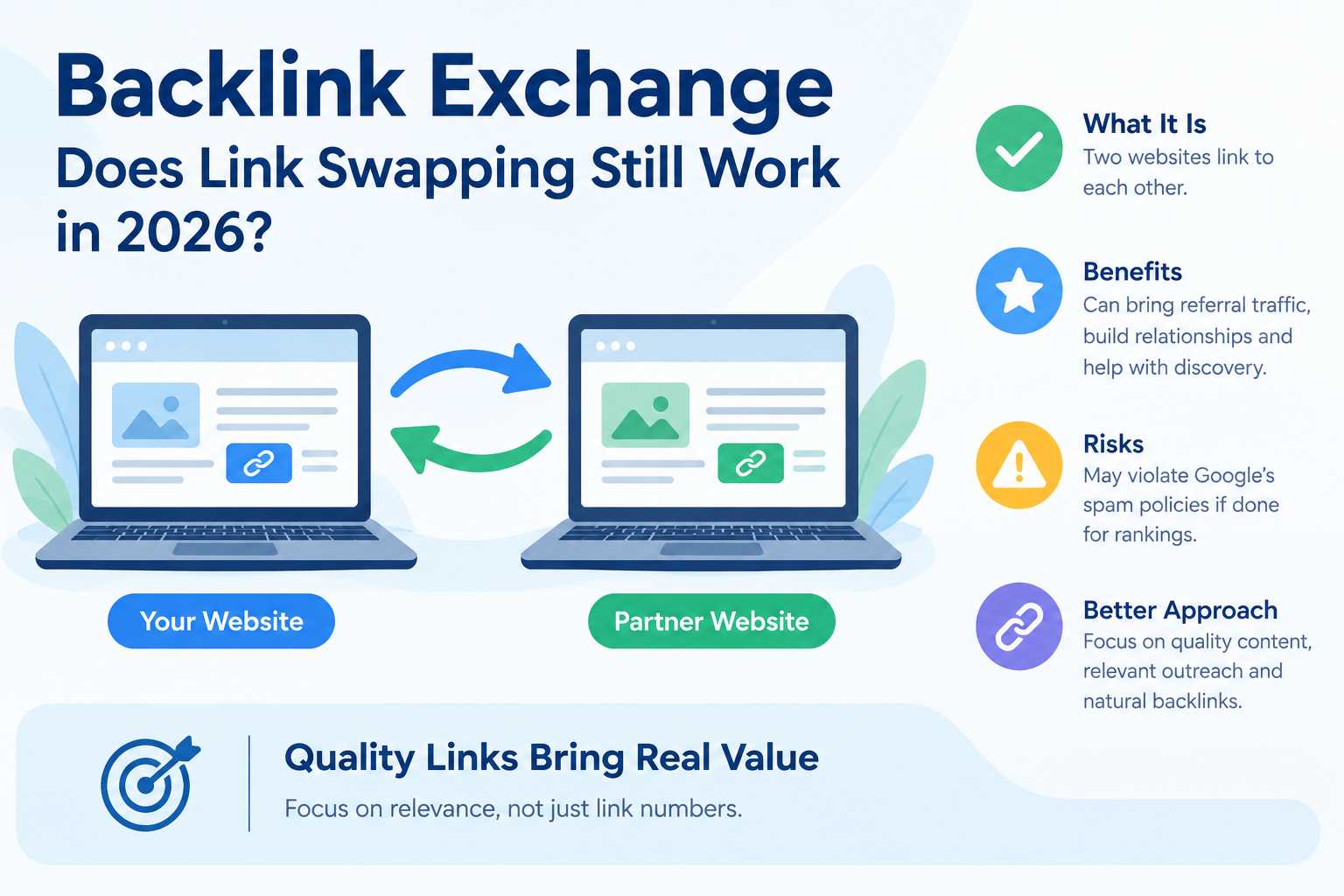
One common method is backlink exchange, also called link swapping. It involves two website owners agreeing to link to each other’s websites.
But does backlink exchange still work in 2026? The answer depends on how you do it. Natural links between relevant websites can be useful. However, exchanging links mainly to manipulate search rankings can violate Google’s spam policies.
In this blog, we will explain how backlink exchange works, its risks, and safer ways to build quality backlinks.
What Is Backlink Exchange?
Backlink exchange is a link-building method in which two websites agree to link to each other.
For example, Website A publishes an article about SEO tools. Website B publishes an article about keyword research. Website A links to Website B because it offers useful information. Website B also links to Website A because its content is relevant to readers.
This is a reciprocal link, meaning both websites link to each other.
Some businesses arrange these exchanges through email outreach, SEO communities, or professional contacts. The main concern arises when the exchange exists primarily to manipulate search rankings rather than provide value to visitors.
Does Link Swapping Still Work in 2026?
Yes, reciprocal links can still exist naturally, but excessive link swapping is risky and should not be used as a ranking strategy.
Google’s official spam policies identify excessive link exchanges, such as “link to me and I’ll link to you,” as a link spam practice. Google may ignore the value of manipulative links or take action against websites that violate its policies.
This does not mean every website linking back to a site that previously linked to it is breaking Google’s rules. Businesses, industry partners, and publishers may naturally reference each other’s resources.
The difference is the purpose behind the link.
- Natural reciprocal links: Each link is useful to readers and relevant to the page.
- Manipulative link swaps: Websites exchange links mainly to influence rankings.
- Large-scale link exchanges: Multiple websites repeatedly swap links as part of a planned backlink scheme.
In 2026, the safer approach is to focus on earning relevant links rather than collecting reciprocal links simply to increase backlink numbers.
Benefits of Backlink Exchange
When links occur naturally between relevant websites, they may offer several benefits.
1. Referral Traffic
A relevant backlink can bring visitors from another website. If those visitors are interested in your services, some may explore your website further.
2. Industry Relationships
Working with related businesses, publishers, and industry professionals can create opportunities for collaboration, interviews, and useful content.
3. Content Discovery
Links help visitors move between related resources. They can also help search engines discover pages across the web.
However, these benefits depend on the quality and relevance of the links. A large number of exchanges does not guarantee better rankings or more traffic.
Risks of Excessive Link Swapping
1. Google Spam Policy Violations
Excessive link exchanges created primarily to manipulate rankings fall under Google’s link spam policies. Violations can result in ranking changes or manual actions.
2. Low Quality Backlinks
Some website owners accept every exchange opportunity without checking the other website’s content, relevance, or quality. Links from unrelated or spam-filled websites may provide little value.
3. Unnatural Link Patterns
Repeated exchanges between the same group of websites, especially with keyword-rich anchor text, can make a link-building campaign look manipulative.
4. Wasted Time and Resources
Managing large numbers of reciprocal links can take time without producing meaningful referral traffic, stronger content, or sustainable SEO improvements.
How to Build Backlinks Safely in 2026
Instead of relying on backlink exchange, use methods that focus on content quality and genuine relationships.
1. Create Link-Worthy Content
Publish useful guides, original research, industry insights, and resources that other websites may want to reference. Content that answers real questions gives publishers a reason to link to your page.
2. Use Relevant Guest Posting
Contribute useful articles to relevant publications when they serve the publication’s audience. Avoid mass guest posting campaigns created mainly to gain ranking credit. Links that are paid for or otherwise commercial should be qualified appropriately, such as with rel="sponsored" where applicable.
3. Build Industry Relationships
Connect with businesses, bloggers, journalists, and professionals in your niche. Genuine relationships can lead to natural mentions, interviews, partnerships, and editorial backlinks.
4. Improve Existing Content
Update outdated articles, add useful examples, and improve your research. Better resources may attract references from other websites over time.
5. Review Your Backlink Profile
Use tools such as Ahrefs or SEMrush to review referring domains, identify unusual link patterns, and evaluate potential link opportunities. Do not judge a backlink only by a third-party authority score. Relevance, context, and the reason for the link also matter.
Backlink Exchange vs. Natural Link Building
| Factor | Backlink Exchange | Natural Link Building |
|---|---|---|
| Main approach | Websites agree to exchange links | Other websites choose to reference useful content |
| Control | Usually arranged in advance | Often earned through content and relationships |
| Main risk | Excessive exchanges can violate Google’s policies | Lower risk when links are genuinely earned |
| Long-term focus | Can become focused on link numbers | Focuses on useful content and genuine references |
A reciprocal link is not automatically harmful. The key is to avoid excessive or manipulative exchanges designed primarily to influence rankings.
Conclusion
Backlink exchange can create useful connections between relevant websites, but it should not be treated as a shortcut to higher rankings. In 2026, excessive link swapping for SEO purposes remains against Google’s spam policies. A better strategy is to earn relevant backlinks through useful content, genuine industry relationships, and responsible outreach.
At SEO Outsourcing Company USA, we help businesses strengthen their search visibility through link building, keyword research, on-page SEO, technical SEO audits, and content optimization. Our focus is on building a sustainable SEO foundation with relevant links and quality content rather than chasing backlink numbers alone.
Explore SEO Outsourcing Company USA to learn how our SEO services can support your website’s long-term growth.
