Link building remains an important part of SEO. However, finding quality backlink opportunities takes time. SEO professionals need to research competitors, identify relevant websites, find contact details, manage outreach, and monitor acquired backlinks.
This is where link building tools become useful. They help SEO teams find opportunities, analyze backlink profiles, and organize campaigns more efficiently.
But which tool should you choose in 2026? Some platforms focus on backlink analysis, while others specialize in email outreach and relationship management.
In this guide, we compare seven popular link building tools to help you choose the right option for your SEO goals.
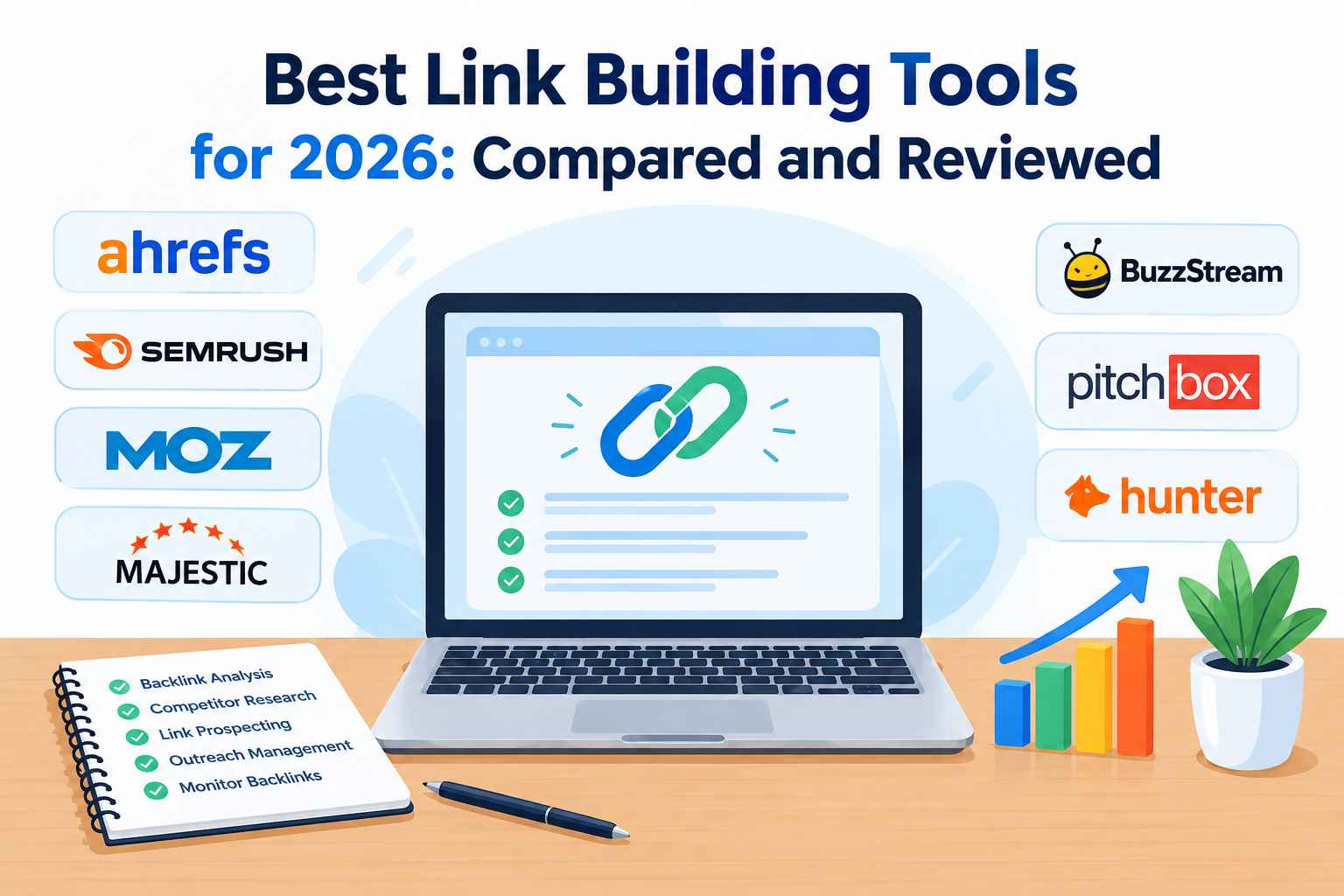
1. Ahrefs: Best for Backlink Analysis
Ahrefs is a popular SEO platform for researching competitor backlinks and discovering link building opportunities.
Key features:
Analyze backlinks and referring domains.
Find websites linking to competitors but not to you.
Discover link opportunities through Content Explorer.
Identify broken backlinks and lost link opportunities.
Monitor changes in backlink profiles.
Pros: Strong backlink research capabilities, useful competitor analysis, and helpful content discovery features.
Cons: Some advanced reports require higher-tier plans. It does not replace a dedicated email outreach platform.
Best for: SEO professionals who want to study competitor backlinks and build targeted prospect lists.
3. Moz Pro: Best for Beginners and Link Quality Research
Moz Pro offers backlink research tools that help users understand their link profiles and compare them with competitors.
Key features:
Discover backlinks and linking domains.
Compare competitor link profiles.
Review Domain Authority and Page Authority metrics.
Use Spam Score as one signal during backlink evaluation.
Track link profile changes.
Pros: Provides familiar SEO metrics and a straightforward way to compare websites.
Cons: Domain Authority is a third-party metric, not a Google ranking factor. Its scores should not be treated as proof that a backlink will improve rankings.
Best for: Beginners and marketers who want an accessible way to research backlinks and compare potential opportunities.
4. Majestic: Best for Specialized Backlink Analysis
Majestic focuses heavily on backlink intelligence. It provides its own metrics to help SEO professionals understand the strength and structure of link profiles.
Key features:
Explore backlinks and referring domains.
Review Trust Flow and Citation Flow.
Investigate competitor link profiles.
Examine link context and linking patterns.
Pros: Specialized backlink analysis and metrics designed for link research.
Cons: It is more focused on backlinks than on complete SEO workflows. Beginners may need time to understand its metrics.
Best for: Experienced SEO professionals who want deeper backlink research and another perspective on link quality.
Before paying for a subscription, identify the main problem you want to solve.
For backlink analysis: Start by comparing Ahrefs and Semrush.
For competitor research: Look for backlink gap and referring domain reports.
For email outreach: Consider BuzzStream or Pitchbox.
For contact discovery: Hunter can help prepare outreach lists.
For specialized link metrics: Explore Majestic or Moz Pro.
You do not need every tool. One backlink research platform and one outreach tool may be enough for many campaigns.
Check current pricing, usage limits, export allowances, and available features on each provider’s official website before purchasing.
What Should You Check Before Building a Backlink?
A tool can identify potential websites, but you still need to evaluate each opportunity.
Check whether the website is relevant to your industry, publishes useful content, attracts a genuine audience, and offers a natural place for your link.
Do not judge a website only by Domain Authority, Domain Rating, or another third-party score. These metrics help with comparisons, but they do not guarantee ranking improvements.
Avoid paid link schemes and excessive link exchanges designed primarily to manipulate rankings. Follow Google’s link spam policies when planning your campaign.
Conclusion
The best link building tool for 2026 depends on your workflow. Ahrefs and Semrush are strong options for backlink research, Moz and Majestic offer alternative ways to evaluate link profiles, while BuzzStream, Pitchbox, and Hunter help with outreach and contact discovery.
The goal is not simply to build more backlinks. It is to find relevant opportunities, earn useful links, and monitor campaign progress.
At SEO Outsourcing Company USA, we help businesses improve their search visibility through backlink research, link building, keyword research, on-page SEO, technical SEO audits, and content optimization. Our focus is on relevant link opportunities and sustainable SEO practices that support long-term growth.
Have you ever opened a website on your mobile phone and found it difficult to read? Maybe the text was too small, the images were not loading properly, or you had to zoom in to understand the content.
This is not a good experience for users. Google also wants to provide search results that help people find useful information and have a good experience on websites.
This is where mobile-first indexing becomes important.
If you have a website or work in digital marketing, understanding mobile-first indexing can help you improve your website’s SEO performance. It is especially important today because many people use smartphones to search for products, services, and information online.
In this guide, we will explain what mobile-first indexing is, how it works, why it matters for SEO, and what you can do to make your website mobile-friendly.
What Is Mobile-First Indexing?
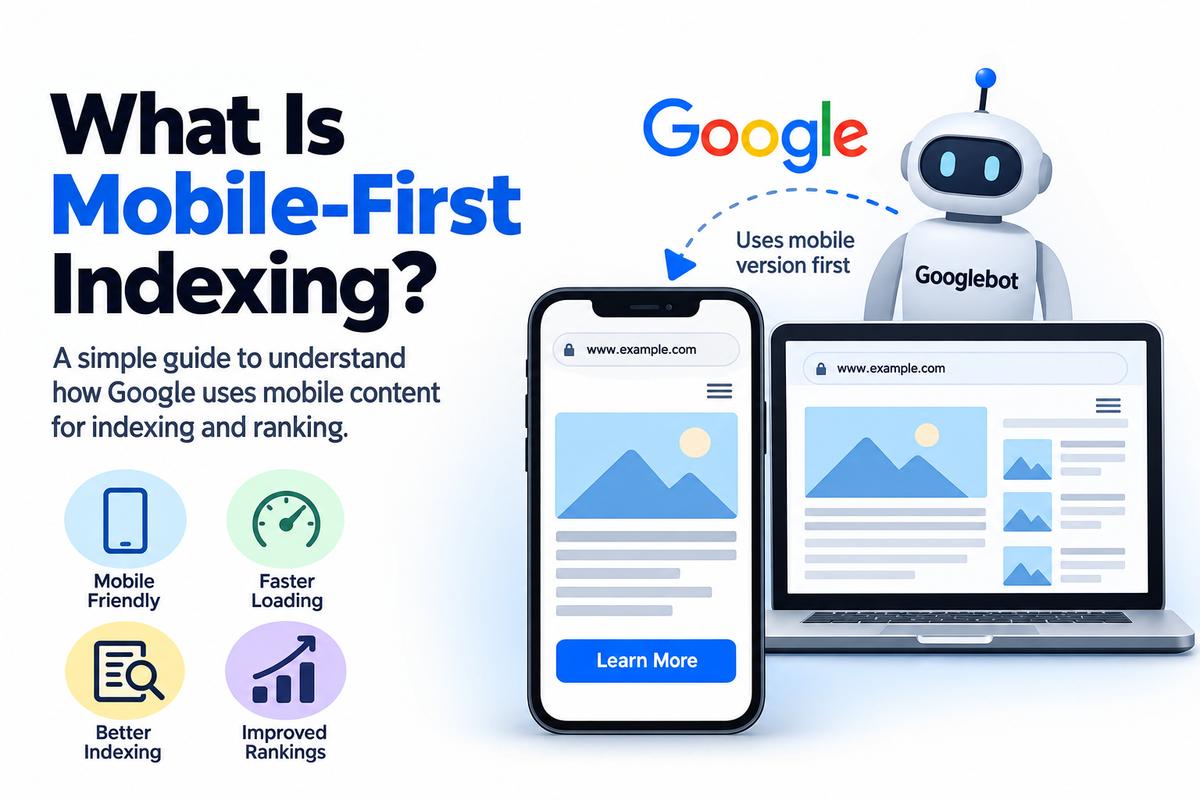
Mobile-first indexing means that Google primarily uses the mobile version of a website’s content for indexing and understanding its pages.
In simple words, Google mainly looks at the mobile version of your website when deciding what your pages are about and how they may appear in search results.
For example, imagine you have a website with two versions:
A desktop version with complete content, images, and internal links.
A mobile version with some content removed to make the page shorter.
If Google primarily evaluates the mobile version and important content is missing from it, Google may not understand your page as completely as you expect.
That is why it is important to ensure that your mobile website contains the same important content as your desktop website.
Remember: Mobile-first indexing does not mean Google only indexes mobile websites. It means Google primarily uses the mobile version of a page for indexing.
How Does Mobile-First Indexing Work?
Let’s understand how it works with a simple example.
Suppose you run a digital marketing agency and have a service page about SEO services.
However, your mobile version only displays a short introduction and a contact form.
In this situation, Google may not find all the information available on your desktop version when it evaluates the mobile page.
This could affect how Google understands your content.
To avoid this problem, make sure that important information is available on both desktop and mobile versions.
Here is a simple overview of the process:
Google discovers your webpage.
Google crawls the page, primarily using a mobile smartphone user agent.
Google processes the available content and other relevant information.
Google uses the information to understand and index the page.
Your page may appear in relevant Google search results.
Keep in mind that indexing does not guarantee rankings. Google considers many other factors when deciding which pages to show for a search query.
Why Is Mobile-First Indexing Important for SEO?
Mobile-first indexing is important because it affects how Google accesses and understands your website’s content.
Let’s look at some of the main reasons why website owners and SEO professionals should care about it.
1. It Helps Google Understand Your Content
Your website content tells Google what your page is about.
If your mobile version contains the same important content as your desktop version, Google has a better opportunity to understand the page properly.
For example, if you offer local SEO services, your mobile page should include the service information, relevant headings, and useful details available on the desktop version.
Removing important content from mobile pages can make it harder for Google to understand everything your website offers.
2. It Supports a Better User Experience
People expect websites to work properly on their phones.
They want to read articles, compare products, contact businesses, and find answers without struggling with the layout.
A mobile-friendly website makes these activities easier.
For example, if a user visits your website to learn about your services, they should be able to read the content, navigate between pages, and contact your business without unnecessary difficulty.
A better user experience can help visitors interact with your website more comfortably.
3. It Helps Protect Important SEO Elements
Mobile-first indexing also makes it important to check whether essential SEO elements are available on mobile pages.
These include:
Page titles and meta descriptions.
Main headings and body content.
Internal links.
Images and their alternative text.
Structured data.
Canonical tags.
You should check these elements carefully, especially if your website uses separate desktop and mobile URLs or displays different content on different devices.
4. It Encourages Mobile-Friendly Website Design
A mobile-friendly website adjusts to different screen sizes.
For example, a visitor should be able to open your website on a smartphone and see readable text, properly displayed images, and buttons that are easy to tap.
Responsive web design is a common way to achieve this.
With responsive design, the same page URL and HTML content can adapt to different screen sizes.
This approach can make website management easier and help maintain consistency between desktop and mobile versions.
What Is the Difference Between Mobile-First Indexing and Mobile-Friendly Design?
These terms sound similar, but they mean different things.
Mobile-first indexing describes how Google primarily uses the mobile version of a website’s content for indexing.
Mobile-friendly design describes how a website is designed to work well on mobile devices.
For example, imagine your website adjusts perfectly to a smartphone screen. The text is readable, the buttons work, and visitors can navigate easily.
That is mobile-friendly design.
However, if your mobile version hides important content that appears on desktop, you may still have an issue related to mobile-first indexing.
Similarly, a website can have the same content on desktop and mobile but still provide a poor mobile experience because its layout is difficult to use.
The goal is to make your website both accessible to Google and easy for people to use.
How to Optimize Your Website for Mobile-First Indexing
Now that you understand what mobile-first indexing means, let’s discuss some practical steps you can take to improve your website.
1. Use Responsive Web Design
Responsive design allows your website to adjust automatically to different screen sizes.
Whether someone visits your website using a desktop computer, tablet, or smartphone, the layout adapts to the available screen space.
For most websites, this is a practical approach because you can maintain one URL for each page rather than managing separate desktop and mobile URLs.
If you use WordPress, many modern themes and page builders already support responsive layouts.
However, always check the final website on different devices instead of assuming that the design works perfectly.
2. Keep Important Content Consistent
This is one of the most important steps.
Make sure your mobile version contains the essential information available on the desktop version.
For example, if your desktop page includes service descriptions, pricing information, FAQs, and useful internal links, check that these elements are also accessible on mobile.
You can use expandable sections such as accordions to organize content on smaller screens. Important content inside these sections should still be accessible to Google.
The goal is to improve the mobile layout without unnecessarily removing useful information.
3. Check Your Website’s Loading Speed
Website speed matters for user experience.
If your pages take too long to load, visitors may become frustrated and leave before interacting with your content.
Here are some practical ways to improve loading speed:
Compress large images.
Use modern image formats such as WebP or AVIF where appropriate.
Reduce unnecessary JavaScript and CSS.
Enable browser caching.
Use a reliable hosting provider.
Remove unnecessary plugins and scripts.
Consider using a content delivery network when appropriate.
You can use Google’s PageSpeed Insights to evaluate your website’s performance and identify potential improvements.
Remember that a faster website does not automatically guarantee higher rankings. However, improving performance can make your website more pleasant to use.
4. Check Your Robots.txt File
Your robots.txt file provides crawling instructions to search engine bots.
If your robots.txt file blocks important resources that Google needs to access your pages, it may interfere with Google’s ability to understand how your website is displayed.
For example, blocking essential CSS or JavaScript files can prevent Google from properly rendering your page.
Review your robots.txt file and ensure that important content and rendering resources are accessible to Googlebot.
Do not block resources simply because they are located inside a particular directory. First, check whether Google needs those resources to understand your pages.
5. Optimize Images for Mobile Devices
Large images can slow down your website, especially for visitors using mobile networks.
To improve image performance, compress images before uploading them and use appropriate dimensions for their placement.
You should also add descriptive alternative text to meaningful images.
For example, if an image shows a digital marketing team working on an SEO campaign, suitable alt text could be “Digital marketing team working on an SEO campaign.”
Avoid stuffing keywords into alt text. Describe the image naturally and accurately.
6. Check Internal Links
Internal links help visitors and search engines discover related pages on your website.
For example, a blog about mobile-first indexing could link to relevant articles about technical SEO, website speed, and mobile SEO.
Make sure important internal links are available on mobile pages.
If your desktop navigation contains links to essential service pages but your mobile version removes them entirely, review whether visitors and Google can still discover those pages through other accessible links.
A clear internal linking structure helps users navigate your website and supports search engine discovery.
7. Review Structured Data
Structured data helps search engines understand specific information about a webpage.
For example, depending on the content and eligibility requirements, you might use relevant structured data for articles, products, local businesses, or organizations.
If you use structured data on your desktop version, check that the equivalent important markup is also present on the mobile version.
Make sure the markup accurately represents the visible or otherwise eligible page content and follows Google’s structured data guidelines.
Adding structured data does not guarantee rich results, but correct implementation can help Google interpret eligible content.
8. Test Your Website on Different Mobile Devices
Do not rely on how your website looks on just one phone.
Test it on different screen sizes and check whether:
Text is easy to read.
Buttons are easy to tap.
Navigation menus work correctly.
Images fit the screen.
Important content is visible.
Forms are easy to complete.
No unnecessary horizontal scrolling occurs.
You can also use Google’s Search Console and URL Inspection tool to investigate how Google accesses and processes a page.
These checks can help you identify problems that might not be obvious when viewing your website on a desktop computer.
Common Mobile-First Indexing Mistakes to Avoid
Even websites with good designs can have technical issues.
Here are some common mistakes to watch for.
Removing important content from mobile pages: Your mobile version should retain the essential content available on desktop.
Blocking important resources: Make sure Google can access the resources required to render and understand your pages.
Using different metadata unnecessarily: Keep important titles, descriptions, and other relevant metadata consistent across versions when separate mobile and desktop URLs are used.
Ignoring mobile performance: Large images, unnecessary scripts, and poorly optimized layouts can create a frustrating experience.
Forgetting internal links: Important pages should remain discoverable through accessible links.
Assuming mobile-first indexing guarantees rankings: Even if your website is indexed correctly, your rankings depend on many factors, including relevance, content quality, competition, and Google’s ranking systems.
Avoiding these mistakes can help you maintain a technically sound website.
How to Check Mobile-First Indexing Issues
If you are an SEO professional, you may wonder how to check whether a website has problems related to mobile-first indexing.
You can start with the following tools.
Google Search Console: Use the URL Inspection tool to check a page’s indexing status and review the available crawl information. Search Console can help you identify indexing issues, but it does not provide a simple switch to enable or disable mobile-first indexing.
PageSpeed Insights: Use this tool to evaluate page performance and identify potential improvements for mobile and desktop experiences.
Chrome DevTools: Use device emulation to inspect how a website behaves at different screen sizes.
Website crawlers: Tools such as Screaming Frog SEO Spider can help you audit URLs, titles, headings, internal links, and other technical SEO elements. Compare desktop and mobile crawling configurations when investigating differences between versions.
You should also inspect important pages manually on a smartphone.
If Google can access your content but users struggle to navigate the page, the website may still need design and usability improvements.
Does Mobile-First Indexing Affect Rankings?
Mobile-first indexing can affect how Google understands and indexes your website, but it is not a direct guarantee of higher or lower rankings.
For example, if your mobile version is missing important content, Google may have less information available to understand your page.
Similarly, if your website is difficult to use on a smartphone, visitors may have a poor experience.
However, a mobile-friendly website will not automatically outrank every competitor.
Google considers many signals and systems when ranking search results. Relevant content, helpful information, website accessibility, technical SEO, and overall page quality remain important.
Instead of focusing only on mobile-first indexing, work on building a website that is technically accessible, useful, and easy to navigate on all devices.
Final Thoughts
Mobile-first indexing is an important part of modern SEO because Google primarily uses the mobile version of a website’s content for indexing.
If you want your website to perform well in search results, make sure that Google can access your important content and that visitors can easily use your website on smartphones.
Start by checking your mobile layout, reviewing important content, optimizing images, improving loading performance, and checking internal links.
If you manage a WordPress website, review your theme and page builder settings to ensure that mobile and desktop versions provide consistent, useful information.
The main takeaway is simple: Build your website for people first, keep important content accessible across devices, and make it easy for Google to understand your pages.
Search engines are changing how people find information online. Earlier, users searched for a keyword, opened different websites, and compared the information themselves. Today, AI-powered search tools can provide direct answers, summarize information, and show links to useful sources.
This change has created a new area of digital marketing called Generative Engine Optimization (GEO).
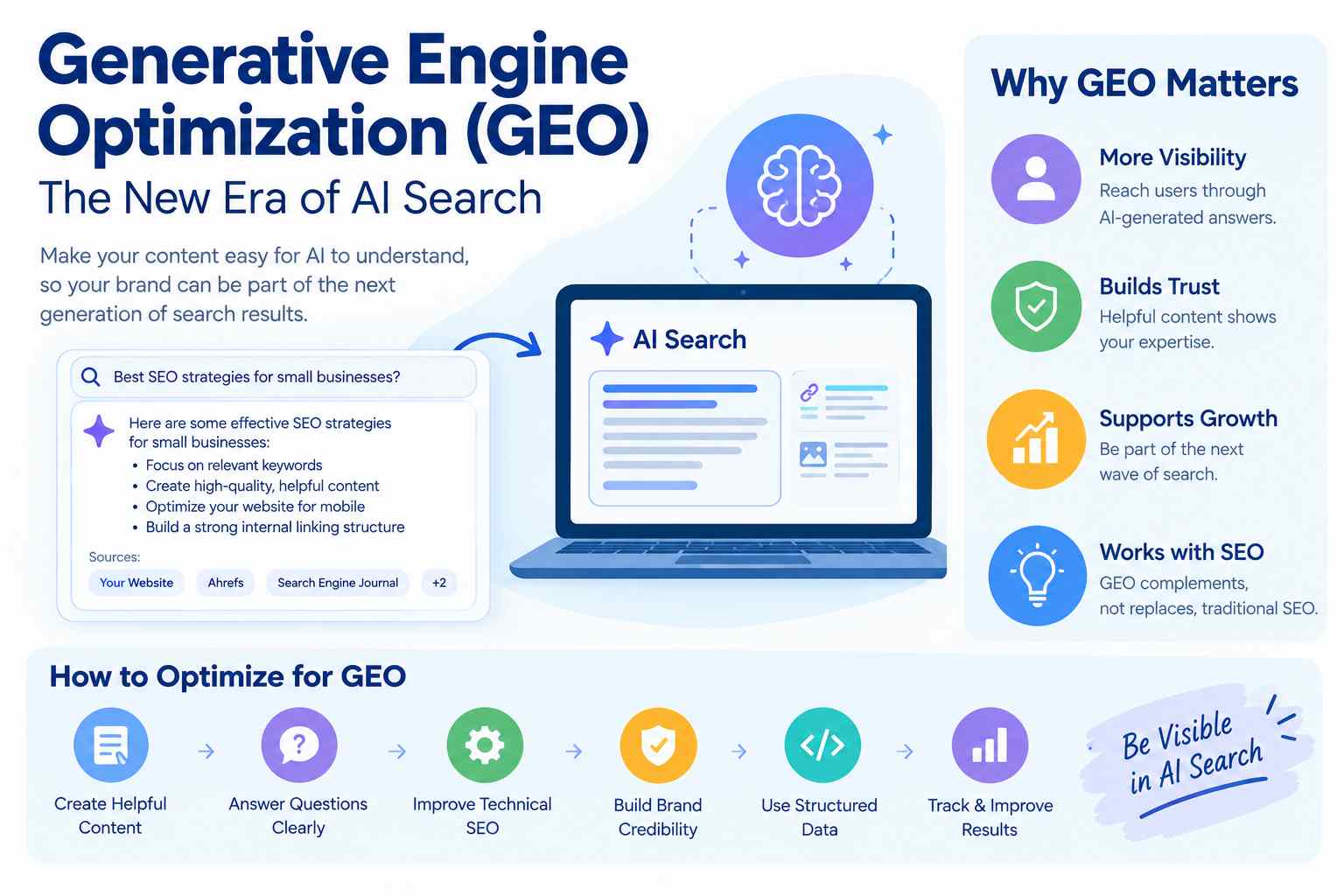
GEO focuses on improving a brand’s visibility in AI-generated answers across search experiences. Instead of focusing only on traditional search rankings, businesses also want their content to be understood, referenced, and recommended by AI-powered search systems.
But what does GEO mean for businesses, and how can websites prepare for this new era of search? Let’s explore.
What Is Generative Engine Optimization (GEO)?
Generative Engine Optimization is the process of improving website content so that AI-powered search systems can understand it and potentially use it when answering users’ questions.
These systems may summarize information from multiple sources and provide links to websites that support their answers.
For example, someone might ask an AI search tool, “Which SEO agency can help a small business improve its website visibility?”
Instead of showing only a list of websites, the tool may provide a summarized response with relevant sources. Businesses want their websites to be among the useful sources considered for such answers.
GEO helps businesses work toward this visibility by focusing on helpful content, clear information, website accessibility, and credibility.
However, no GEO strategy can guarantee that an AI platform will mention or recommend a particular brand.
How Is GEO Different From Traditional SEO?
Traditional SEO focuses on improving a website’s visibility in search results. GEO focuses on visibility within AI-generated responses.
Both approaches share many important practices.
Traditional SEO
GEO
Focuses on organic search visibility
Focuses on visibility in AI-generated answers
Optimizes pages for relevant search queries
Helps AI systems understand useful, relevant information
Uses keyword research and on-page SEO
Uses clear content that answers user questions
Builds technical website health
Relies on accessible, understandable website content
Tracks rankings, clicks, and impressions
Also considers AI mentions, citations, and referral visits where measurable
GEO does not replace SEO. Google’s official guidance confirms that foundational SEO practices remain relevant to its generative AI search features. <Link url=”https://developers.google.com/search/docs/fundamentals/ai-optimization-guide” title=”Google’s guide to generative AI search optimization”/> explains how useful content and technical SEO support search visibility.
Why Is GEO Important for Businesses?
1. People Are Using AI to Find Answers
Users increasingly interact with AI-powered search experiences to research products, compare services, and understand complex topics.
Businesses that publish useful information have an opportunity to reach these users through AI-generated responses, although visibility is never guaranteed.
2. Search Visibility Is Changing
A business may appear in traditional search results but not be mentioned in an AI-generated answer. Similarly, an AI answer may reference a website that the user would not otherwise have discovered.
This makes it useful to monitor both traditional search performance and available AI visibility data.
3. Helpful Content Can Build Brand Trust
When a website provides clear answers, original insights, and accurate information, it gives readers a reason to trust the brand.
Content that genuinely helps people can support both traditional SEO and GEO efforts.
4. Businesses Can Reach Users During Research
AI search tools can help users compare different solutions before making a decision. Detailed service pages, practical guides, and clear explanations can help businesses communicate their expertise during this process.
How to Optimize Your Website for GEO
1. Create Helpful, Original Content
Content should provide something useful beyond repeating information already available online.
Include practical examples, original insights, real experience, and clear explanations. Answer the main question directly, then provide supporting details.
For example, an SEO agency writing about technical SEO could explain common website errors, how to identify them, and how they can be fixed.
Google recommends creating valuable, distinctive content that serves people rather than producing generic pages mainly to gain search visibility.
2. Answer Questions Clearly
Many people use AI search to ask complete questions rather than type short keywords.
Organize your content around the questions your audience genuinely asks. Use descriptive headings, concise explanations, examples, and FAQs where they help readers.
Avoid adding unnecessary questions or repeating the same answer in multiple sections just to target more queries.
3. Maintain Strong Technical SEO
AI search visibility still depends on whether relevant systems can access and understand your content.
Review your website for:
Crawlability and indexing problems
Broken links and incorrect redirects
Clear internal linking
Mobile usability
Page loading issues
Accurate titles and headings
Useful, descriptive image content
For Google’s AI search features, pages generally need to be indexed and eligible to appear with a search snippet. Meeting technical requirements does not guarantee that a page will be selected for an AI-generated answer.
4. Build Brand Credibility
Publish accurate information and keep important business details consistent across your website and relevant public profiles.
Show your experience through case studies, author information, original research, customer examples, and useful resources where appropriate.
Earn relevant mentions and backlinks through genuine industry relationships and valuable content. Avoid buying artificial mentions or creating spammy links to influence AI recommendations.
5. Use Structured Data Correctly
Structured data helps search engines understand specific information about a webpage. Depending on the page, relevant markup may describe an organization, product, article, or other supported content type.
Make sure the markup matches the information visible on the page.
There is no special schema markup that guarantees inclusion in generative AI answers. Use structured data as part of a sound SEO strategy rather than treating it as a GEO shortcut.
6. Track Results and Improve
Measure performance using available tools and meaningful business outcomes.
Google Search Console can help you review search impressions, clicks, and queries. Website analytics can help you understand referral visits and user activity. Where supported, AI visibility tools may help track brand mentions or citations across selected platforms.
Remember that third-party AI visibility measurements may not represent every user or every response. Use them as directional information rather than guaranteed measures of success.
Common GEO Mistakes to Avoid
Publishing generic content: Repeating common information without adding value makes your website less distinctive.
Stuffing keywords: Unnatural keyword repetition can make content difficult to read.
Creating pages in bulk: Publishing large numbers of similar pages without meaningful value can violate Google’s scaled content abuse policies.
Relying only on schema: Structured data cannot guarantee AI citations.
Ignoring traditional SEO: Poor indexing, broken links, and inaccessible content can limit your search visibility.
Expecting guaranteed mentions: No agency or tool can guarantee that every AI platform will recommend your business.
Conclusion
Generative Engine Optimization is becoming an important consideration for businesses that want to improve their visibility in AI-powered search experiences. The best starting point is not complicated: create useful content, maintain a technically healthy website, demonstrate genuine expertise, and make information easy for people to understand.
GEO works alongside traditional SEO rather than replacing it. Businesses that invest in quality content and sustainable optimization practices can build a stronger foundation for changing search experiences.
At SEO Outsourcing Company USA, we help businesses improve their online presence through keyword research, on-page SEO, technical SEO audits, content optimization, and link building. Our approach focuses on useful content, website health, and long-term search visibility to help businesses adapt as search continues to evolve.
Backlinks remain an important part of SEO. They help search engines discover pages and understand how websites connect with each other. Because of this, many website owners look for ways to earn backlinks without spending too much time or money.
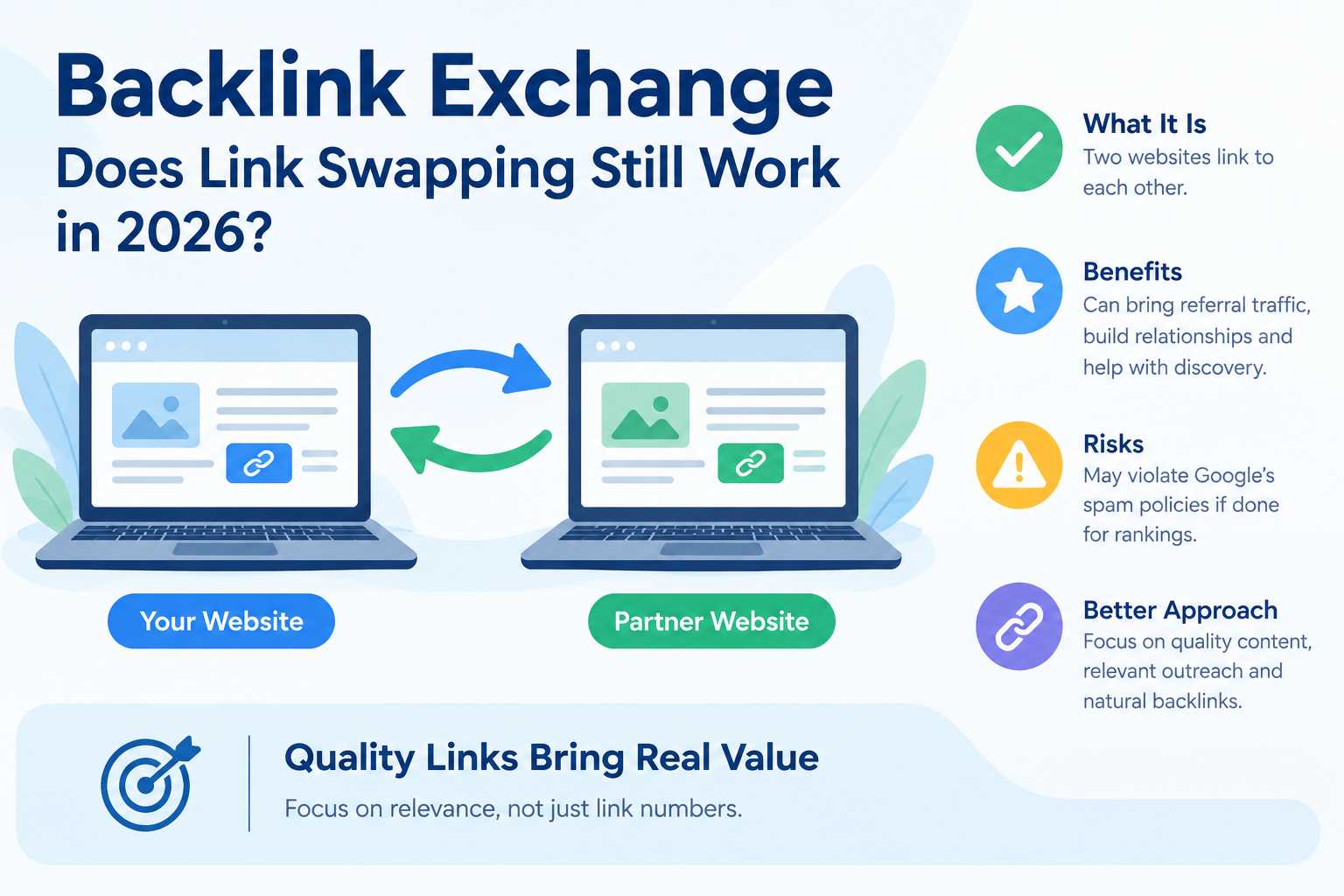
One common method is backlink exchange, also called link swapping. It involves two website owners agreeing to link to each other’s websites.
But does backlink exchange still work in 2026? The answer depends on how you do it. Natural links between relevant websites can be useful. However, exchanging links mainly to manipulate search rankings can violate Google’s spam policies.
In this blog, we will explain how backlink exchange works, its risks, and safer ways to build quality backlinks.
What Is Backlink Exchange?
Backlink exchange is a link-building method in which two websites agree to link to each other.
For example, Website A publishes an article about SEO tools. Website B publishes an article about keyword research. Website A links to Website B because it offers useful information. Website B also links to Website A because its content is relevant to readers.
This is a reciprocal link, meaning both websites link to each other.
Some businesses arrange these exchanges through email outreach, SEO communities, or professional contacts. The main concern arises when the exchange exists primarily to manipulate search rankings rather than provide value to visitors.
Does Link Swapping Still Work in 2026?
Yes, reciprocal links can still exist naturally, but excessive link swapping is risky and should not be used as a ranking strategy.
Google’s official spam policies identify excessive link exchanges, such as “link to me and I’ll link to you,” as a link spam practice. Google may ignore the value of manipulative links or take action against websites that violate its policies.
This does not mean every website linking back to a site that previously linked to it is breaking Google’s rules. Businesses, industry partners, and publishers may naturally reference each other’s resources.
The difference is the purpose behind the link.
Natural reciprocal links: Each link is useful to readers and relevant to the page.
Manipulative link swaps: Websites exchange links mainly to influence rankings.
Large-scale link exchanges: Multiple websites repeatedly swap links as part of a planned backlink scheme.
In 2026, the safer approach is to focus on earning relevant links rather than collecting reciprocal links simply to increase backlink numbers.
Benefits of Backlink Exchange
When links occur naturally between relevant websites, they may offer several benefits.
1. Referral Traffic
A relevant backlink can bring visitors from another website. If those visitors are interested in your services, some may explore your website further.
2. Industry Relationships
Working with related businesses, publishers, and industry professionals can create opportunities for collaboration, interviews, and useful content.
3. Content Discovery
Links help visitors move between related resources. They can also help search engines discover pages across the web.
However, these benefits depend on the quality and relevance of the links. A large number of exchanges does not guarantee better rankings or more traffic.
Risks of Excessive Link Swapping
1. Google Spam Policy Violations
Excessive link exchanges created primarily to manipulate rankings fall under Google’s link spam policies. Violations can result in ranking changes or manual actions.
2. Low Quality Backlinks
Some website owners accept every exchange opportunity without checking the other website’s content, relevance, or quality. Links from unrelated or spam-filled websites may provide little value.
3. Unnatural Link Patterns
Repeated exchanges between the same group of websites, especially with keyword-rich anchor text, can make a link-building campaign look manipulative.
4. Wasted Time and Resources
Managing large numbers of reciprocal links can take time without producing meaningful referral traffic, stronger content, or sustainable SEO improvements.
How to Build Backlinks Safely in 2026
Instead of relying on backlink exchange, use methods that focus on content quality and genuine relationships.
1. Create Link-Worthy Content
Publish useful guides, original research, industry insights, and resources that other websites may want to reference. Content that answers real questions gives publishers a reason to link to your page.
2. Use Relevant Guest Posting
Contribute useful articles to relevant publications when they serve the publication’s audience. Avoid mass guest posting campaigns created mainly to gain ranking credit. Links that are paid for or otherwise commercial should be qualified appropriately, such as with rel="sponsored" where applicable.
3. Build Industry Relationships
Connect with businesses, bloggers, journalists, and professionals in your niche. Genuine relationships can lead to natural mentions, interviews, partnerships, and editorial backlinks.
4. Improve Existing Content
Update outdated articles, add useful examples, and improve your research. Better resources may attract references from other websites over time.
5. Review Your Backlink Profile
Use tools such as Ahrefs or SEMrush to review referring domains, identify unusual link patterns, and evaluate potential link opportunities. Do not judge a backlink only by a third-party authority score. Relevance, context, and the reason for the link also matter.
Backlink Exchange vs. Natural Link Building
Factor
Backlink Exchange
Natural Link Building
Main approach
Websites agree to exchange links
Other websites choose to reference useful content
Control
Usually arranged in advance
Often earned through content and relationships
Main risk
Excessive exchanges can violate Google’s policies
Lower risk when links are genuinely earned
Long-term focus
Can become focused on link numbers
Focuses on useful content and genuine references
A reciprocal link is not automatically harmful. The key is to avoid excessive or manipulative exchanges designed primarily to influence rankings.
Conclusion
Backlink exchange can create useful connections between relevant websites, but it should not be treated as a shortcut to higher rankings. In 2026, excessive link swapping for SEO purposes remains against Google’s spam policies. A better strategy is to earn relevant backlinks through useful content, genuine industry relationships, and responsible outreach.
At SEO Outsourcing Company USA, we help businesses strengthen their search visibility through link building, keyword research, on-page SEO, technical SEO audits, and content optimization. Our focus is on building a sustainable SEO foundation with relevant links and quality content rather than chasing backlink numbers alone.
Explore SEO Outsourcing Company USA to learn how our SEO services can support your website’s long-term growth.
Finding the right SEO agency in Utah can help your business improve its search engine rankings, attract more website visitors, and generate quality leads. Whether you run a small local business, an online store, or a large company, search engine optimization (SEO) can help you reach potential customers who are actively looking for your products or services.
With so many agencies offering SEO services, choosing the right partner can be challenging. Some agencies focus on local SEO, while others specialize in technical SEO, e-commerce SEO, content marketing, or AI search optimization.
In this guide, we will explore three SEO agencies in Utah, explain what SEO services businesses need, and share practical tips for selecting the best agency for your goals.
What Is an SEO Agency?
An SEO agency helps businesses improve their visibility in search engines such as Google. Its main goal is to help relevant website pages appear higher in organic search results.
A professional SEO agency may provide several services, including:
Keyword research: Finding the search terms your potential customers use.
On-page SEO: Improving page titles, meta descriptions, headings, and content.
Technical SEO: Fixing crawling, indexing, website speed, and other technical issues.
Link building: Earning relevant backlinks that can support website authority.
Local SEO: Helping businesses appear in local search results and Google Maps.
Content marketing: Creating useful content that answers customer questions.
AI SEO: Improving how a business is represented in AI-powered search experiences.
The services you need will depend on your industry, competition, website condition, and business objectives.
Top 3 SEO Agencies in Utah
Here are three agencies worth considering when searching for an SEO agency in Utah.
1. Searchbloom
Searchbloom is a digital marketing agency based in South Jordan, Utah. The company provides SEO and paid search services for businesses looking to improve online visibility and attract relevant visitors.
Its services include technical SEO, local SEO, e-commerce SEO, and broader organic search strategies.
Searchbloom may be a suitable option for businesses that want a structured SEO campaign supported by research, performance tracking, and ongoing optimization.
Best for: Businesses looking for dedicated SEO services, technical improvements, and measurable organic growth.
Big Leap is a digital marketing agency based in Lehi, Utah. It offers services such as SEO, content marketing, and digital strategy to help businesses strengthen their online presence.
Content plays an important role in SEO because customers often search for answers before deciding to purchase a product or contact a service provider. An effective content strategy can help a website reach customers at different stages of the buying journey.
Big Leap is worth considering if your business wants to combine search optimization with useful content and a broader digital marketing strategy.
Best for: Businesses focused on content marketing, organic visibility, and long-term growth.
SEO National is a Utah-based SEO company that focuses on improving organic search visibility. Its services include search optimization strategies designed to help businesses attract relevant traffic from search engines.
Businesses competing in crowded markets often need a combination of keyword research, technical improvements, useful content, and quality backlinks to strengthen their search presence.
SEO National is another company to evaluate when comparing Utah SEO providers. Before making a decision, review its current service offerings, relevant case studies, and experience in your industry.
Best for: Businesses looking for an organic search strategy focused on rankings, visibility, and lead generation.
Note: This list is a starting point for your research, not a definitive ranking. Compare current pricing, services, reviews, and verified results before choosing an agency.
What Services Should You Expect From an SEO Agency in Utah?
Before hiring an SEO agency, understand which services can help your business achieve its goals.
Local SEO
Local SEO is important for businesses that serve customers in specific Utah cities, such as Salt Lake City, Provo, Lehi, or Ogden.
A local SEO campaign may include Google Business Profile optimization, local keyword research, location pages, business directory listings, and reputation management.
These activities can help customers discover your business when searching for nearby services.
Technical SEO
Technical SEO focuses on making your website easier for search engines to crawl, understand, and index.
An agency may review broken links, redirect issues, duplicate content, XML sitemaps, canonical tags, mobile usability, and Core Web Vitals.
Fixing technical problems can help search engines access important pages and provide visitors with a better website experience.
On-Page SEO and Content
On-page SEO involves improving individual pages so they better match the needs of searchers.
This includes writing relevant titles and meta descriptions, organizing headings, improving internal links, and creating helpful content.
Instead of repeating a keyword unnecessarily, a good SEO strategy focuses on answering the user’s question clearly and providing useful information.
AI SEO and Generative Engine Optimization
Search behavior is changing as users increasingly explore AI-powered search tools and answer engines.
AI SEO and generative engine optimization (GEO) aim to improve how clearly a business’s information is presented across its website and other relevant online sources.
This work can include publishing accurate, useful content, improving structured data where appropriate, building brand credibility, and maintaining consistent business information.
However, no agency can guarantee that a brand will appear in every AI-generated answer.
How Much Does an SEO Agency in Utah Cost?
The cost of SEO depends on the size of your website, the competitiveness of your industry, your target locations, and the amount of work required.
Small local businesses may need a focused local SEO campaign, while national businesses and e-commerce stores may require more extensive technical work, content production, and link acquisition.
When comparing proposals, ask what is included in the monthly fee. Check whether the agency provides keyword research, technical audits, content optimization, reporting, and regular strategy reviews.
Avoid choosing a provider based only on the lowest price. A clear plan, realistic expectations, and transparent reporting are often more valuable than promises of instant rankings.
How to Choose the Best SEO Agency in Utah
Use these practical steps before signing a contract.
1. Review previous work. Ask for relevant case studies and examples of improvements in organic traffic, rankings, or qualified leads.
2. Understand the strategy. The agency should explain what it plans to improve and why those activities matter to your business.
3. Check communication. Regular updates and understandable reports make it easier to evaluate progress.
4. Ask about timelines. SEO usually takes time. Results depend on competition, website quality, and the work involved.
5. Avoid unrealistic promises. No agency can honestly guarantee a number-one ranking for every keyword.
6. Measure business results. Look beyond traffic and rankings. Track relevant enquiries, sales, conversions, and the quality of visitors.
Conclusion
Choosing the right SEO agency in Utah starts with understanding your business goals and comparing providers carefully. Searchbloom, Big Leap, and SEO National are three companies you can research when looking for professional SEO support.
Compare their expertise, pricing, communication, and experience in your industry before making your final decision.
If you want to explore another option, SEO Outsourcing Company USA provides SEO-related services, including traditional SEO and AI-focused search optimization. Businesses looking for affordable SEO support can review its service offerings and discuss their requirements before deciding whether it is the right fit.
The best SEO partner is one that understands your audience, follows sustainable optimization practices, communicates clearly, and works toward measurable business growth.
Looking for the top SEO agencies in Washington DC? Choosing the right SEO partner can help your business improve its search visibility, attract relevant website visitors, and generate more leads.
Today, customers use Google to find local businesses, compare services, read reviews, and make purchasing decisions. If your website does not appear when people search for your services, you may miss valuable business opportunities.
Search engine optimization (SEO) helps businesses improve their presence in organic search results. It includes keyword research, website optimization, technical improvements, content creation, and link building.
Washington, DC, has a competitive business environment. Companies in healthcare, law, real estate, education, technology, and professional services can benefit from a well-planned SEO strategy.
However, not every agency offers the same services. Some focus on local SEO, while others specialize in technical SEO, content marketing, or lead generation.
In this guide, we explore five SEO agencies serving the Washington, DC, market, their services, and the types of businesses they may suit.
Why Hire an SEO Agency in Washington DC?
Working with an experienced SEO agency can help your business develop a clear strategy for improving its online presence.
Here are some important benefits.
Improve Search Engine Visibility
SEO helps search engines understand your website and its content. Agencies identify relevant keywords and improve website pages to make them more useful to customers.
The goal is to increase your chances of appearing for searches related to your products or services.
Attract Relevant Website Traffic
Getting visitors is important, but attracting the right visitors matters more.
Keyword research helps identify what potential customers are searching for. An agency can use this information to improve service pages, create useful articles, and reach people with relevant needs.
Generate More Business Leads
SEO can help potential customers discover your business when they are looking for a solution.
A well-optimized website should also make it easy for visitors to call your company, submit an enquiry, request a quote, or purchase a product.
Build Long-Term Online Visibility
SEO requires regular work, but successful pages can continue attracting organic visitors over time.
Results depend on your competition, website condition, content quality, and other factors. No agency can guarantee a particular ranking or amount of traffic.
Top 5 SEO Agencies in Washington DC
The following agencies are worth considering when comparing SEO providers serving Washington, DC. This is an editorial shortlist based on publicly available company information and industry listings, rather than an official ranking.
1. Searchbloom
Searchbloom is an SEO and digital marketing agency that focuses on improving organic search performance for businesses. Its services include SEO strategy and related digital marketing activities.
The company is listed among SEO providers serving Washington, DC, and is featured in industry directories that evaluate agencies using factors such as client reviews, experience, and market presence.
Services to Explore
Businesses considering Searchbloom can explore its SEO services, including:
Keyword research and SEO strategy.
On-page website optimization.
Technical SEO.
Content optimization.
Link acquisition.
Organic search performance tracking.
Who Should Consider Searchbloom?
Searchbloom may be worth evaluating if your business needs a structured SEO campaign that connects website optimization with measurable business goals.
Before choosing the agency, ask about its experience in your industry, campaign deliverables, reporting process, and expected timeline.
You should also confirm which services are included in the proposed package and whether additional work carries separate costs.
2. BluShark Digital
BluShark Digital is a Washington, DC-based digital marketing agency known for its work with law firms and other businesses seeking stronger online visibility.
Legal services are competitive online. Law firms often need to appear in local searches, explain their practice areas clearly, and build trust with potential clients.
BluShark Digital focuses on SEO and local search strategies, with additional digital marketing services available.
Services to Explore
Its service offerings include areas such as:
Search engine optimization.
Local SEO.
Website design and development.
Content marketing.
Pay-per-click advertising.
Social media marketing.
Analytics and reporting.
Who Should Consider BluShark Digital?
BluShark Digital may be a suitable option for law firms and professional service businesses that want to improve their search visibility.
For example, a law firm may want to attract people searching for legal services in a specific Washington, DC, neighbourhood or practice area.
When evaluating the agency, ask how it approaches local competition, Google Business Profile optimization, content strategy, and lead tracking.
Businesses outside the legal industry should confirm that the agency has relevant experience with their particular market.
3. Silverback Strategies
Silverback Strategies is a digital marketing agency that offers SEO and other marketing services. It is included in agency listings for the Washington, DC, market.
Businesses that want to improve organic visibility while coordinating their broader digital marketing activities may find it useful to evaluate a provider with multiple marketing capabilities.
Services to Explore
Silverback Strategies offers services in areas such as:
Search engine optimization.
Content strategy and content development.
Paid digital advertising.
Digital marketing strategy.
Performance measurement and reporting.
Who Should Consider Silverback Strategies?
This agency may be worth considering for businesses that want to connect SEO with a broader digital marketing strategy.
For example, an established company may need to improve its organic traffic while running paid advertising campaigns to attract customers through different channels.
A coordinated approach can help businesses understand which channels contribute to website visits, enquiries, and sales.
Before signing a contract, discuss the agency’s SEO process, project scope, reporting frequency, and experience with businesses of a similar size.
4. PBJ Marketing
PBJ Marketing is a Washington, DC-based digital marketing agency that offers SEO and paid advertising services.
Its broader marketing capabilities may appeal to companies that want support with search visibility and customer acquisition.
For many businesses, SEO works best when website content, user experience, and conversion tracking are considered together.
Services to Explore
PBJ Marketing offers services in areas including:
Technical SEO.
On-page optimization.
Content strategy.
Link building and link development.
Local search support.
Pay-per-click advertising.
Website development and digital marketing.
Who Should Consider PBJ Marketing?
PBJ Marketing may be worth evaluating if your business wants to combine SEO with paid advertising or other digital marketing activities.
For example, a service company could use SEO to build organic visibility while using paid search to reach potential customers for selected services.
This approach allows businesses to work toward both short-term marketing goals and longer-term organic growth.
Ask for a clear breakdown of the SEO work, the advertising services offered, and how the agency measures leads and conversions.
5. 321 Web Marketing
321 Web Marketing is another agency worth considering when comparing SEO providers serving the Washington, DC, area.
The company is associated with SEO and digital marketing services for businesses seeking stronger online visibility and lead generation.
For businesses that depend on enquiries from potential customers, an SEO strategy should focus on more than improving keyword positions.
It should also help the right visitors find useful information and take the next step.
Services to Explore
When evaluating 321 Web Marketing, explore its offerings in areas such as:
SEO strategy.
Keyword research.
Website content optimization.
Technical website improvements.
Content marketing.
Organic traffic and lead generation.
Confirm the current scope of services directly with the agency before making a decision.
Who Should Consider 321 Web Marketing?
This agency may be worth evaluating if your business wants to improve its search presence and generate more qualified leads.
For example, a B2B company could optimize service pages and publish useful articles that answer questions potential customers ask before choosing a provider.
Businesses should ask how the agency measures campaign performance, tracks qualified enquiries, and adjusts its strategy when results change.
Comparison of the Top 5 SEO Agencies
The following table provides a simple starting point for comparing the agencies.
SEO Agency
Main Area to Explore
Potential Fit
Searchbloom
SEO strategy and organic visibility
Businesses seeking structured SEO campaigns
BluShark Digital
SEO and local search
Law firms and local service businesses
Silverback Strategies
SEO and broader digital marketing
Companies seeking coordinated marketing
PBJ Marketing
SEO and paid advertising
Businesses combining organic and paid search
321 Web Marketing
SEO and lead generation
Companies focused on enquiries and business growth
This comparison is intended to help you create a shortlist. It does not mean one agency will deliver better results than another for every business.
How to Choose the Best SEO Agency in Washington DC
After identifying potential agencies, compare their services and working methods before making a decision.
1. Review Previous Work
Ask to see case studies that explain the client’s original challenges, the work completed, and the results achieved.
Look for examples from businesses with similar goals or competition.
A useful case study should explain the context behind the results rather than show rankings without additional information.
2. Understand the SEO Plan
A professional agency should explain how it plans to improve your website.
Depending on your needs, the plan may include a technical audit, keyword research, on-page improvements, content development, local SEO, or link acquisition.
Avoid choosing an agency based only on a generic list of services.
3. Check Communication and Reporting
Regular communication helps you understand what the agency is doing and whether the campaign is moving in the right direction.
Ask whether you will receive monthly reports covering organic traffic, search impressions, clicks, leads, conversions, and completed work.
The agency should explain these metrics in simple language.
4. Compare Pricing
SEO pricing depends on website size, competition, the number of target pages, and the amount of work required.
Some businesses need a focused local campaign. Others need technical improvements, regular content production, and ongoing SEO support.
Ask for a detailed proposal that explains the deliverables, reporting schedule, contract terms, and any additional charges.
5. Look for Realistic Expectations
SEO takes time, and results are not guaranteed.
Be cautious of agencies promising instant rankings, guaranteed first positions, or large numbers of backlinks without explaining their methods.
A reliable provider should set clear expectations and use performance data to improve the campaign.
The Role of AI SEO and Generative Engine Optimization
Search behaviour is evolving as AI-powered tools provide summaries and answers alongside traditional search results.
Businesses are increasingly interested in AI SEO and Generative Engine Optimization (GEO) to improve how their information is understood and discovered across different search experiences.
These strategies can include creating accurate content, answering customer questions, improving website structure, demonstrating expertise, and maintaining consistent business information.
However, no agency can guarantee that a particular AI platform will mention or recommend your business.
If AI search visibility matters to your company, ask potential agencies how they approach this area and how they measure progress.
Conclusion
Choosing from the top SEO agencies in Washington DC requires careful research. Searchbloom, BluShark Digital, Silverback Strategies, PBJ Marketing, and 321 Web Marketing are five options to explore based on their publicly listed services and presence in the market.
The best choice depends on your business goals, budget, industry, and website requirements.
Before selecting an agency, review its experience, understand its strategy, compare pricing, and confirm how it measures success.
If you are also looking for SEO, local SEO, e-commerce SEO, and AI-focused SEO and GEO services, SEO Outsourcing Company USA offers digital marketing solutions designed to help businesses improve their online presence at affordable pricing.
Visit SEO Outsourcing Company USA to learn more about its services and explore potential options for your business.
A clear SEO strategy, useful website content, and consistent improvements can help your business build stronger online visibility over time.
Finding the right SEO agency in New York can help your business reach more customers, improve its Google rankings, and increase website traffic. New York is a competitive market where businesses need a strong online presence to attract customers and stay ahead of competitors.
Whether you run a small business, an e-commerce store, a local service company, or a large organization, search engine optimization (SEO) can help people discover your products and services online.
However, choosing the right SEO company is not always easy. Many agencies offer different packages, strategies, and pricing plans. Some focus on local SEO, while others provide technical SEO, content marketing, link building, and AI SEO services.
In this guide, we will explain what an SEO agency does, what services you should look for, how much SEO may cost, and how to choose the right SEO partner for your business.
What Does an SEO Agency Do?
An SEO agency helps businesses improve their visibility in search engines such as Google. Its main goal is to make your website easier to find when potential customers search for relevant products, services, or information.
For example, if someone searches for a digital marketing company in New York, businesses with relevant and well-optimized websites may have a better chance of appearing in search results.
A professional SEO agency works on several areas of your website and online presence.
Common SEO activities include:
Keyword research: Finding the search terms your potential customers use.
On-page SEO: Improving page titles, meta descriptions, headings, content, and internal links.
Content optimization: Creating useful content that answers customers’ questions.
Link building: Earning relevant backlinks to strengthen website authority.
Local SEO: Improving visibility in location-based searches and Google Maps.
Performance tracking: Monitoring organic traffic, keyword rankings, leads, and conversions.
These activities work together to help businesses build sustainable organic visibility.
Why Do Businesses in New York Need SEO?
New York has businesses across almost every industry, including real estate, healthcare, legal services, restaurants, retail, finance, and technology. With so many companies competing for customers, appearing in relevant search results can make a difference.
Here are some important reasons to invest in SEO.
1. Reach More Potential Customers
Many customers search online before choosing a service provider or purchasing a product. SEO helps your website appear when people search for services related to your business.
For example, a plumbing company may target searches such as “emergency plumber in Brooklyn” or “plumbing services in Manhattan.”
By creating relevant service pages and improving local visibility, the company can reach people who are actively looking for help.
2. Build Trust and Credibility
Customers often compare several businesses before making a decision. A website with helpful information, clear service details, positive reviews, and a professional design can build trust.
SEO also encourages businesses to improve their website structure, content quality, and user experience.
Remember that rankings alone do not guarantee trust. Your website should provide accurate information and make it easy for visitors to contact your business.
3. Generate Long-Term Organic Traffic
Paid advertising can bring visitors while campaigns are running. SEO focuses on improving your website’s visibility in unpaid search results.
Although SEO takes time and ongoing work, well-optimized pages can continue attracting relevant visitors after publication.
Results depend on competition, website condition, content quality, and the strategy used.
4. Compete With Larger Businesses
Small and medium-sized businesses do not always have the same marketing budgets as large companies. A focused SEO strategy can help them target specific services, locations, and customer needs.
Instead of competing for every broad keyword, a business can target more specific searches that match its services.
This approach can help attract visitors who are more likely to become customers.
Services to Look for in a Top SEO Agency in New York
Before choosing an agency, understand which services your business needs. The right combination depends on your industry, website, goals, and budget.
1. Local SEO Services
Local SEO is important for businesses that serve customers in specific areas of New York.
A local SEO campaign may include Google Business Profile optimization, local keyword research, business directory listings, review management, location pages, and local link building.
For example, a dental clinic in Queens may want to appear for searches related to dental services in Queens rather than targeting the entire United States.
A good agency should understand your target locations and help your business reach relevant local customers.
2. Technical SEO
Technical SEO helps search engines crawl, understand, and index your website.
Technical problems can affect how search engines access your pages and how visitors experience your website.
A technical SEO audit may identify:
Broken links and incorrect redirects.
Missing or incorrect canonical tags.
Sitemap and robots.txt issues.
Slow-loading pages.
Mobile usability problems.
Duplicate content.
Structured data errors.
Orphan pages and poor internal linking.
An experienced agency should prioritize problems based on their impact rather than simply providing a long list of technical errors.
3. On-Page SEO
On-page SEO improves individual website pages so that they clearly communicate their topics and satisfy user intent.
This can include optimizing title tags, meta descriptions, headings, URLs, images, internal links, and page content.
For example, an accounting firm may need separate pages for tax preparation, bookkeeping, business accounting, and payroll services.
Each page should answer the questions potential customers have about that particular service.
An SEO agency may research topics, develop a content plan, optimize existing pages, and create blog posts, service pages, and industry guides.
The focus should be on useful information rather than publishing large amounts of low-quality content.
Good content can also support other marketing activities by helping customers understand your expertise before contacting your business.
5. E-commerce SEO
Online stores need a different approach from service-based businesses.
E-commerce SEO focuses on product pages, category pages, product descriptions, site navigation, internal linking, structured data, and duplicate URLs.
For example, an online clothing store may need optimized category pages for different clothing types, sizes, styles, and customer preferences.
A suitable agency should understand your e-commerce platform and help improve both search visibility and the shopping experience.
6. AI SEO and Generative Engine Optimization (GEO)
Search behavior continues to change as people use AI-powered tools to discover information, compare products, and research services.
AI SEO and Generative Engine Optimization (GEO) focus on improving the chances that your business’s information can be understood, retrieved, and potentially referenced by AI-powered search and answer experiences.
Depending on the website, this work may include:
Creating clear, accurate, and well-structured content.
Answering common customer questions.
Demonstrating expertise and credibility.
Maintaining consistent business information.
Improving technical accessibility and structured data where appropriate.
Publishing useful information that can be verified through reliable sources.
AI visibility is not guaranteed, and no agency can promise that your website will always appear in AI-generated answers.
However, combining strong traditional SEO with helpful content and a clear brand presence can prepare your website for changing search experiences.
How to Choose the Right SEO Agency in New York
Choosing an SEO agency requires more than comparing prices. You should understand how the company works and whether its services match your business goals.
Check Its SEO Experience
Look for an agency that understands your industry, target audience, and website requirements.
Ask about previous projects, the problems they solved, and the results they achieved. Relevant experience can be valuable, especially in competitive industries.
Review Case Studies and Work Samples
Ask for examples of SEO audits, content strategies, technical improvements, or organic growth campaigns.
A good case study should explain the starting situation, actions taken, time period, and measurable results.
Be cautious if an agency makes big promises but cannot explain its approach.
Understand Its SEO Strategy
A reliable agency should explain how it plans to improve your website.
Its strategy should be based on research, competition, technical requirements, and business objectives.
Avoid agencies that promise guaranteed first-page rankings or rely on unclear tactics.
Ask About Reporting
SEO should be measured through meaningful data.
Monthly reporting may include organic clicks, impressions, keyword visibility, landing-page performance, conversions, and technical progress.
The agency should explain what the numbers mean and what it plans to improve next.
Compare Pricing and Services
The cheapest SEO package is not necessarily the best option. Similarly, an expensive package does not automatically deliver better results.
Compare the work included, the team’s experience, reporting quality, communication, and expected deliverables.
Choose a plan that fits your budget and business goals.
How Much Does SEO Cost in New York?
SEO pricing varies depending on competition, website size, project complexity, and the services required.
A small local business may need a focused local SEO campaign, while a large e-commerce website may require technical SEO, content production, and ongoing optimization across thousands of pages.
Common pricing models include:
SEO pricing model
Best suited for
Monthly SEO retainer
Businesses seeking ongoing growth
One-time SEO audit
Websites with technical or content issues
Project-based SEO
Specific improvements or website migrations
Local SEO package
Businesses targeting customers in selected areas
White-label SEO services
Agencies outsourcing SEO work
AI SEO and GEO services
Businesses developing visibility across AI-driven discovery
Before signing an agreement, ask for a clear breakdown of deliverables, payment terms, reporting, and any additional charges.
If you have a limited budget, start with the activities most likely to address your website’s current problems and business priorities.
Why Businesses Should Consider White-Label SEO Services
Not every company needs to hire a full in-house SEO team. Digital marketing agencies, web development companies, and independent consultants may choose to outsource some or all of their SEO work.
White-label SEO services allow a business to provide SEO services to its clients while an external provider handles the agreed work behind the scenes.
Typical services include keyword research, technical audits, on-page optimization, content support, link-building activities, and monthly reporting.
This arrangement can help agencies manage additional projects without immediately expanding their permanent workforce.
However, businesses should select a provider with clear communication, reliable quality checks, realistic timelines, and transparent reporting.
White-label SEO can be particularly useful for agencies that want to expand their services while controlling operating costs.
Common SEO Mistakes to Avoid
Even with a professional agency, businesses should understand some common mistakes that can waste time and resources.
Expecting immediate results: SEO usually requires consistent work and patience. The timeline varies according to competition and the website’s current condition.
Choosing an agency only because of price: Low pricing may mean fewer deliverables or limited support. Compare the actual value offered.
Publishing content without research: Content should match what users want to know rather than simply repeat keywords.
Ignoring technical SEO: Excellent content may struggle to perform if important pages cannot be crawled or indexed properly.
Building low-quality backlinks: Unnatural link-building tactics can create risks. Focus on relevant, trustworthy ways to earn links and mentions.
Measuring success only through rankings: Rankings matter, but leads, sales, qualified traffic, and conversions are often more useful business measures.
Ignoring AI-driven search: Businesses should keep their content accurate and accessible while monitoring how search behavior evolves, without abandoning proven SEO fundamentals.
How Long Does SEO Take to Show Results?
SEO does not have a fixed timeline. Some technical improvements may show benefits relatively quickly, while competitive keywords and new websites may take much longer to gain meaningful visibility.
The timeline depends on your website’s history, technical health, competition, content quality, authority, and the resources invested.
During the initial stage, an agency may audit the website, research keywords, fix critical technical problems, and establish performance benchmarks.
The next stages may involve improving service pages, publishing useful content, strengthening internal links, and earning relevant backlinks.
Regular reporting helps you understand which activities are working and where the strategy needs adjustment.
Rather than expecting instant rankings, look for consistent progress toward measurable business goals.
Conclusion: Choose an SEO Agency That Supports Your Growth
Finding the right SEO agency in New York can help your business improve online visibility, attract relevant visitors, and generate more opportunities. The best choice depends on your business goals, budget, industry, and the level of support you need.
Before selecting an agency, review its experience, understand its strategy, compare its services, and ask how it measures results. Look for a partner that values long-term growth, useful content, technical quality, and transparent communication.
SEO Outsourcing Company USA is one option to consider for businesses and agencies looking for affordable SEO support. The company offers SEO-related services, including traditional SEO, AI SEO, and Generative Engine Optimization (GEO), to help businesses work toward stronger search visibility and adapt to changing online discovery methods.
Whether you need technical SEO, on-page optimization, content support, or AI-focused search optimization, choosing the right service package can help you focus on your business while building your online presence.
Visit SEO Outsourcing Company USA to learn more about its services and explore affordable SEO solutions for your business.
top 10
Top 10 SEO Agencies in New York, USA
Finding the right SEO agency in New York can help businesses improve Google rankings, increase organic traffic, generate leads, and build a stronger online presence. Here are 10 SEO agencies to consider based on their services and market presence.
WebFX : SEO, content marketing, and digital marketing services.
SmartSites : SEO, PPC, web design, and lead generation.
Victorious : SEO strategy, technical optimization, and organic growth.
Ignite Visibility : SEO, paid media, and digital marketing consulting.
SEO Image : SEO, local search, and online reputation management.
Sure Oak : SEO consulting, content, and link building.
Path Interactive : SEO, paid search, and digital marketing strategy.
Coalition Technologies : E-commerce SEO, web development, and digital marketing.
Thrive Internet Marketing Agency : SEO, local SEO, web design, and PPC.
SEO Outsourcing Company USA : SEO outsourcing, traditional SEO, AI SEO, and Generative Engine Optimization (GEO), with affordable service options.
Why consider SEO Outsourcing Company USA?
SEO Outsourcing Company USA provides SEO-related services for businesses and agencies seeking support with organic search and emerging AI-driven discovery.
Our services include:
Traditional SEO and technical SEO
On-page and off-page SEO
AI SEO and Generative Engine Optimization (GEO)
White-label SEO outsourcing
Affordable SEO solutions for businesses and agencies
If you’re looking for SEO support without the cost of building a full in-house team, compare its packages with your business needs and budget.
The digital marketing industry is changing quickly. Businesses no longer depend only on traditional search engine optimization (SEO) to attract website visitors. They are also focusing on Generative Engine Optimization (GEO), which helps brands improve their visibility in AI-powered search tools and answer engines.
SKIMS is a well-known clothing and shapewear brand that has built a strong online presence. As competition in the fashion industry grows, organic search visibility becomes increasingly important for attracting customers, increasing website traffic, and building brand awareness.
This article explains what a Director of Organic Growth does, why SEO and GEO matter to fashion brands, and how professionals can prepare for similar positions.
What Is the SKIMS Director of Organic Growth SEO GEO Job Posting LA?
The search term skims director of organic growth seo geo job posting la refers to a search for a director-level organic growth opportunity associated with SKIMS in Los Angeles.
However, the exact job title, current availability, salary, and official requirements should be confirmed through SKIMS’ official careers page or a verified job listing. This article explains what such a position would generally involve rather than claiming that a specific vacancy is currently open.
A Director of Organic Growth typically leads strategies that help a company gain more visibility through unpaid search results and other organic discovery channels.
The position may combine traditional SEO, content strategy, technical website optimization, ecommerce growth, and GEO. The goal is to help customers discover the brand when they search for relevant products, compare options, or ask questions through AI tools.
For a fashion and shapewear company, organic growth can support product discovery, category visibility, customer education, and long-term online sales.
What Does a Director of Organic Growth Do?
A Director of Organic Growth is responsible for developing and managing strategies that increase a company’s organic reach.
Unlike an entry-level SEO executive, a director usually works across multiple teams and connects organic marketing activities with business goals.
Typical responsibilities may include the following.
1. Developing an Organic Growth Strategy
The director creates a long-term plan to increase organic traffic, improve keyword visibility, and attract relevant customers.
This includes identifying search opportunities, understanding customer behavior, analyzing competitors, and selecting the right pages and content to optimize.
For SKIMS, potential opportunities could include product categories, shapewear guides, clothing collections, sizing information, and other topics that match customer searches.
2. Managing Technical SEO
Technical SEO helps search engines discover, crawl, understand, and index website pages.
A director may work with developers to improve website structure, page speed, mobile usability, internal linking, canonical tags, structured data, and XML sitemaps.
For an ecommerce website, technical SEO is especially important because product pages, category pages, filters, and product variations can create complex indexing challenges.
3. Leading Content and Keyword Strategy
Content plays an important role in organic growth.
The director may research customer search intent and identify topics that deserve dedicated landing pages, product descriptions, buying guides, or educational articles.
The objective is to create useful content that answers customer questions and helps people make informed purchasing decisions.
Content should also reflect the brand’s tone and avoid making unsupported product claims.
4. Improving Ecommerce SEO
Ecommerce SEO focuses on increasing the visibility of product and category pages in search engines.
For a brand such as SKIMS, this may involve optimizing product titles, meta descriptions, product copy, image alt text, category content, and internal links.
A strong ecommerce SEO strategy makes it easier for shoppers to find relevant products and navigate the website.
5. Measuring Organic Performance
A director needs to understand whether organic marketing activities are delivering results.
Common performance indicators include organic clicks, impressions, keyword rankings, non-branded traffic, product page visits, conversions, and revenue from organic channels.
Tools such as Google Search Console, Google Analytics 4, and professional SEO platforms can help measure progress.
The focus should be on meaningful business outcomes rather than rankings alone.
Why Is GEO Important for Organic Growth?
Generative Engine Optimization, or GEO, focuses on improving the chances that useful brand information will be discovered, understood, and referenced by AI-powered search and answer experiences.
Traditional SEO remains important, but customers are increasingly using tools that provide summarized answers instead of displaying only a list of links.
The search for skims director of organic growth seo geo job posting la also reflects interest in how SEO and GEO skills may fit into modern marketing leadership roles.
GEO activities may include:
Publishing accurate and helpful information about products and services.
Organizing content with clear headings and direct answers.
Building brand credibility through reliable third-party mentions.
Using structured data where appropriate.
Maintaining consistent and accurate brand information across websites.
Creating content that answers real customer questions.
Monitoring brand mentions and visibility in relevant AI search experiences.
GEO does not guarantee that an AI system will mention a brand. Results can vary between platforms, queries, and users.
The best approach is to create valuable content, maintain a technically accessible website, and build genuine brand authority.
Skills Required for an Organic Growth Director
A director-level position generally requires a combination of technical knowledge, strategic thinking, communication skills, and leadership experience.
SEO Expertise
Candidates should understand keyword research, search intent, on-page SEO, technical SEO, link building, content optimization, and website audits.
Experience with ecommerce websites can be particularly valuable for fashion brands.
GEO and AI Search Knowledge
Professionals should understand how AI-powered search experiences discover and present information.
They should be able to develop content strategies for both traditional search engines and AI-driven discovery platforms.
Data Analysis
The ability to interpret website performance data is essential.
Candidates should know how to use Google Search Console, Google Analytics 4, spreadsheets, and SEO tools to identify opportunities and report results.
Leadership and Communication
A director may coordinate SEO specialists, content writers, developers, designers, and external agencies.
Clear communication helps teams prioritize tasks and complete projects efficiently.
Business Understanding
Organic growth should support broader business objectives.
Candidates need to understand how search visibility can influence product discovery, customer acquisition, conversions, and revenue.
How to Find the Official Job Posting in Los Angeles
Anyone interested in the skims director of organic growth seo geo job posting la should verify the vacancy before applying.
Start with the official SKIMS website and look for its careers section. Search for relevant titles such as Director of Organic Growth, Director of SEO, Head of Organic Search, or Director of Search and AI Discovery.
You can also check established professional networking platforms and reputable job boards.
When reviewing a listing, pay attention to:
The exact job title and employment location.
Required years of experience.
SEO, GEO, and ecommerce responsibilities.
Leadership and team management expectations.
Salary range, if disclosed.
Application deadlines and submission instructions.
Whether the listing comes from the company or an authorized recruiter.
If the exact title is unavailable, similar roles may offer relevant opportunities. Do not assume that a search result or third-party page confirms an active vacancy.
How to Prepare for a Similar SEO and GEO Position
Candidates can improve their readiness by developing a portfolio that demonstrates practical results.
First, prepare case studies showing how you improved organic traffic, rankings, technical website health, or conversions.
Second, include examples of technical audits and explain how you prioritized and resolved issues.
Third, demonstrate your understanding of ecommerce SEO, including product page optimization, category structure, internal linking, and indexation management.
Fourth, create a GEO case study that examines how a brand appears in relevant AI search experiences. Document the queries tested, the platforms used, the findings, and the improvements recommended.
Finally, prepare to explain how you connect SEO activities with measurable business results.
The skims director of organic growth seo geo job posting la search can be a starting point for exploring senior organic growth opportunities, but applicants should focus on the skills and outcomes required for the specific role they intend to pursue.
How SEO Agencies Can Support Organic Growth
Companies do not always need to build a large in-house SEO team to manage every organic growth activity.
An SEO agency or outsourcing partner can provide additional support with technical audits, keyword research, content optimization, ecommerce SEO, link-building campaigns, and reporting.
This approach can help internal marketing teams manage workloads while accessing specialized skills when needed.
White-label SEO services can also help agencies deliver SEO work to their own clients under their existing brand.
For businesses investing in GEO, an experienced SEO partner can help develop useful content, strengthen website structure, improve technical accessibility, and monitor organic visibility across relevant search experiences.
However, outsourcing should support a clear strategy. Businesses still need to set objectives, maintain quality standards, and measure performance.
Conclusion
The skims director of organic growth seo geo job posting la search highlights an important development in digital marketing: organic growth increasingly involves traditional SEO, ecommerce optimization, content strategy, and AI search visibility.
For professionals, building strong technical SEO skills, understanding GEO, analyzing performance data, and demonstrating leadership experience can help prepare them for senior organic growth opportunities.
For businesses and agencies, a structured organic growth strategy can improve search visibility, strengthen brand discovery, and support long-term customer acquisition.
If you need professional assistance with SEO strategy, technical audits, content optimization, white-label SEO, or GEO services, SEO Outsourcing Company USA can help you explore solutions tailored to your business needs.
Visit us to learn more about SEO services, outsourcing support, and strategies for improving your brand’s online visibility.
Can a website rank on Google without building backlinks? Yes, it is possible. A website can rank for relevant keywords through helpful content, proper on-page SEO, strong internal linking, and a technically healthy website. However, ranking without external backlinks can become difficult when competitors have stronger websites and more trusted links.
Link building is an important part of SEO, but it is not the only activity that affects search visibility. A website should not depend on backlinks alone. It also needs useful content, a clear website structure, and pages that search engines can discover and understand.
In this blog, we will explain how SEO without link building works, when it can be effective, and which activities you should focus on to improve rankings.
What Is SEO Without Link Building?
SEO without link building means improving your website’s search visibility without actively building external backlinks from other websites.
Instead of focusing on guest posts, directory submissions, profile creation, or link outreach, you concentrate on activities such as:
Keyword research
On-page SEO
Content optimization
Internal linking
Technical SEO
User experience
Content updates
This approach can help websites improve their visibility without running a dedicated link-building campaign.
However, it does not mean ignoring links completely. Internal links still help visitors navigate your website and help search engines discover related pages.
Is It Possible to Rank on Google Without Backlinks?
Yes. A website can rank without actively building backlinks, especially for specific keywords with limited competition.
For example, a small business might publish a detailed page answering a specific question about its service. If the page matches what people are searching for, provides useful information, and is accessible to search engines, it may rank even without a strong backlink profile.
Google uses many signals to determine which pages are relevant and useful. Links remain important because they help Google discover pages and understand their relevance. However, backlinks alone do not guarantee high rankings. Google Search Central
Your chances of ranking depend on the keyword, competition, content quality, website structure, and other factors.
6 Ways to Improve SEO Without Link Building
1. Focus on Low Competition Keywords
Keyword research is one of the first steps when working on SEO without link building.
Highly competitive keywords often have established websites competing for the top positions. A new website may find it easier to target more specific searches that match its services.
For example, instead of targeting only “SEO services,” a business could create content around “SEO services for small law firms” or “local SEO for dental clinics.”
These specific keywords may have fewer competing pages and a clearer search intent. Always check the actual search results and keyword data before choosing them.
2. Improve On-Page SEO
On-page SEO helps search engines understand the topic of each page.
Review the following elements:
Title tag: Clearly describe the page topic.
Meta description: Write a useful summary that encourages relevant clicks.
Headings: Organize the content with clear H1, H2, and H3 headings where appropriate.
URL: Use a short, descriptive URL.
Content: Answer the main search query directly.
Images: Use relevant images with descriptive alternative text.
Internal links: Connect visitors to related pages on your website.
These improvements help make your pages easier to understand and use. They do not guarantee rankings, but they provide a strong SEO foundation.
3. Publish Helpful, Original Content
Content quality matters when you want to rank without relying on a link-building campaign.
Your content should answer the reader’s question instead of simply repeating information available on other websites.
For better results:
Understand the search intent before writing.
Explain the topic in simple language.
Include useful examples and practical advice.
Answer common questions related to the topic.
Update outdated information when necessary.
Avoid publishing several pages that target the same search intent without a clear reason.
Google recommends creating helpful, reliable, people-first content rather than content produced mainly to manipulate rankings. Google’s helpful content guidance
4. Use Internal Linking Strategically
Internal links connect one page of your website to another. They help visitors discover related information and help search engines find important pages.
For example, a blog about technical SEO can link to your technical SEO service page. A blog about keyword research can link to a related content optimization guide.
Use descriptive anchor text so readers understand what they will find after clicking.
Make sure your important pages receive internal links from relevant pages on your website. Avoid adding links where they do not help the reader.
Internal linking cannot fully replace the value of external backlinks, but it can improve website navigation and content discovery.
5. Fix Technical SEO Issues
Even useful content may struggle to appear in search results if search engines cannot access or index the page properly.
Review your website for common technical issues, including:
Pages blocked from crawling unintentionally
Important pages missing from internal links
Broken links
Incorrect canonical tags
Missing or incorrect XML sitemap entries
Slow page loading
Mobile usability problems
Duplicate or poorly organized content
Use Google Search Console to review indexing issues and inspect important URLs. Tools such as Screaming Frog can help identify broken links, missing metadata, redirect issues, and other website problems.
Technical SEO helps search engines access and understand your content. It does not guarantee that every page will rank.
6. Improve Existing Pages
You do not always need to publish new content to improve SEO.
Review your existing pages to find opportunities for improvement. Check whether the content answers the search query, whether important information is missing, and whether the page is still accurate.
Google Search Console can help you identify pages receiving impressions but relatively few clicks. You can review their titles, descriptions, search queries, and content to find possible improvements.
Make meaningful updates rather than changing a few words simply to make a page look fresh.
When Can SEO Without Link Building Work?
This approach may work well when:
Your website targets specific, low competition keywords.
Your content answers a clear question.
Your website has good internal linking.
Your technical SEO is in good condition.
Your competitors are not strongly established for the target query.
Your business serves a focused niche or local audience.
It may be harder when targeting broad, highly competitive keywords. Established competitors may have strong content, recognizable brands, and relevant backlinks that support their search visibility.
Should You Completely Avoid Link Building?
Not necessarily.
You can start with content, on-page optimization, and technical SEO before investing heavily in link building. This is especially useful when your website has unresolved technical issues or weak content.
However, relevant backlinks can help search engines discover pages and understand their relevance. Google’s documentation also explains that links are used in crawling and relevance assessment. Google’s link best practices
The better approach is to earn relevant links naturally through useful content, original research, digital PR, and genuine industry relationships. Avoid focusing on large backlink numbers without considering relevance and quality.
Conclusion
SEO without link building is possible, but results depend on your website, target keywords, content quality, competition, and technical health. Strong on-page SEO, useful content, internal linking, and proper indexing can help you build search visibility without an active backlink campaign. For highly competitive searches, relevant backlinks may still make a difference.
At SEO Outsourcing Company USA, we help businesses strengthen their online presence through keyword research, on-page SEO, technical SEO audits, content optimization, and link-building strategies. Whether you want to improve existing pages or build a stronger SEO foundation, our team can help you develop an approach suited to your business goals.
Most startups don’t have spare time to learn SEO, and they don’t have spare budget to waste on the wrong provider. That’s what makes choosing an SEO service feel risky. Every pitch sounds confident, prices are all over the place, and few providers explain what you’ll actually get for your money.
You don’t need to be an expert to hire well. You need a clear goal, a rough idea of what kind of help you need, and a short list of questions that separate the people who do the work from the people who only sell it. This guide walks through each step, using Google’s own hiring advice and published pricing data so you aren’t relying on anyone’s sales pitch, including mine.
Start With a Goal, Not a Service List
Before you talk to a single provider, write down what you want search to do for the business. For a startup it’s usually something specific: more demo requests, more trial sign-ups, more qualified leads for a small sales team. “More traffic” isn’t a goal. Traffic from people who will never buy just makes your analytics look busy.
Be honest about where you stand, too. Is the site live? Do you have a handful of pages or a real library of content? Does your domain have any authority yet? A brand-new site usually has less of it, which means a longer climb in the early months. A good provider will ask about all of this before quoting a price, and will usually start by auditing what your site already does in search.
Work Out Which Kind of SEO Help You Need
“SEO” covers several different jobs. Google’s guidance on whether you need an SEO lists the common ones: reviewing site content and structure, technical advice on things like hosting, redirects and JavaScript, content development, keyword research, and expertise in specific markets. For a startup, three areas matter most.
Technical foundations
If your site is new or was built in a hurry, start here. Can Google crawl and index your pages? Are there broken redirects, duplicate pages, or painfully slow templates? Fixing the base first keeps you from paying someone to build on top of problems. For a rundown of the usual checks, see this technical SEO audit checklist.
Content and keyword strategy
For most startups, this is where growth comes from: pages that match what future customers actually search for. Ask whether the provider will write the content, coach your team, or just hand over a keyword list. Google’s guide to generative AI search says unique, useful content will likely matter more in the long run than any of the other suggestions in that guide, and it warns against simply recycling what’s already online. So “we publish thirty articles a month” isn’t automatically a good sign.
Authority and links
This is the riskiest category to buy blindly. Real authority comes from being worth mentioning. Google’s hiring advice warns against link popularity schemes and adds that you should never have to link to your SEO. If a provider can’t explain where links will come from, keep looking.
What Should a Startup Expect to Pay?
Prices vary widely, so it helps to know the market. Ahrefs polled 439 SEO providers and found that 78.2% charge a monthly retainer, and that agencies charge about 138% more than freelancers on average. The most common agency retainer fell between $500 and $1,000 a month, and local SEO averaged $1,557 a month.
Treat those figures as a starting point. A low price isn’t a bargain if it buys only a few hours of attention each month, and a high price doesn’t guarantee good work. Ask for the scope in writing: what gets done each month, who does it, and how you’ll see the results.
Questions to Ask Before You Sign
Google publishes a list of questions worth putting to any SEO. These are the ones I’d start with:
Can you show me examples of your previous work and share some success stories?
Do you follow Google’s Search Essentials?
What results do you expect, in what timeframe, and how will you measure success?
What’s your experience in my industry and my market?
How will we communicate, and will you explain every change you make to my site and why?
Can I speak with past clients?
Pay attention to what they ask you, too. Google says a good SEO should be interested in your business: what makes it unique, who your competitors are, and how customers find you. If the first call is all about their packages, that tells you something.
Red Flags That Should End the Conversation
Google’s hiring guidance is blunt about what to avoid:
Guaranteed rankings: No one can guarantee a number one spot. Walk away from anyone who claims a “special relationship” with Google or offers a “priority submit.”
Cold emails promising page one: Treat unsolicited pitches with real skepticism.
Secrecy: You’re responsible for the actions of anyone you hire, and deceptive tactics could get your site removed from Google’s index. If they won’t explain the plan clearly, leave.
“Google-approved” tools: Google doesn’t evaluate or endorse third-party SEO tools, and those tools can’t see its internal ranking data.
AI-related claims deserve a close look right now. From Google’s perspective, optimizing for its generative AI features is still SEO, and its guidance on third-party advice says good advice either presents itself as opinion based on data or experience, or cites official documentation. Some tactics, like llms.txt files, are ignored by Google Search, although other services may read them. The point isn’t that every AI tactic is worthless. It’s that a provider should say plainly what is proven and what is a bet. SEO Outsourcing Company USA also has a post on how to know if an SEO agency is spamming your website, which covers the same topic from another angle.
Set Realistic Expectations on Timing
No provider can promise how fast SEO will work, and the data shows why. In an Ahrefs study of how long it takes to rank, only 5.7% of two million newly published pages reached Google’s top 10 within a year, and the ones that did typically needed about two to six months. That study looked at individual pages, not SEO engagements, but the lesson carries over: with a young site, plan in months, not weeks.
So ask for early signals instead of early rankings: pages getting indexed, impressions and clicks growing in Google Search Console, and movement on a short list of agreed keywords. Search Console is free and comes straight from Google, so you can check progress yourself instead of taking a report on faith.
Start Small Before You Commit
If a long contract makes you nervous, there’s a sensible middle path. Google says an audit should give you realistic estimates of improvement and of the work involved, and that you should grant only read access to Search Console at that stage, not write access. A paid audit or a short pilot of two or three months shows you how a provider communicates, whether their advice matches official guidance, and whether the work actually gets done, before you commit for a year. Look for a pilot that follows a simple rhythm: audit, prioritize, then improve and measure, with results judged over complete reporting periods instead of a few days of data.
Timing matters as well. Google notes that a great time to hire an SEO is when you’re planning a redesign or launching a new site, and that the earlier you bring them in, the better, because the site can be built to be search-friendly from the start.
Frequently Asked Questions
Does my startup need an SEO service at all?
Not always. Google’s advice for small local businesses is that you can probably do much of the work yourself, starting with the SEO Starter Guide. Hiring helps when you lack the time or technical skill, or when you’re about to build or rebuild your site.
Should a startup hire a freelancer or an agency?
My own rule of thumb: a freelancer or small studio suits a startup that needs focused help and has someone in-house to carry out the recommendations. An agency makes more sense when you need a team covering strategy, writing, technical fixes, and reporting. If your needs are narrow, a one-off audit followed by in-house work can cost far less than a monthly retainer.
Final Thoughts
The best SEO service for your startup won’t be the one with the boldest promise. It will ask about your goals, explain the plan in plain language, and show how progress gets measured. Before you hire, run through this short list:
You have a specific business goal for search.
You know whether you need technical, content, or authority help.
The scope, price, and reporting are in writing.
The provider answered the questions above without dodging.
You’ve agreed on a realistic timeline and early signals to watch.
Get those five things right, and choosing an SEO service for your startup gets a lot less stressful.