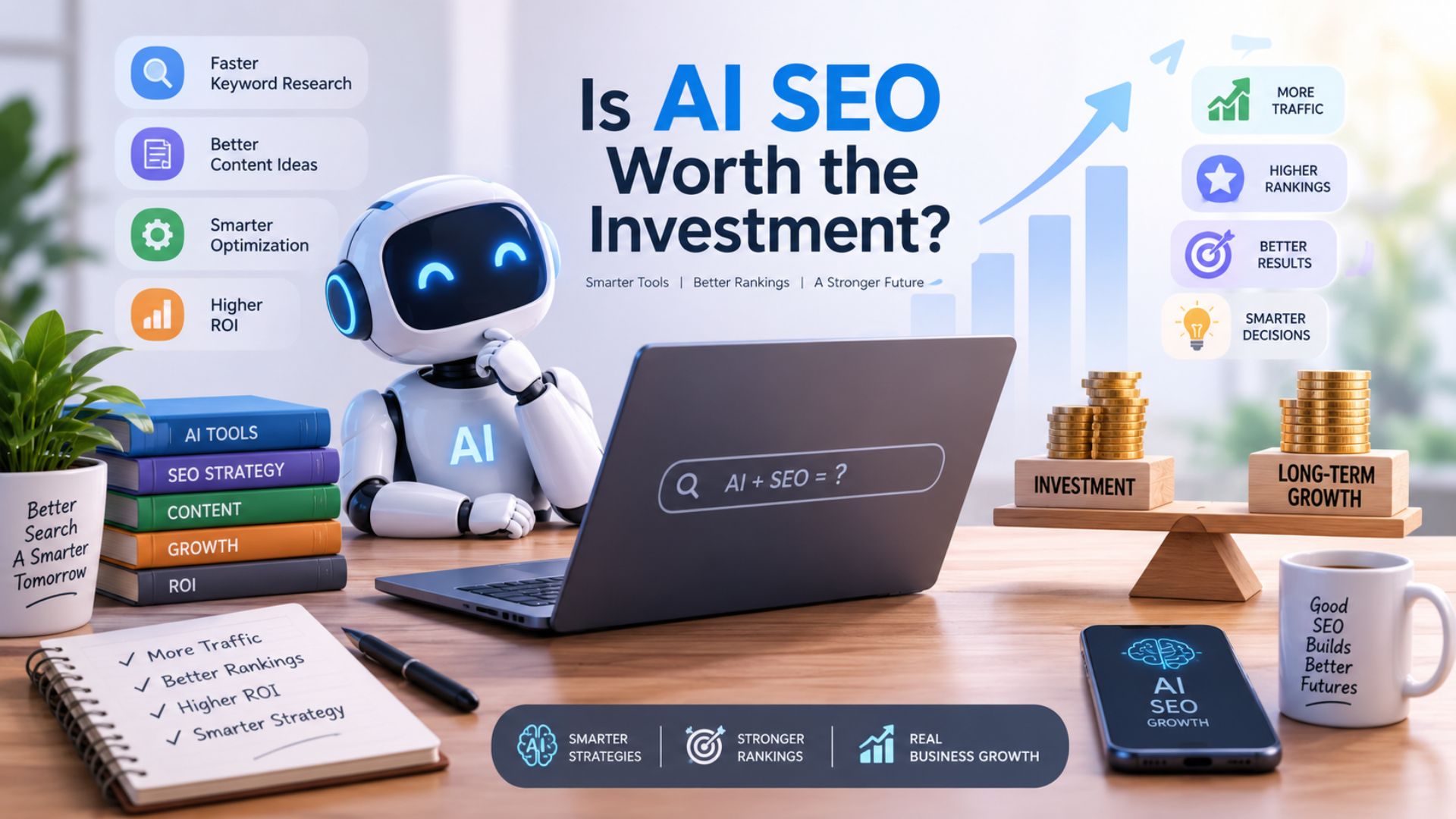

Is AI SEO worth the Investment and Which Tools You Actually Need
The Search engine optimization evolved across the world and has undergone a
seismic shift. For over two decades, digital marketers were following a familiar
playbook: conduct manual keyword research, write comprehensive long-form
content, optimize title tags, and build high-authority backlinks. While these
fundamental principles have become outdated, the mechanics of the search engine
now evaluate content-how audiences consume information-have radically changed.
In the present era, marketing executives, founders, and e-commerce leaders are
grappling with a pivotal question: Is AI SEO worth the investment or is it merely
another transient marketing buzzword? With Google integrating Search Generative Experiences, Open AI search capabilities, and consumers expecting hyper-personalised answers, adopting
smarter seo strategies powered by artificial intelligence without a clear framework
can lead to wasted budget and compromised brand authority.
In this comprehensive article, we will examine the return on investment (ROI) of AI
SEO, break down the top AI tools for SEO, and analyze when businesses should
leverage specialized AI search engine optimization services or partner with a
dedicated AI SEO agency.
Understanding AI SEO: What has Changed?
AI SEO refers to the application of machine learning algorithms, natural language
processing (NLP), and generative AI models to analyze, automate, and optimize
search engine performance.
Traditionally, search engine optimization was heavily reactive. Marketers publish
content, wait weeks or months for indexing and ranking data and then manually
adjust on-page elements. Modern smarter seo frameworks flip this dynamic by
making optimization proactive and predictive.
AI systems can instantly analyze millions of search queries, decode complex the
search pattern, identify content gaps across top-ranking competitors, and predict
how changes in search algorithms might affect organic visibility, Rather than
replacing human intuition, artificial intelligence amplifies human strategic capabilities,
enabling marketing teams to make data-backed decisions at unprecedented speed.
Is AI SEO Worth the investment?
To determine whether AI SEO yields a positive return on investment for US-based
businesses, we just evaluate four key performance drivers:execution velocity,
analytical depth, content scaling, and adaptation to generative search engines.
Velocity and Operational Efficiency:
Time-to-market is critical in competitive US industries such as SaaS, fintech,
real estate,and healthcare. Traditional research-analyzing keyword search
volume, keyword difficulty, user intent, and competitor content structures-can
take dozens of hours.
By using modern ai tools for SEO, marketing teams can easily convert the
hours of manual research into seconds. Automated tools can create topic
clusters, optimize headings, and draft contextual metadata instantly. This
velocity allows brands to publish high-quality targeted content far faster than
competitors using legacy workflows.
Deeper Intent Analysis and Relevance:
Google algorithms are powered by deep neural networks. They do not simply
count keywords, they measure the relevance of the content with the intent of
the users and their satisfaction level.
Using smarter seo techniques allows brands to align their content directly with
these algorithmic standards. AI tools analyze Search Engine Results Pages
(SERPs) in real time, identifying micro intents and related entities that
traditional keyword software often misses. This results in higher search
rankings, improved CTR, and lower bounce rates.
Cost Efficiency at Scale:
Hiring massive in-house content production teams or relying solely on
traditional copywriting agencies can quickly erode marketing budgets. While
human expertise remains indispensable for thought leadership and editorial
oversight, leveraging ai tools for SEO drastically reduces the cost per
published piece. Brands can scale their content strategy without exponentially
increasing their headcount, lowering customer acquisition costs (CAC) over
time.
Preparing for Generative Search Experiences:
The way Americans search is transforming, users are no longer just clicking
the blue links, they ask direct questions to conversational AI assistants and
search platforms. To maintain visibility in a post-traditional SERP environment,
organizations must optimize for Large Language Models (LLM) retrieval.
AI-driven search strategies help ensure that your brand’s cited as a trusted
source within generative answer boxes and AI summary cards
The Core Stack: Best AI Tools for SEO in 2026
Building an effective technology stack is essential for maximizing ROI. here are the
leading categories and ai tools for seo transforming the industry today:
Content Optimization
● Surfer SEO & Clearscope: These platforms use natural language processing
to analyse top performing SERP content. They provide real-time
recommendations on word count, semantic keywords, heading structures, and
content readability.
● MarketMuse: An enterprise-grade platform that analyzes entire website
domains to construct a comprehensive topic authority map, identifying critical
content gaps before you write a single paragraph.
Generative Drafting and Strategic Expansion
● Jasper & CopyAI: Designed for content scaling, these tools help content
teams expand outlines, generate meta descriptions, craft compelling
introductions, and create tailored ad variations while maintaining brand
guidelines.
● ChatGPT & Claude: Versatile LLM engines that can perform complex custom
tasks, such as generating custom schema markup, parsing datasets, running
sentiment analysis on user reviews, and structuring programmatic SEO
templates.
Technical Auditing and Predictive Analytics
● Semrush AI & Ahrefs: Both industry leaders have embedded machine
learning into their core features, enabling automated keywords clustering,
predictive traffic modeling, and instant link-building gap analyses.
● Screaming Frog with AI integrations: Integrates custom API connections to
evaluate thousands of URLs simultaneously for semantic intent alignment,
readability scores, and automated metadata generation.
In-House Execution vs Hiring an AI SEO Agency
Many of the tools are widely available, software alone does not guarantee organic
search growth. Unstructured or unguided use of artificial intelligence can result in
generic content, hallucinated claims, and severe algorithmic penalties for thin
content. This brings US business leaders to a critical crossroad: Should you manage
your tech stack internally or invest in an experienced AI SEO agency?
When In-House Execution Works
Executing the strategy in-house makes sense if your company already possesses:
● A mature content team capable of editing, fact-checking, and elevating AI
drafts.
● Technical SEO engineers who understand structured data, crawl budget
optimization, and site architecture.
● The resources to continuously train personnel on emerging generative
technologies.
The Strategic Value of Professional AI Search Engine Optimization Services
For the enterprise focusing on the growth, partnering with a specialised provider of ai
search engine optimization services yields a significantly higher ROI. Here is why:
● Strategic Prompt Engineering: Leading service providers do not just use
off-the-shelf software, they build proprietary workflows, fine-tune custom AI
models on your brand voice, and integrate advanced API automations.
● Strict E-E-A-T Quality Control: Search engines prioritise experience,
expertise, authoritativeness, and Trustworthiness (E-E-A-T). A top tier AI SEO
agency bridges the gap between machine efficiency and human
subject-matter expertise, ensuring every piece of content meets strict quality
standards and editorial integrity.
● Faster Time-to-Value: Instead of spending six months testing tools and
training staff, an experienced agency provides instant access to tested stacks,
proven frameworks, and senior strategists.
Best Practices for Maximizing Your AI SEO Investment
To make sure that your investment delivers measurable business outcomes, adhere
to these proven strategic principles:
● Focus on the original data and subject matter expertise: AI models excel can
synthesize existing information on the web, but they cannot conduct original
primary research, interview industry leaders, or share real-world customer
case studies. Combine AI efficiency with proprietary company data.
● Optimize for search entities: Transition from traditional keywords stuffing to
topic modeling. Structured content around interconnected entities, enabling AI
search engines to clearly comprehend your authority within your specific
niche.
● Implement Structured Data and Schema Markup: Help search engine
crawlers and generative models parse your pages effortlessly. Rich schema
markup ensures your products, articles, FAQs, and organizational details are
accurately ingested.
The Verdict: Is AI SEO Worth It?
Without question, AI SEO is worth the investment for American businesses aiming to
capture and maintain market share in an increasingly competitive digital landscape.
However, the value is realized not simply by acquiring software, but by deploying
smarter seo strategies that blend automated efficiency with rigorous human
oversight.
By leveraging top-tier AI tools for SEO or partnering with an established AI SEO agency, your enterprise can accelerate content production, capture high-intent
search traffic, and future-proof its digital presence against ongoing search algorithm
updates.
