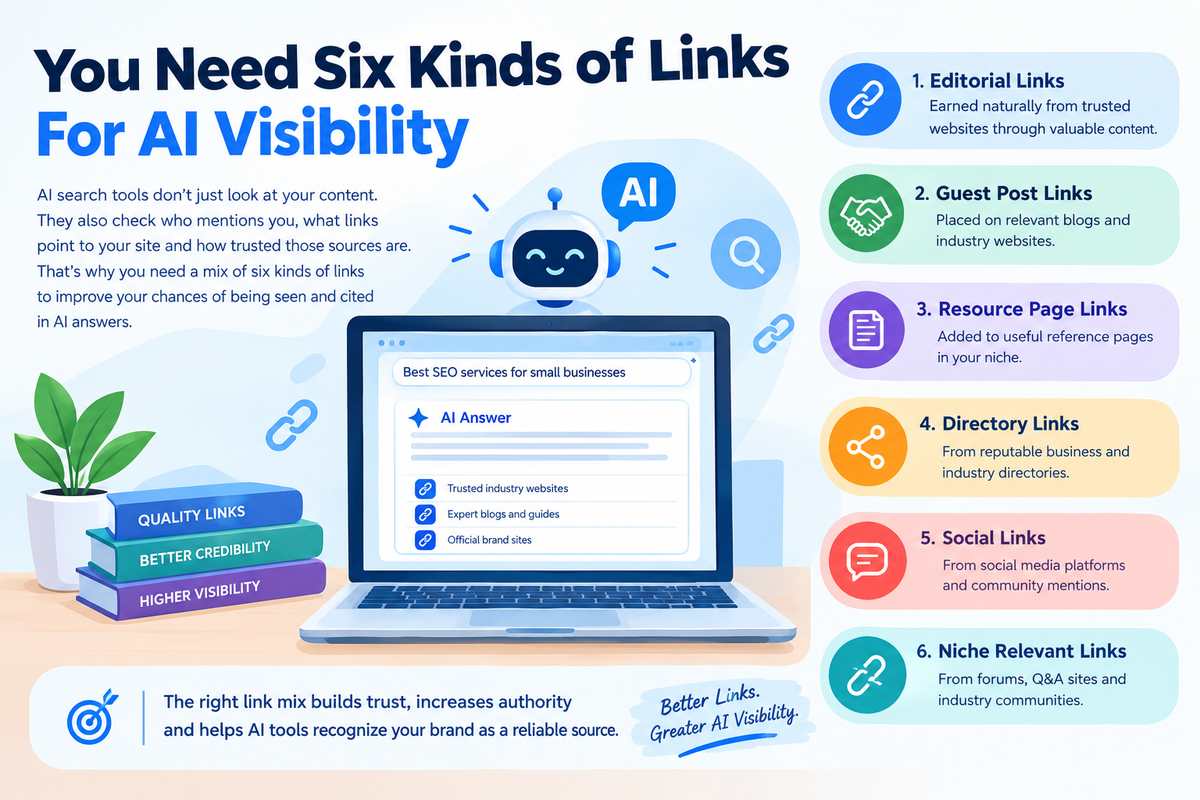

You Need Six Kinds of Links for AI Visibility
AI search is changing how people discover businesses, products, and services. Instead of showing only a list of websites, AI-powered search tools can summarize information and mention sources that help answer a user’s question.
For businesses, this creates a new challenge: getting discovered in both traditional search results and AI-generated answers.
Links can support this goal by helping search engines discover pages, understand connections between websites, and find relevant information. However, AI visibility depends on several factors, including content quality, relevance, accuracy, and how well a website answers users’ questions.
Here are six kinds of links worth considering for a stronger AI visibility strategy.
1. Editorial Backlinks
Editorial backlinks are links that other websites include naturally in their content because they find your information useful.
For example, a marketing website might link to your original research, industry report, or detailed guide while explaining an SEO topic.
Why they matter:
- They can help establish your website’s reputation.
- They can bring relevant visitors to your pages.
- They help connect your content with trusted industry sources.
How to earn them: Publish original research, useful statistics, expert commentary, and detailed guides that other websites have a reason to reference.
2. Links From Relevant Industry Websites
A link from a website related to your industry can be more useful than a link from an unrelated website.
For example, an SEO agency may benefit from relevant digital marketing publications, marketing blogs, and software resource websites.
Why they matter:
- They connect your business with its relevant subject area.
- They can introduce your website to the right audience.
- They support a more natural and relevant backlink profile.
How to build them: Identify websites that cover your industry. Offer useful contributions, share expert insights, or create content that answers questions their readers commonly ask.
Remember that relevance and editorial value matter more than simply collecting links.
3. Brand Mentions and Linked References
Your business may be mentioned online without a clickable link. These are often called unlinked brand mentions.
For example, a marketing publication might mention SEO Outsourcing Company USA while discussing SEO services.
A linked mention gives readers a direct route to your website. An unlinked mention does not provide that same navigation path.
Why they matter:
- They can increase awareness of your brand.
- They may help people discover your business.
- Relevant third-party coverage can strengthen your overall online presence.
What to do: Monitor brand mentions and contact publishers when adding a link would genuinely help their readers. Do not assume that every unlinked mention directly improves AI rankings or citations.
4. Links From Trusted Publications
Coverage from established publications can help people learn about your business through credible sources.
For example, an industry publication might quote your team in an article about search trends or link to your original research.
Why they matter:
- They can expose your brand to a wider audience.
- They may send relevant referral traffic.
- They can provide independent context about your expertise.
How to earn them: Share original findings, offer useful expert comments, and respond to relevant journalist requests. Focus on genuine editorial coverage instead of paying for links that exist only to manipulate rankings.
A publication’s reputation alone does not guarantee that an AI system will cite your business.
5. Internal Links Between Related Pages
Internal links connect different pages on your own website.
For example, an article about AI search optimization could link to your GEO services page, while the services page could link to a detailed guide explaining your approach.
Why they matter:
- They help visitors find related information.
- They help search engines discover and understand important pages.
- They create clearer connections between topics and services.
How to improve them: Link relevant blog posts to useful service pages. Use descriptive anchor text, keep important pages accessible, and avoid adding links that do not help the reader.
Internal links are within your control, making them a practical part of your AI and traditional SEO strategy.
6. Links From Relevant Directories and Business Profiles
Business directories and professional profiles can help people find your company and verify basic information.
Examples include relevant industry directories, professional association listings, and established business profiles.
Why they matter:
- They can improve business discoverability.
- They may provide referral visits.
- Consistent business details can help people verify your company.
How to build them: Choose reputable platforms relevant to your industry or location. Keep your company name, website, services, and contact details accurate.
Avoid submitting your website to hundreds of low-quality directories just to create backlinks. Quality, relevance, and accuracy are more important than the number of listings.
How to Use These Six Link Types Together
You do not need to build all six types at once. Start with a practical plan:
- Improve your website: Create helpful, accurate content and connect related pages with internal links.
- Build relevant relationships: Reach out to industry websites and publications that cover your subject.
- Earn editorial coverage: Share original research, expert insights, and useful resources.
- Maintain business profiles: Keep your company information consistent across reputable platforms.
- Monitor your mentions: Find relevant brand mentions and identify opportunities for useful links.
- Review results: Track referring domains, backlink quality, referral visits, search visibility, and relevant brand mentions over time.
Do not judge success only by the number of backlinks. Look at whether the links are relevant, whether they bring useful visitors, and whether your content is becoming easier to discover.
Do Links Directly Improve AI Visibility?
There is no publicly confirmed formula showing that these six link types guarantee citations in AI-generated answers. AI search systems use different methods to retrieve, evaluate, and present information, and their exact processes vary.
Links remain a useful part of a broader strategy, but they should work alongside clear content, factual accuracy, technical accessibility, relevant expertise, and a strong website structure.
Create content that answers real questions, make important pages easy to find, and earn links because your information deserves to be referenced.
Conclusion
AI visibility is not about collecting as many backlinks as possible. It is about building a credible online presence that people and search systems can discover and understand.
Editorial backlinks, industry-relevant links, brand mentions, trusted publication coverage, internal links, and reputable business listings can all play useful roles in that strategy. None guarantees an AI citation, so combine link building with helpful content and sound SEO practices.
SEO Outsourcing Company USA can help businesses strengthen their online presence through link building, content optimization, and SEO services designed to support long-term search visibility. A consistent, quality-focused strategy can help your business build stronger connections across the web.
