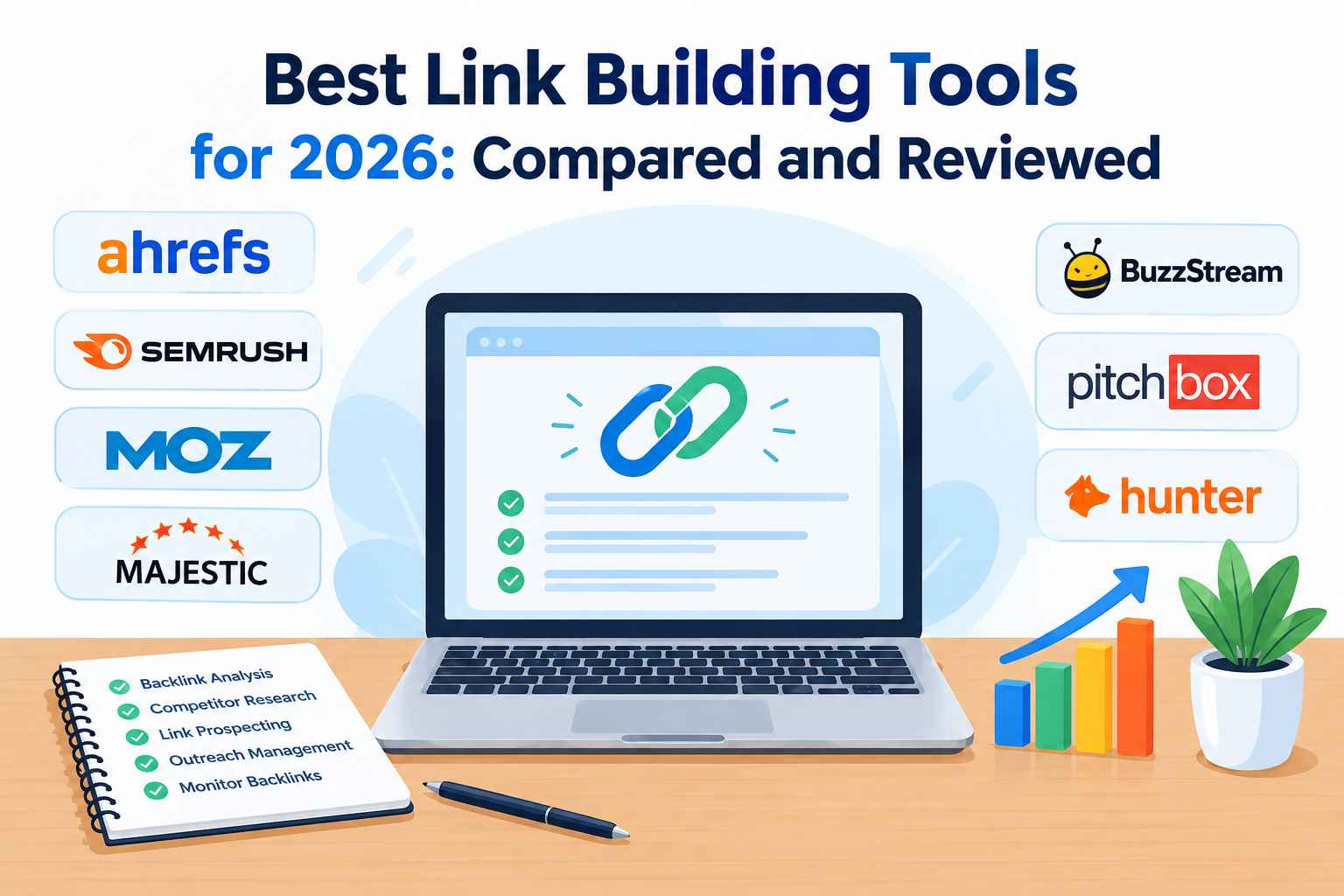

Best Link Building Tools for 2026: Reviewed and Compared
Link building remains an important part of SEO. However, finding quality backlink opportunities takes time. SEO professionals need to research competitors, identify relevant websites, find contact details, manage outreach, and monitor acquired backlinks.
This is where link building tools become useful. They help SEO teams find opportunities, analyze backlink profiles, and organize campaigns more efficiently.
But which tool should you choose in 2026? Some platforms focus on backlink analysis, while others specialize in email outreach and relationship management.
In this guide, we compare seven popular link building tools to help you choose the right option for your SEO goals.
1. Ahrefs: Best for Backlink Analysis
Ahrefs is a popular SEO platform for researching competitor backlinks and discovering link building opportunities.
Key features:
- Analyze backlinks and referring domains.
- Find websites linking to competitors but not to you.
- Discover link opportunities through Content Explorer.
- Identify broken backlinks and lost link opportunities.
- Monitor changes in backlink profiles.
Pros: Strong backlink research capabilities, useful competitor analysis, and helpful content discovery features.
Cons: Some advanced reports require higher-tier plans. It does not replace a dedicated email outreach platform.
Best for: SEO professionals who want to study competitor backlinks and build targeted prospect lists.
Website: Ahrefs
2. Semrush: Best for All-Round SEO and Link Building
Semrush offers backlink analysis alongside keyword research, competitor research, site audits, and link building workflows.
Key features:
- Analyze competitor backlink profiles.
- Find backlink gaps between websites.
- Audit backlinks and monitor changes.
- Identify potential outreach opportunities.
- Track link building campaign progress.
Pros: Combines several SEO activities in one platform. Its backlink gap features can help identify relevant websites that link to competitors.
Cons: The range of features can take time to learn. Costs can increase when you need additional tools or higher usage limits.
Best for: Agencies and SEO teams that want backlink research and broader SEO analysis in one platform.
Website: Semrush
3. Moz Pro: Best for Beginners and Link Quality Research
Moz Pro offers backlink research tools that help users understand their link profiles and compare them with competitors.
Key features:
- Discover backlinks and linking domains.
- Compare competitor link profiles.
- Review Domain Authority and Page Authority metrics.
- Use Spam Score as one signal during backlink evaluation.
- Track link profile changes.
Pros: Provides familiar SEO metrics and a straightforward way to compare websites.
Cons: Domain Authority is a third-party metric, not a Google ranking factor. Its scores should not be treated as proof that a backlink will improve rankings.
Best for: Beginners and marketers who want an accessible way to research backlinks and compare potential opportunities.
Website: Moz
4. Majestic: Best for Specialized Backlink Analysis
Majestic focuses heavily on backlink intelligence. It provides its own metrics to help SEO professionals understand the strength and structure of link profiles.
Key features:
- Explore backlinks and referring domains.
- Review Trust Flow and Citation Flow.
- Investigate competitor link profiles.
- Examine link context and linking patterns.
Pros: Specialized backlink analysis and metrics designed for link research.
Cons: It is more focused on backlinks than on complete SEO workflows. Beginners may need time to understand its metrics.
Best for: Experienced SEO professionals who want deeper backlink research and another perspective on link quality.
Website: Majestic
5. BuzzStream: Best for Outreach Management
BuzzStream helps SEO professionals organize link outreach and maintain relationships with website owners, bloggers, and publishers.
Key features:
- Organize outreach prospects.
- Manage contact information and conversations.
- Track outreach campaigns.
- Schedule and manage follow-ups.
- Keep campaign records in one place.
Pros: Useful for managing large prospect lists and keeping outreach organized across a team.
Cons: It is not a replacement for a large backlink research database. You may need another tool to discover and evaluate prospects.
Best for: Agencies and teams running ongoing guest posting, digital PR, and link outreach campaigns.
Website: BuzzStream
6. Pitchbox: Best for Large-Scale Link Building Campaigns
Pitchbox is an outreach and link building platform designed for teams that manage campaigns at scale.
Key features:
- Discover and organize link prospects.
- Manage personalized outreach.
- Automate follow-up workflows.
- Coordinate team activities.
- Monitor campaign progress.
Pros: Supports structured workflows for teams managing multiple campaigns.
Cons: It may be more than a freelancer or small business needs. Costs and setup requirements should be checked before committing.
Best for: Agencies and larger teams that need organized, scalable outreach workflows.
Website: Pitchbox
7. Hunter: Best for Finding Email Addresses
Hunter helps users discover professional email addresses associated with websites and verify whether addresses are likely to be deliverable.
Key features:
- Find email addresses connected to a domain.
- Search for professional contacts.
- Verify email addresses.
- Support outreach list preparation.
Pros: Useful for finding the right contact before sending a link request or collaboration pitch.
Cons: It does not provide the same depth of backlink analysis as Ahrefs or Semrush. Email discovery also does not guarantee a response or a backlink.
Best for: SEO professionals who already have a prospect list and need help finding contact details.
Website: Hunter
Link Building Tools Compared
| Tool | Main strength | Best suited for |
|---|---|---|
| Ahrefs | Backlink research | Competitor analysis |
| Semrush | SEO and backlink workflows | SEO agencies |
| Moz Pro | Link metrics and comparisons | Beginners |
| Majestic | Specialized link intelligence | Experienced SEOs |
| BuzzStream | Outreach management | Small and medium teams |
| Pitchbox | Scalable outreach | Larger agencies |
| Hunter | Email discovery | Outreach prospecting |
How to Choose the Right Link Building Tool
Before paying for a subscription, identify the main problem you want to solve.
- For backlink analysis: Start by comparing Ahrefs and Semrush.
- For competitor research: Look for backlink gap and referring domain reports.
- For email outreach: Consider BuzzStream or Pitchbox.
- For contact discovery: Hunter can help prepare outreach lists.
- For specialized link metrics: Explore Majestic or Moz Pro.
You do not need every tool. One backlink research platform and one outreach tool may be enough for many campaigns.
Check current pricing, usage limits, export allowances, and available features on each provider’s official website before purchasing.
What Should You Check Before Building a Backlink?
A tool can identify potential websites, but you still need to evaluate each opportunity.
Check whether the website is relevant to your industry, publishes useful content, attracts a genuine audience, and offers a natural place for your link.
Do not judge a website only by Domain Authority, Domain Rating, or another third-party score. These metrics help with comparisons, but they do not guarantee ranking improvements.
Avoid paid link schemes and excessive link exchanges designed primarily to manipulate rankings. Follow Google’s link spam policies when planning your campaign.
Conclusion
The best link building tool for 2026 depends on your workflow. Ahrefs and Semrush are strong options for backlink research, Moz and Majestic offer alternative ways to evaluate link profiles, while BuzzStream, Pitchbox, and Hunter help with outreach and contact discovery.
The goal is not simply to build more backlinks. It is to find relevant opportunities, earn useful links, and monitor campaign progress.
At SEO Outsourcing Company USA, we help businesses improve their search visibility through backlink research, link building, keyword research, on-page SEO, technical SEO audits, and content optimization. Our focus is on relevant link opportunities and sustainable SEO practices that support long-term growth.
