
The New Era of Generative AI Search (GEO)
Search engines are changing how people find information online. Earlier, users searched for a keyword, opened different websites, and compared the information themselves. Today, AI-powered search tools can provide direct answers, summarize information, and show links to useful sources.
This change has created a new area of digital marketing called Generative Engine Optimization (GEO).
GEO focuses on improving a brand’s visibility in AI-generated answers across search experiences. Instead of focusing only on traditional search rankings, businesses also want their content to be understood, referenced, and recommended by AI-powered search systems.
But what does GEO mean for businesses, and how can websites prepare for this new era of search? Let’s explore.
What Is Generative Engine Optimization (GEO)?
Generative Engine Optimization is the process of improving website content so that AI-powered search systems can understand it and potentially use it when answering users’ questions.
These systems may summarize information from multiple sources and provide links to websites that support their answers.
For example, someone might ask an AI search tool, “Which SEO agency can help a small business improve its website visibility?”
Instead of showing only a list of websites, the tool may provide a summarized response with relevant sources. Businesses want their websites to be among the useful sources considered for such answers.
GEO helps businesses work toward this visibility by focusing on helpful content, clear information, website accessibility, and credibility.
However, no GEO strategy can guarantee that an AI platform will mention or recommend a particular brand.
How Is GEO Different From Traditional SEO?
Traditional SEO focuses on improving a website’s visibility in search results. GEO focuses on visibility within AI-generated responses.
Both approaches share many important practices.
| Traditional SEO | GEO |
|---|---|
| Focuses on organic search visibility | Focuses on visibility in AI-generated answers |
| Optimizes pages for relevant search queries | Helps AI systems understand useful, relevant information |
| Uses keyword research and on-page SEO | Uses clear content that answers user questions |
| Builds technical website health | Relies on accessible, understandable website content |
| Tracks rankings, clicks, and impressions | Also considers AI mentions, citations, and referral visits where measurable |
GEO does not replace SEO. Google’s official guidance confirms that foundational SEO practices remain relevant to its generative AI search features. <Link url=”https://developers.google.com/search/docs/fundamentals/ai-optimization-guide” title=”Google’s guide to generative AI search optimization”/> explains how useful content and technical SEO support search visibility.
Why Is GEO Important for Businesses?
1. People Are Using AI to Find Answers
Users increasingly interact with AI-powered search experiences to research products, compare services, and understand complex topics.
Businesses that publish useful information have an opportunity to reach these users through AI-generated responses, although visibility is never guaranteed.
2. Search Visibility Is Changing
A business may appear in traditional search results but not be mentioned in an AI-generated answer. Similarly, an AI answer may reference a website that the user would not otherwise have discovered.
This makes it useful to monitor both traditional search performance and available AI visibility data.
3. Helpful Content Can Build Brand Trust
When a website provides clear answers, original insights, and accurate information, it gives readers a reason to trust the brand.
Content that genuinely helps people can support both traditional SEO and GEO efforts.
4. Businesses Can Reach Users During Research
AI search tools can help users compare different solutions before making a decision. Detailed service pages, practical guides, and clear explanations can help businesses communicate their expertise during this process.
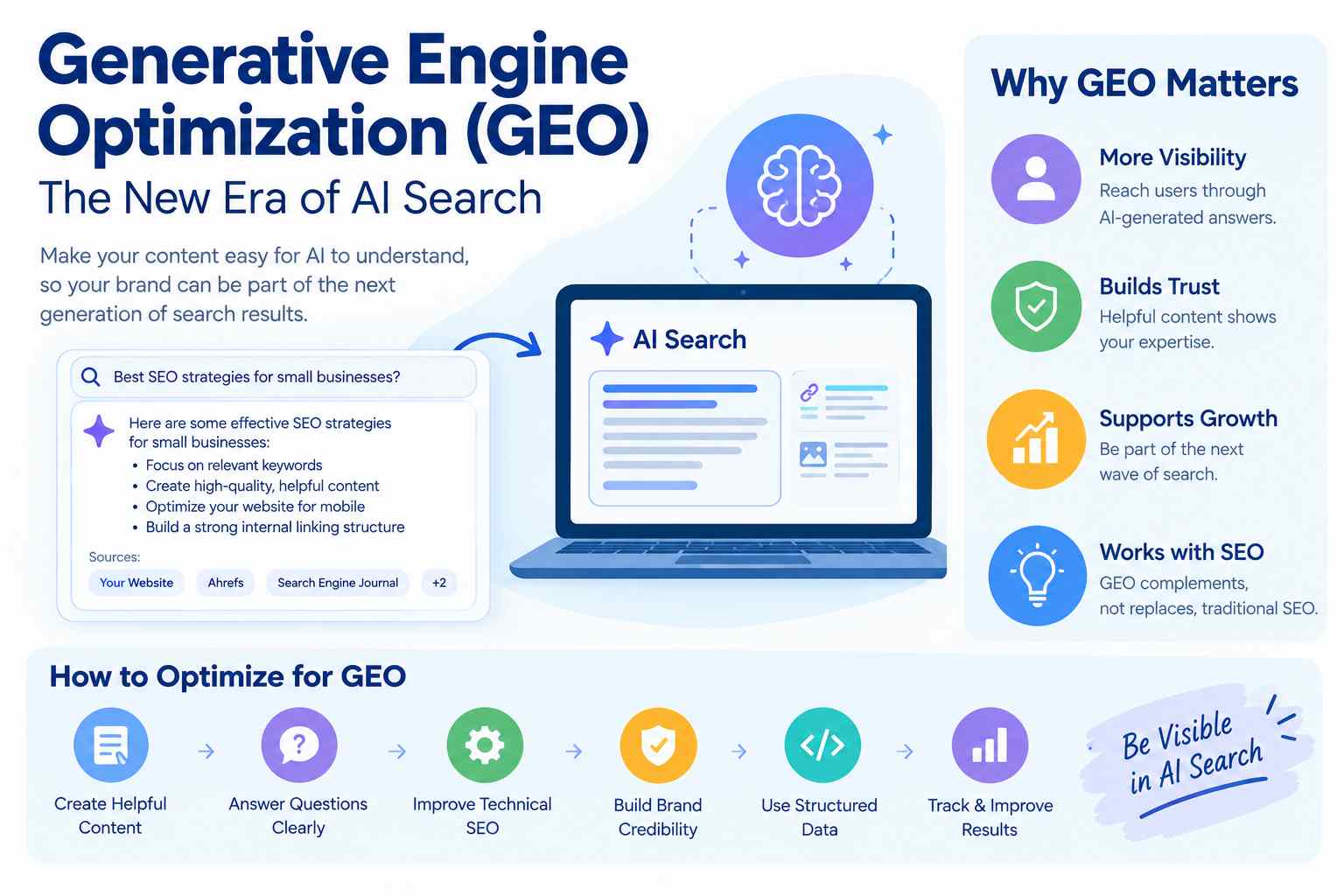
How to Optimize Your Website for GEO
1. Create Helpful, Original Content
Content should provide something useful beyond repeating information already available online.
Include practical examples, original insights, real experience, and clear explanations. Answer the main question directly, then provide supporting details.
For example, an SEO agency writing about technical SEO could explain common website errors, how to identify them, and how they can be fixed.
Google recommends creating valuable, distinctive content that serves people rather than producing generic pages mainly to gain search visibility.
2. Answer Questions Clearly
Many people use AI search to ask complete questions rather than type short keywords.
Organize your content around the questions your audience genuinely asks. Use descriptive headings, concise explanations, examples, and FAQs where they help readers.
Avoid adding unnecessary questions or repeating the same answer in multiple sections just to target more queries.
3. Maintain Strong Technical SEO
AI search visibility still depends on whether relevant systems can access and understand your content.
Review your website for:
- Crawlability and indexing problems
- Broken links and incorrect redirects
- Clear internal linking
- Mobile usability
- Page loading issues
- Accurate titles and headings
- Useful, descriptive image content
For Google’s AI search features, pages generally need to be indexed and eligible to appear with a search snippet. Meeting technical requirements does not guarantee that a page will be selected for an AI-generated answer.
4. Build Brand Credibility
Publish accurate information and keep important business details consistent across your website and relevant public profiles.
Show your experience through case studies, author information, original research, customer examples, and useful resources where appropriate.
Earn relevant mentions and backlinks through genuine industry relationships and valuable content. Avoid buying artificial mentions or creating spammy links to influence AI recommendations.
5. Use Structured Data Correctly
Structured data helps search engines understand specific information about a webpage. Depending on the page, relevant markup may describe an organization, product, article, or other supported content type.
Make sure the markup matches the information visible on the page.
There is no special schema markup that guarantees inclusion in generative AI answers. Use structured data as part of a sound SEO strategy rather than treating it as a GEO shortcut.
6. Track Results and Improve
Measure performance using available tools and meaningful business outcomes.
Google Search Console can help you review search impressions, clicks, and queries. Website analytics can help you understand referral visits and user activity. Where supported, AI visibility tools may help track brand mentions or citations across selected platforms.
Remember that third-party AI visibility measurements may not represent every user or every response. Use them as directional information rather than guaranteed measures of success.
Common GEO Mistakes to Avoid
- Publishing generic content: Repeating common information without adding value makes your website less distinctive.
- Stuffing keywords: Unnatural keyword repetition can make content difficult to read.
- Creating pages in bulk: Publishing large numbers of similar pages without meaningful value can violate Google’s scaled content abuse policies.
- Relying only on schema: Structured data cannot guarantee AI citations.
- Ignoring traditional SEO: Poor indexing, broken links, and inaccessible content can limit your search visibility.
- Expecting guaranteed mentions: No agency or tool can guarantee that every AI platform will recommend your business.
Conclusion
Generative Engine Optimization is becoming an important consideration for businesses that want to improve their visibility in AI-powered search experiences. The best starting point is not complicated: create useful content, maintain a technically healthy website, demonstrate genuine expertise, and make information easy for people to understand.
GEO works alongside traditional SEO rather than replacing it. Businesses that invest in quality content and sustainable optimization practices can build a stronger foundation for changing search experiences.
At SEO Outsourcing Company USA, we help businesses improve their online presence through keyword research, on-page SEO, technical SEO audits, content optimization, and link building. Our approach focuses on useful content, website health, and long-term search visibility to help businesses adapt as search continues to evolve.
