
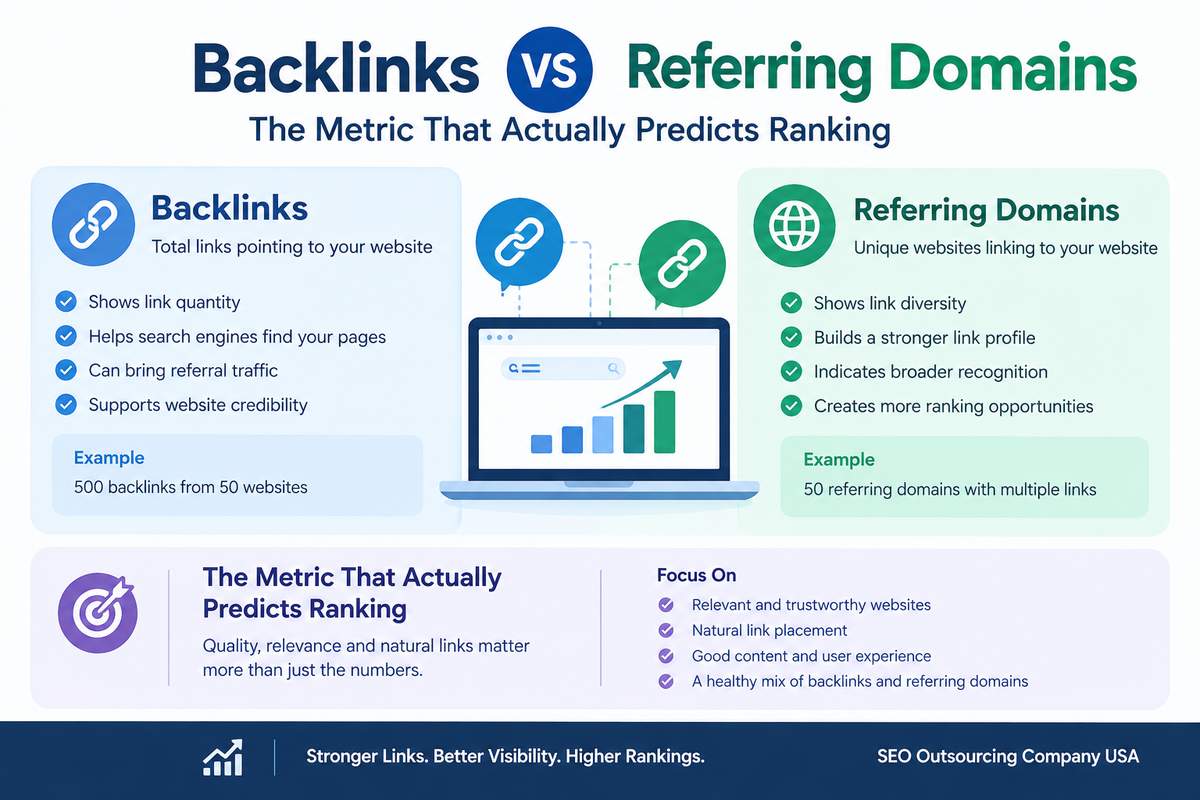

Backlinks vs. Referring Domains: The Metric That Actually Predicts Ranking
Backlinks and referring domains are two important SEO metrics. Both help you understand your website’s link profile, but they measure different things.
Backlinks count the links pointing to your website. Referring domains count the unique websites linking to it.
Getting more backlinks may seem like the best way to improve SEO. However, links from relevant, trustworthy websites can be more valuable than multiple links from the same source.
Let’s understand the difference between backlinks and referring domains, which metric matters more, and how to use both for better SEO results.
What Are Backlinks?
A backlink is a link from another website that points to your website.
For example, a marketing blog publishes an article about SEO tools and includes a link to your website. That link is a backlink.
Why Are Backlinks Important?
Backlinks can help you:
- Support search visibility: Relevant backlinks can contribute to SEO performance.
- Attract visitors: People can click links to visit your website.
- Help search engines discover pages: Links can help search engines find content.
- Build credibility: Links from trusted websites can help people discover your business.
Not every backlink has the same value. A relevant editorial link may be more useful than a link from an unrelated or low-quality page.
What Are Referring Domains?
A referring domain is a unique website that links to your website.
For example, if three different websites link to your website, you have three referring domains. If one website links to you ten times, your backlink count increases, but your referring domain count remains one for that website.
Why Are Referring Domains Important?
Referring domains help you understand how many different websites link to your content.
They help you:
- Measure the diversity of your backlink profile.
- Compare your link profile with competitors.
- Identify websites that mention your business.
- Discover guest posting, outreach, and digital PR opportunities.
A higher number of relevant referring domains can indicate broader recognition across websites. However, quality matters more than quantity alone.
Backlinks vs. Referring Domains: Key Differences
| Feature | Backlinks | Referring Domains |
|---|---|---|
| Meaning | Total links pointing to your website | Unique websites linking to your website |
| Measures | Link quantity | Diversity of linking websites |
| Example | 500 links | 100 unique websites |
| Main benefit | Shows the total number of incoming links | Shows how widely your website earns links |
| Common tools | Ahrefs, Semrush | Ahrefs, Semrush |
| Limitation | Many links may come from one domain | More domains do not guarantee better quality |
In simple words: Backlinks show how many links you receive. Referring domains show how many different websites provide those links.
Example: Why Referring Domains Can Matter More
Imagine two websites have these backlink profiles.
Website A
- 500 backlinks
- 15 referring domains
Website B
- 250 backlinks
- 100 referring domains
Website A has more backlinks, but many links come from the same websites. Website B has links from a wider range of domains.
Website B may have a more diverse link profile, especially if those domains are relevant and trustworthy.
However, Website B will not automatically rank higher. Google rankings depend on several factors, including content quality, search intent, competition, technical SEO, and link relevance.
This example shows why backlink count alone cannot tell you how strong a website’s SEO performance is.
Which Metric Actually Predicts Rankings?
Neither backlinks nor referring domains can reliably predict rankings on their own.
The quality and relevance of your links matter more than simply increasing the numbers.
Consider these factors when reviewing your backlink profile:
1. Quality of Linking Websites
Check whether the website publishes useful content and serves a genuine audience. Do not judge a website only by its authority score.
2. Website Relevance
Links from websites related to your industry can provide useful context. For example, a digital marketing blog linking to an SEO agency’s guide is relevant.
3. Natural Link Placement
Editorial links placed naturally within useful content can help readers discover related information. Avoid link-building schemes designed to manipulate rankings.
4. Link Attributes
Links may include attributes such as nofollow, sponsored, or ugc. These describe the relationship between the linking website and the destination. Not all links pass the same ranking signals.
5. Overall Website Quality
Backlinks cannot solve every SEO problem. Your website also needs useful content, proper indexing, accessible pages, and a good user experience.
How to Check Backlinks and Referring Domains
You can use Ahrefs or Semrush to review your website’s backlink profile.
Step 1: Enter Your Website URL
Open your SEO tool and enter your domain.
Step 2: Open the Backlink Report
Review total backlinks, referring domains, linking pages, and available link attributes.
Step 3: Check Link Quality
Look for relevant websites with useful content and genuine audiences.
Step 4: Compare Competitors
Review competitors ranking for your target keywords. Identify relevant websites linking to them but not to you.
Step 5: Find Opportunities
Use your findings to plan content promotion, outreach, guest contributions, and digital PR.
Remember that SEO tools use their own databases and estimates. Backlink counts may differ between tools.
Common Mistakes to Avoid
- Chasing backlink numbers: More links do not automatically mean better rankings.
- Ignoring referring domains: Thousands of backlinks may come from only a few websites.
- Focusing only on authority scores: Third-party scores are useful for comparisons but are not direct Google ranking factors.
- Building irrelevant links: Prioritize links that make sense for your industry and audience.
- Ignoring link quality: Review your backlink profile regularly and investigate unusual patterns before taking action.
Best Practices for a Strong Backlink Profile
- Publish useful content that other websites want to reference.
- Build relationships with relevant websites.
- Use ethical guest posting and digital PR.
- Prioritize quality referring domains over unnecessary link volume.
- Monitor new and lost backlinks.
- Review competitor backlink profiles for genuine opportunities.
- Avoid paid link schemes intended to manipulate search rankings.
The goal is not to collect the highest number of backlinks. It is to earn relevant links that support your website’s visibility and help users find useful information.
Conclusion
Backlinks measure the total number of incoming links, while referring domains measure the number of unique websites linking to you. Both metrics are useful, but neither guarantees higher rankings.
Focus on link quality, relevance, domain diversity, and natural link acquisition. Combine these efforts with content optimization and technical SEO for a stronger SEO strategy.
At SEO Outsourcing Company USA, we help businesses improve online visibility through link building, backlink analysis, keyword research, on-page SEO, and technical SEO.
Visit SEO Outsourcing Company USA to explore our SEO services and strengthen your website’s search visibility.
