
Latest Google Algorithm August Spam Update
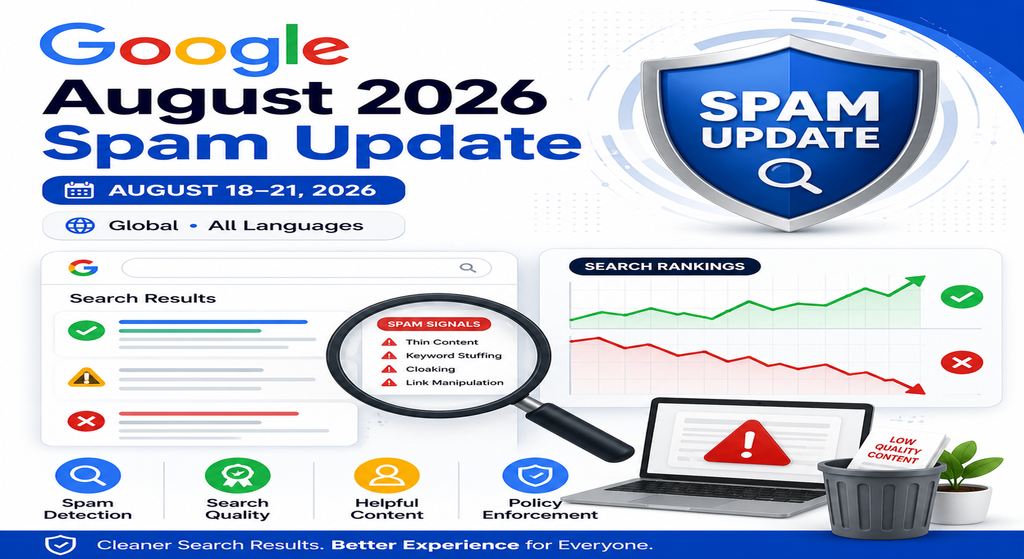
With its August 2026 Spam Update, Google has made an important modification in its search engines. The update launched on August 18, 2026, and concluded on August 21, 2026. Google has confirmed the launch of the update everywhere in the world and in all languages.
For website owners as well as SEO specialists, Google updates make some anxiety since even some small changes in search ranks can influence website traffic as well as sales. However, before applying fundamental changes to the SEO strategy, it is very important to understand the aim of the update.
The August update is officially classified as a spam update rather than a broad core update. Google has not disclosed any particular type of spam dealt with in this update but it is the next step in the constant process of making improvement in the ability of the search engines in recognizing and minimizing spam in search.
What is the Google August spam update?
Google is always enhancing its automated systems capable of detecting sites and content that violate the spam policies. Whenever Google significantly enhances its detection systems, it may declare it a spam update.
The spam update for August 2026 came into effect on 18 August and completed by 21 August. According to Google’s Search Status Dashboard, it took approximately two days and sixteen hours for Google to complete it. This update is neither the global update nor the core update.
This update takes a more focused approach toward Google’s spam detection systems rather than being a core update that is aimed at numerous systems at once. Hence, any observed change in ranking during this period does not imply that the website has been subjected to any penalties.
Why does Google release spam updates?
Google aims to ensure that its search results give useful and pertinent information to the users. Yet, certain websites employ strategies aimed mostly to distort rankings without providing adequate value to users.
Spam techniques can be understood as misleading methods, useless autogenerated content, keyword usage and other unethical methods violating Google requirements.
Spam updates contribute to Google’s ability to detect such practices. The conclusion for businesses is evident. SEO has to be built around real value rather than shortcuts.
Does the update target AI content?
The introduction of the concept of AI generated content has garnered attention from SEO discussions. This increase in interest has been mainly due to some of the recent changes introduced by Google. Despite this, the search engine has not made any statement regarding AI generated content being the focus of the Spam Update that was rolled out in August 2026.
When it comes to content creation, the content quality and the content purpose are key elements. Just because a piece of content was created using AI, it is not considered to be spam by default. Low-quality content is usually produced by business owners who are trying to take advantage of the automation process and easy channels of creating content in order to optimize their website for search.
The idea is that if a company utilizes AI to generate content, it still needs to make sure that the content and the data used are accurate and include useful information derived from some real-life experience, examples, or even unique information.
Who could be affected?
Google has not mentioned in particular what industry or website type has been affected by the latest spam update that occurred in August.
Nevertheless, websites that practice some forms of manipulative SEO can be more susceptible to the improvements in Google’s filter.
As a result, companies are recommended to check the pages that lack relevant content, use an excessive amount of keywords, and were created mainly for the search engines.
At the same time, and it should be noted that just because the website ranking goes down does not mean that the spam is the reason behind it, as the search performance may change due to competitors, search demand, indexing and technical issues, or other Google systems.
What would you do if rankings dropped?
In case your site faced a drop following August 18, make sure to monitor your Google Search Console statistics.
Make a comparison between your metrics before and after the update to analyze the clicks, impressions, average positions, and the keywords sending traffic to your site.
You also need to decide whether the decline affected the entire website or the specific pages of it. If only certain pages suffered, check their content and understand whether or not it fulfills the purpose of the search.
Analyze whether the information is reliable, helpful, relevant, and easily understandable. Moreover, perform an analysis of all technical aspects of your website – indexing, internal linking, redirects, duplicates, and accessibility.
Avoid making major changes till you know for sure what is the reason for the problem.
Do not panic after an algorithm update
One prevalent error made following a Google update relates to making decisions in haste because of panic.
Website owners may remove material, modify pages, change phrases or start constructing links without understanding what led to changes in the rankings and so they could confuse the issue..
Rather it would be better to monitor the data and discover any noticeable trends. Once the August update has already taken place, companies could compare their performance before and after the update.
Whenever issues are detected, improvements should be made to enhance the quality of the website instead of finding any ranking hack.
Focus on useful content
When it comes to search engine optimization, the safest way is still to write content for humans first before anything else.
Every single page on a website has to have a clear goal and share relevant information, which is really going to aid a visitor. A services page sets out the services clearly while blog content is supposed to answer the questions the audience has.
Articles shouldn’t be written just when a certain keyword has a high search volume. The emphasis should actually be put on useful insights, genuine examples, useful advice leading to real value for consumers.
Content must also be easy to read since the page should contain informative headings, short paragraphs, internal links, and simple language used throughout the content.
Review your website regularly
Companies should not put off the assessment of their SEO results before they get an algorithm refresh.
Consistent website audits can reveal technical difficulties, dead connections, issues with indexing, duplicate material, and pages that ought to be enhanced.
Outdated content should be updated regularly. If some page loses its value, check if you can refresh or merge it with a related page.
Systematic checking provides organizations with the opportunity to recognize problems in good time.
What does the August update mean for SEO?
The newest update on Google’s spam algorithm is a reminder that search engine optimization is a long term project.
The company completed rolling out the update on August 21, 2026, announcing that it had been implemented globally and in all the spoken languages. Google has not provided the public with information about any specific passive spam forms related to this update, so it is advised to watch out for any misleading reports about what the company intends to target.
The best approach in this situation would be to check the statistics of the site, study Google’s spam policies, and enhance your content and technical quality if needed.
Final thoughts
There is no reason to panic when it comes to the August spam update. Businesses need to evaluate the state of their site, work on enriching weak content, conduct technical SEO and avoid any shady practices when creating their websites.
As Google progresses further, long lasting SEO becomes more important than ranking tricks.
The mission of an SEO outsourcing service provider is to help businesses establish a strong web presence and achieve the maximum return on their investment.
