
Google Search is changing as artificial intelligence becomes a bigger part of how people find information online. Instead of showing only a list of websites, Google can now provide AI-generated answers with links to relevant sources.
One important development is Google AI Mode, which helps users explore complex questions, compare options, and ask follow-up questions without starting a completely new search each time.
For businesses, this creates new opportunities to reach potential customers. Websites need useful content, strong technical SEO, and clear information to improve their chances of appearing in search results and AI-generated answers.
What Is Google AI Mode?
Google AI Mode is an AI-powered search experience that provides detailed answers to users’ questions and links to websites where they can learn more.
For example, someone looking for an SEO agency might ask:
“How do I choose an SEO agency for my small business, and which services should I compare?”
Instead of searching separately for SEO services, pricing, and agency selection tips, the user can explore these topics through one detailed question and follow-up searches.
AI Mode helps users research topics, compare options, and discover information from different sources. However, appearing in an AI-generated answer is not guaranteed for any website.
How Does Google AI Mode Work?
1. It Understands the User’s Question
AI Mode is designed to understand detailed questions, including those involving several requirements.
For example, a user might ask for affordable SEO services for a small business, including technical audits, content optimization, and link building.
The system can use these details to help identify relevant information.
2. It Searches for Related Information
Google uses an approach called query fan-out for its AI search experiences. This allows it to break a complex question into related searches and explore different subtopics.
For example, a question about choosing an SEO agency could involve searches related to technical SEO, link building, pricing, and agency experience.
This approach helps Google explore different aspects of a question and find potentially useful sources.
3. It Generates an AI-Powered Answer
AI Mode combines relevant information to create a response that addresses the user’s question.
The answer may include explanations, comparisons, and suggestions. AI systems can make mistakes, so users should verify important information using reliable sources.
4. It Shows Relevant Website Links
AI Mode can display links to web pages that help users explore a topic in greater detail.
This gives businesses an opportunity to attract visitors through useful content. However, having a page indexed or ranking in traditional search does not guarantee that AI Mode will cite it.
AI Mode vs. Traditional Google Search vs. AI Overviews
These Google Search experiences are related, but they serve different purposes.
| Feature | Traditional Google Search | AI Overviews | Google AI Mode |
|---|---|---|---|
| Main purpose | Find relevant web pages | Provide a quick AI summary | Explore questions in greater depth |
| Results | Mainly a list of links | AI summary with supporting links | Detailed AI responses with relevant links |
| Follow-up questions | Usually require another search | Depends on the available experience | Designed for continued exploration |
| Best use | Finding specific websites | Understanding a topic quickly | Researching and comparing options |
How Can SEO Prepare for Google AI Mode?
Businesses do not need to abandon traditional SEO. Google recommends following its existing SEO best practices for AI search features. There is no special schema or separate AI optimization requirement that guarantees inclusion.
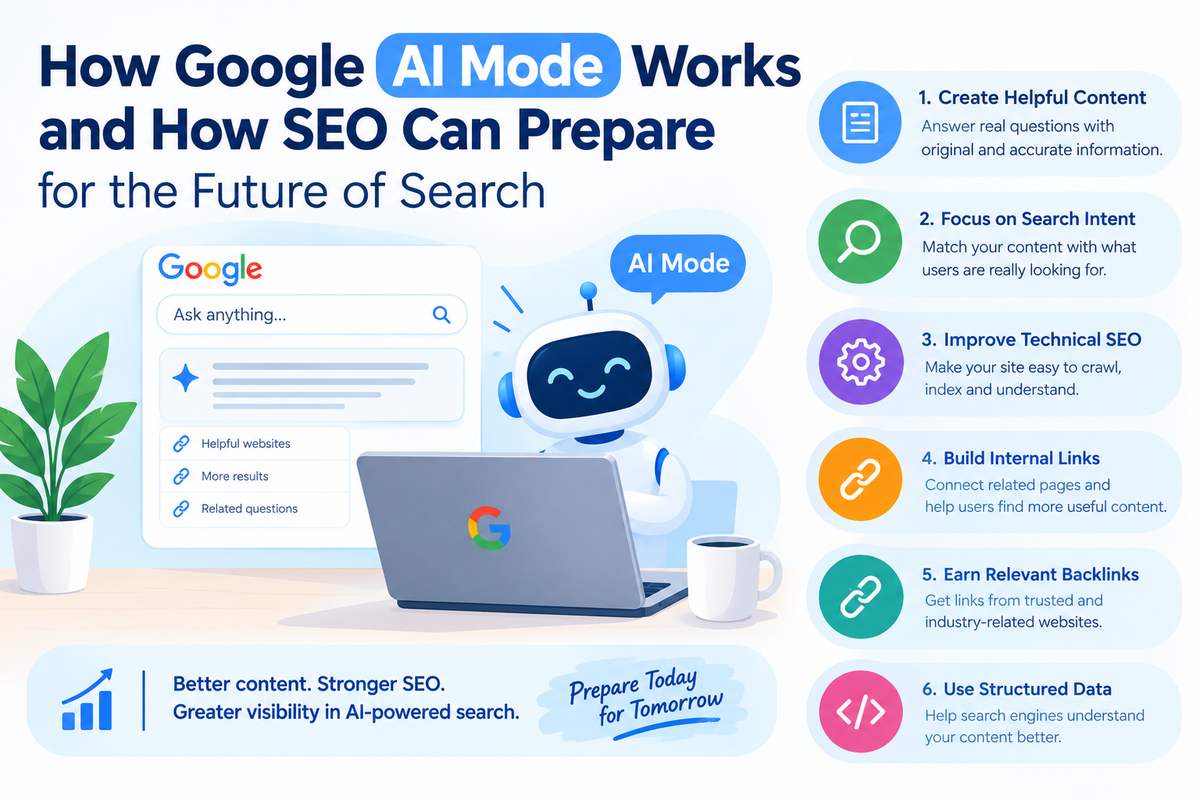
Here are six practical ways to prepare your website.
1. Create Helpful and Original Content
AI search makes it important to publish content that genuinely helps users rather than simply repeating information available on other websites.
For example, instead of publishing a general article about link building, explain how businesses can evaluate backlink quality, identify relevant websites, and avoid low-quality link-building practices.
You can also include original examples, expert insights, useful comparisons, and clear explanations.
What to do:
- Answer the main question early in the article.
- Organize content with clear headings.
- Include examples that make complex topics easier to understand.
- Keep facts accurate and update outdated information.
- Avoid publishing repetitive content simply to target more keywords.
2. Focus on Search Intent
Search intent means understanding what a person wants when they enter a query.
Someone searching for “what is technical SEO” wants an explanation. Someone searching for “technical SEO services” may be looking for a service provider.
Your content should match the purpose behind the search.
What to do:
- Create informative blogs for users researching a topic.
- Build service pages for people looking to hire a provider.
- Answer common customer questions.
- Avoid creating several pages that repeat the same information.
Matching search intent makes content more useful for readers and supports a stronger SEO strategy.
3. Improve Technical SEO
Your content must be accessible to search engines to have a chance of appearing in search results and AI-powered experiences.
Review your website for common technical issues, such as:
- Pages blocked from crawling.
- Important pages missing from Google’s index.
- Broken internal links.
- Incorrect redirects or canonical tags.
- Poor mobile usability and slow page loading.
- Important content that is difficult for search engines to access.
Use Google Search Console to review indexing and search performance. Crawling tools can help identify technical problems that require attention.
For a broader overview of these issues, read our guide to SEO audit services.
4. Build Strong Internal Links
Internal links connect different pages on your own website. They help visitors discover related information and help search engines find important pages.
For example, a blog about AI search optimization can link to a relevant GEO service page. The service page can then guide visitors toward useful resources or contact information.
What to do:
- Connect relevant blog posts with related service pages.
- Use descriptive anchor text that explains the destination.
- Make important pages easy to reach.
- Avoid adding links that do not help readers.
Internal links should provide a clear path between related topics. Adding more links is not automatically better; relevance and usefulness matter most.
5. Earn Relevant Backlinks and Build Brand Credibility
Backlinks are links from other websites to your website. They can help people discover your content, bring referral traffic, and contribute to your overall SEO efforts.
Focus on earning links from relevant publications, industry websites, and genuine editorial resources.
You can build these links by publishing original research, sharing expert insights, contributing useful articles, and developing relationships with relevant publishers.
Explore our link building services to learn more about building a quality-focused backlink strategy.
However, there is no guaranteed backlink formula for AI visibility. A large number of links alone does not ensure that Google AI Mode will mention or cite your business.
6. Use Structured Data Correctly
Structured data helps search engines understand specific information on a web page. Depending on the page, it may describe an organization, product, service, or other supported information.
Use relevant schema markup when appropriate and ensure it accurately represents the visible page content.
Do not add unnecessary schema simply because you want to appear in AI-generated answers. Google states that no special structured data is required for AI Overviews or AI Mode.
Structured data can support search engine understanding, but it does not guarantee enhanced results or AI citations.
How Can You Measure SEO Performance in the AI Search Era?
Traditional SEO metrics still matter, but businesses should also consider how people discover and interact with their content.
Useful measurements include:
- Organic clicks and impressions: Use Google Search Console to review search performance.
- Organic traffic: Use Google Analytics 4 to understand visits from organic search.
- Keyword visibility: Monitor important search terms and landing pages.
- Conversions: Track inquiries, contact form submissions, calls, and other business actions.
- AI search visibility: Where reliable reporting is available, monitor brand mentions, citations, and referral visits from AI platforms.
Do not rely on one metric alone. More visibility is valuable when it helps the right audience find useful information and take meaningful action.
Common SEO Mistakes to Avoid
Businesses may be tempted to try shortcuts as AI search develops. Avoid these common mistakes:
- Publishing large amounts of repetitive, low-value content.
- Adding keywords unnaturally to every paragraph.
- Buying low-quality backlinks to increase link counts.
- Adding schema that does not match visible content.
- Assuming that special AI markup guarantees inclusion.
- Making claims that are not supported by evidence.
Instead, focus on useful content, accurate information, accessible pages, and sustainable SEO practices.
Conclusion
Google AI Mode is changing how people explore information, compare services, and discover websites. Businesses can prepare by understanding their audiences, publishing helpful content, maintaining sound technical SEO, improving internal linking, and earning relevant backlinks.
There is no guaranteed way to make a website appear in every AI-generated answer. The practical approach is to make your website easy to discover, useful to readers, and trustworthy in its subject area.
SEO Outsourcing Company USA helps businesses strengthen their online presence through SEO audits, link building, and content optimization. A consistent, quality-focused strategy can build a stronger foundation for traditional search and help businesses prepare for the continuing development of AI-powered search.