
AI is changing the way people search for information online. Today, users do not always type short keywords into Google. They also ask complete questions through AI tools and search systems.
This change has created a growing area of SEO called AI SEO. AI SEO focuses on making website content easy for search engines and AI systems to understand, find, and use when answering user questions.
AI SEO does not replace traditional SEO. It works with it. Websites still need good content, keywords, technical SEO, links, and a good user experience.
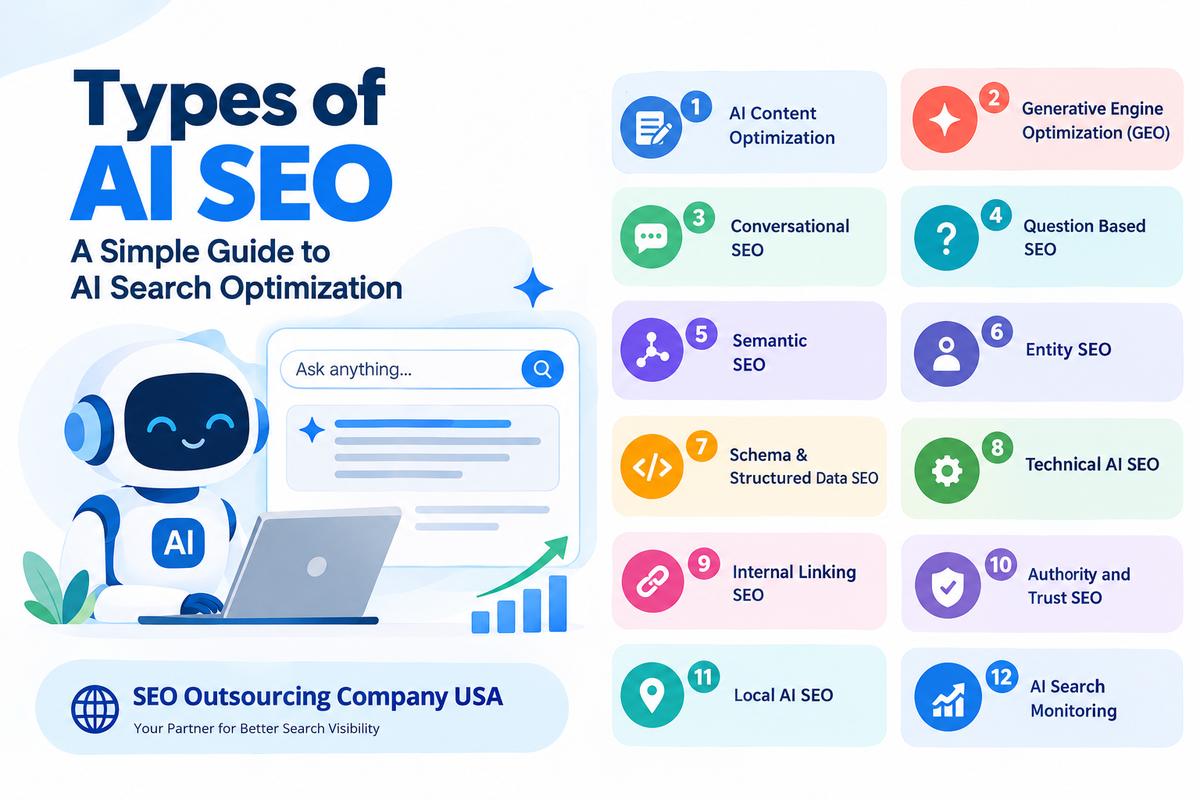
Here are the main types of AI SEO businesses should know about.
1. AI Content Optimization
AI content optimization means creating content that is useful, clear, and easy to understand.
Good content should:
- Answer the user’s question directly
- Use simple language
- Have clear headings
- Provide useful examples
- Avoid unnecessary information
- Give accurate and updated information
The main goal is to help the reader first while also making the content easier for AI systems to understand.
2. Generative Engine Optimization
Generative Engine Optimization, also called GEO, focuses on improving content for AI generated search results.
AI search tools may collect information from different websites before creating an answer. Businesses can improve their chances of being noticed by creating useful and trustworthy content.
Some important practices include:
- Giving clear answers
- Covering topics in detail
- Using accurate information
- Adding original information
- Answering common questions
- Keeping content updated
3. Conversational SEO
People often search by asking complete questions instead of using only two or three keywords.
For example, instead of searching for “local SEO services,” someone may ask:
“How can local SEO help my small business?”
Conversational SEO focuses on these natural questions.
Businesses can use:
- Question based headings
- Long tail keywords
- FAQs
- Natural language
- Direct answers
This helps content match the way people naturally search and communicate with AI tools.
4. Question Based SEO
Question based SEO focuses on answering the questions customers have about a business, service, or product.
For example, an SEO website can answer:
- What is SEO?
- How does keyword research work?
- What is technical SEO?
- How long does SEO take?
- What is AI SEO?
- Why is link building important?
Answering these questions clearly can make a website more useful to users and search systems.
5. Semantic SEO
Semantic SEO focuses on the meaning of a topic rather than using the same keyword repeatedly.
For example, a page about SEO for doctors can naturally discuss:
- Medical websites
- Patient searches
- Local SEO
- Healthcare content
- Online reviews
- Google Business Profile
- Website trust
These related topics help search systems understand the subject of the page.
6. Entity SEO
Entity SEO helps search engines understand important subjects such as businesses, people, products, places, and organizations.
For a business, important information can include:
- Business name
- Location
- Services
- Industry
- Website
- Contact information
Keeping this information clear and consistent can help search systems understand the business better.
7. Schema and Structured Data SEO
Schema markup provides search engines with additional information about a webpage.
Depending on the website, businesses may use different types of schema, such as:
- Organization
- Local Business
- Article
- Product
- Service
- FAQ
- Review
Schema does not guarantee that a website will appear in an AI answer, but it can help search systems understand page information more clearly.
8. Technical AI SEO
Technical SEO is still important for AI search.
If search engines cannot properly crawl or access a website, its content may have difficulty being found and understood.
Technical SEO can include:
- Checking crawling problems
- Fixing indexing issues
- Improving website speed
- Fixing broken links
- Checking mobile performance
- Managing redirects
- Using canonical tags
- Checking XML sitemaps
- Reviewing robots.txt
- Checking structured data
A technically healthy website provides a better foundation for search visibility.
9. Internal Linking SEO
Internal links connect different pages on your website.
For example, an SEO services page can link to pages about:
- Technical SEO
- Local SEO
- Content SEO
- Link building
- AI SEO
- Keyword research
Good internal linking helps users find related information and helps search systems understand how different pages are connected.
10. Authority and Trust SEO
Trust is important when people and AI systems look for information.
Businesses can build a stronger online presence through:
- Helpful content
- Accurate information
- Relevant backlinks
- Trusted website mentions
- Consistent business information
- Expert content
- Regular content updates
The focus should be on providing information that users can understand and trust.
11. Local AI SEO
Local AI SEO focuses on businesses that serve specific locations.
For example, someone may ask:
“Which SEO agency can help my business in Florida?”
Businesses should make sure their local information is accurate across their website and other online platforms.
This can include:
- Business name
- Address
- Phone number
- Service areas
- Local pages
- Business listings
- Customer reviews
- Location based content
12. AI Search Monitoring
AI SEO is not a one time activity. Search systems and user behavior continue to change.
Businesses should regularly monitor:
- Search rankings
- AI search results
- Brand mentions
- Website traffic
- Important search queries
- Competitor content
- Old content that needs updating
Regular monitoring helps businesses find new opportunities and improve their content.
How to Build an AI SEO Strategy
A simple AI SEO strategy starts with understanding your customers.
First, find the questions they ask. Then create useful content that provides clear answers.
Businesses can also:
- Research keywords and topics
- Study competitors
- Create helpful blogs and pages
- Improve technical SEO
- Add relevant internal links
- Use suitable schema
- Build relevant backlinks
- Update old content
- Keep business information consistent
- Monitor SEO and AI search visibility
The main goal should always be the user. AI SEO is not about adding keywords again and again. It is about creating useful, clear, accurate, and easy to understand information.
Conclusion
AI SEO is becoming an important part of modern search marketing. It includes content optimization, GEO, conversational SEO, semantic SEO, entity SEO, technical SEO, schema, internal linking, authority building, local AI SEO, and AI search monitoring.
Businesses should focus on both traditional SEO and AI search optimization to build a stronger online presence.
If you need help improving your website for traditional search and AI search, SEO Outsourcing Company USA can help. Our agency provides services such as keyword research, content optimization, technical SEO, link building, on page SEO, off page SEO, local SEO, and AI SEO support.
With a clear strategy focused on useful content and better search visibility, SEO Outsourcing Company USA can help your business build a stronger presence in the changing world of search.