google_august_spam_update

Latest Google Algorithm August Spam Update

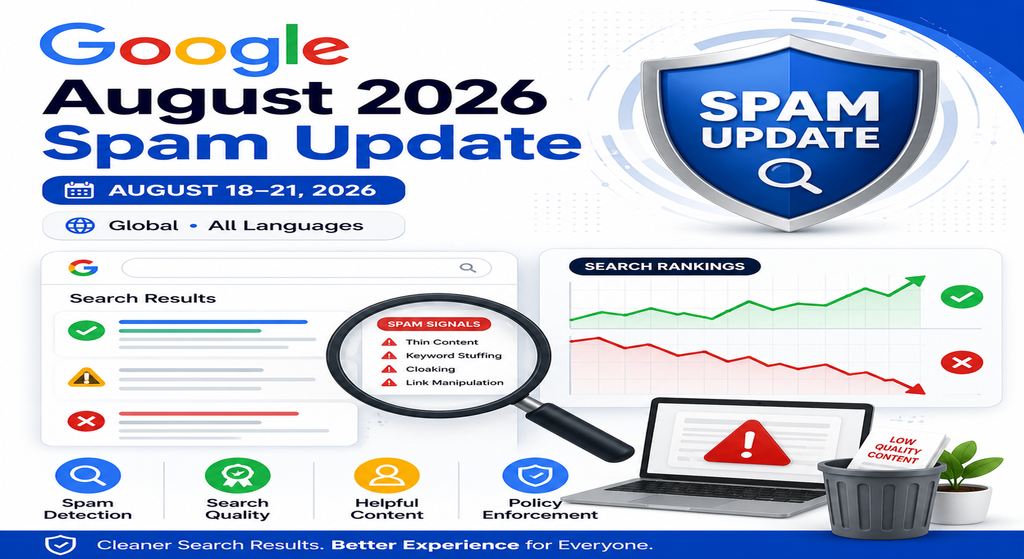
With its August 2026 Spam Update, Google has made an important modification in its search engines. The update launched on August 18, 2026, and concluded on August 21, 2026. Google has confirmed the launch of the update everywhere in the world and in all languages.

For website owners as well as SEO specialists, Google updates make some anxiety since even some small changes in search ranks can influence website traffic as well as sales. However, before applying fundamental changes to the SEO strategy, it is very important to understand the aim of the update.

The August update is officially classified as a spam update rather than a broad core update. Google has not disclosed any particular type of spam dealt with in this update but it is the next step in the constant process of making improvement in the ability of the search engines in recognizing and minimizing spam in search.

What is the Google August spam update?

Google is always enhancing its automated systems capable of detecting sites and content that violate the spam policies. Whenever Google significantly enhances its detection systems, it may declare it a spam update.

The spam update for August 2026 came into effect on 18 August and completed by 21 August. According to Google’s Search Status Dashboard, it took approximately two days and sixteen hours for Google to complete it. This update is neither the global update nor the core update.

This update takes a more focused approach toward Google’s spam detection systems rather than being a core update that is aimed at numerous systems at once. Hence, any observed change in ranking during this period does not imply that the website has been subjected to any penalties.

Why does Google release spam updates?

Google aims to ensure that its search results give useful and pertinent information to the users. Yet, certain websites employ strategies aimed mostly to distort rankings without providing adequate value to users.

Spam techniques can be understood as misleading methods, useless autogenerated content, keyword usage and other unethical methods violating Google requirements.

Spam updates contribute to Google’s ability to detect such practices. The conclusion for businesses is evident. SEO has to be built around real value rather than shortcuts.

Does the update target AI content?

The introduction of the concept of AI generated content has garnered attention from SEO discussions. This increase in interest has been mainly due to some of the recent changes introduced by Google. Despite this, the search engine has not made any statement regarding AI generated content being the focus of the Spam Update that was rolled out in August 2026.

When it comes to content creation, the content quality and the content purpose are key elements. Just because a piece of content was created using AI, it is not considered to be spam by default. Low-quality content is usually produced by business owners who are trying to take advantage of the automation process and easy channels of creating content in order to optimize their website for search.

The idea is that if a company utilizes AI to generate content, it still needs to make sure that the content and the data used are accurate and include useful information derived from some real-life experience, examples, or even unique information.

Who could be affected?

Google has not mentioned in particular what industry or website type has been affected by the latest spam update that occurred in August.

Nevertheless, websites that practice some forms of manipulative SEO can be more susceptible to the improvements in Google’s filter.

As a result, companies are recommended to check the pages that lack relevant content, use an excessive amount of keywords, and were created mainly for the search engines.

At the same time, and it should be noted that just because the website ranking goes down does not mean that the spam is the reason behind it, as the search performance may change due to competitors, search demand, indexing and technical issues, or other Google systems.

What would you do if rankings dropped?

In case your site faced a drop following August 18, make sure to monitor your Google Search Console statistics.

Make a comparison between your metrics before and after the update to analyze the clicks, impressions, average positions, and the keywords sending traffic to your site.

You also need to decide whether the decline affected the entire website or the specific pages of it. If only certain pages suffered, check their content and understand whether or not it fulfills the purpose of the search.

Analyze whether the information is reliable, helpful, relevant, and easily understandable. Moreover, perform an analysis of all technical aspects of your website – indexing, internal linking, redirects, duplicates, and accessibility. 

Avoid making major changes till you know for sure what is the reason for the problem.

Do not panic after an algorithm update

One prevalent error made following a Google update relates to making decisions in haste because of panic.

Website owners may remove material, modify pages, change phrases or start constructing links without understanding what led to changes in the rankings and so they could confuse the issue..

Rather it would be better to monitor the data and discover any noticeable trends. Once the August update has already taken place, companies could compare their performance before and after the update.

Whenever issues are detected, improvements should be made to enhance the quality of the website instead of finding any ranking hack.

Focus on useful content

When it comes to search engine optimization, the safest way is still to write content for humans first before anything else.

Every single page on a website has to have a clear goal and share relevant information, which is really going to aid a visitor. A services page sets out the services clearly while blog content is supposed to answer the questions the audience has.

Articles shouldn’t be written just when a certain keyword has a high search volume. The emphasis should actually be put on useful insights, genuine examples, useful advice leading to real value for consumers.

Content must also be easy to read since the page should contain informative headings, short paragraphs, internal links, and simple language used throughout the content.

Review your website regularly

Companies should not put off the assessment of their SEO results before they get an algorithm refresh.

Consistent website audits can reveal technical difficulties, dead connections, issues with indexing, duplicate material, and pages that ought to be enhanced.

Outdated content should be updated regularly. If some page loses its value, check if you can refresh or merge it with a related page.

Systematic checking provides organizations with the opportunity to recognize problems in good time.

What does the August update mean for SEO?

The newest update on Google’s spam algorithm is a reminder that search engine optimization is a long term project. 

The company completed rolling out the update on August 21, 2026, announcing that it had been implemented globally and in all the spoken languages. Google has not provided the public with information about any specific passive spam forms related to this update, so it is advised to watch out for any misleading reports about what the company intends to target. 

The best approach in this situation would be to check the statistics of the site, study Google’s spam policies, and enhance your content and technical quality if needed.

Final thoughts

There is no reason to panic when it comes to the August spam update. Businesses need to evaluate the state of their site, work on enriching weak content, conduct technical SEO and avoid any shady practices when creating their websites.

As Google progresses further, long lasting SEO becomes more important than ranking tricks.

The mission of an SEO outsourcing service provider is to help businesses establish a strong web presence and achieve the maximum return on their investment.

EO Tasks Should Businesses Outsource Offshore

What SEO Tasks Should Businesses Outsource to an Offshore Team

Most businesses are not struggling with the decision to outsource SEO. They are faced with a different dilemma: what aspects of SEO to delegate and what to keep in-house.

A founder hands over the website credentials and waits for results for a quarter. A marketing manager handles everything internally since they have no faith that an external agent will do a better job, and specialist SEO work is left neglected.

The real question is which tasks are suitable for delegation and which should remain the responsibility of the company’s employees.

This article highlights the SEO tasks that can and should be outsourced, the deliverables of an offshore SEO team, and how to evaluate their performance.

Why Businesses Choose to Outsource SEO

The reasons for outsourcing are similar for any company that contemplates the move. Access to expertise is often the primary consideration, as technical SEO, structured data markup, and outreach are highly specialized areas. In addition, outsourcing lifts a part of the workload off the in-house team, which is often stretched too thin to handle SEO in addition to social media, email marketing, and ads.

An offshore team is also more scalable than a single in-house SEO executive and can often work faster since they are not multitasking. However, cost considerations should not be the deciding factor, as the temptation to go for a cheaper option can lead to suboptimal work, such as generic keyword lists, templated content, and spammy backlinks.

What SEO Tasks Are Best Outsourced?

SEO tasks that can be delegated fall under specialist, repetitive, process-heavy, time-consuming, and easily measurable categories. At the same time, they should not require judgment that is specific to the company.

Here are the SEO tasks that can be safely delegated:

Keyword Research and Search Intent

An experienced team will do more than just identify keywords and their volumes. They should be able to assess search intent, separate commercial from informational queries, group keywords into clusters, analyze the competition for each keyword, and allocate keywords to specific pages.

Volume is not as important as it used to be, as keywords with similar intent can be organized into one page. At the same time, not all keywords with the same intent are equal, so the business should provide the offshore team with services, target markets, and priorities to guide the research.

The deliverable should be a keyword list grouped by search intent rather than a general list sorted by volume.

Technical SEO Audits

A technical SEO audit should highlight crawlability and indexability issues, canonicalization errors, redirect chains, sitemap problems, internal linking structure, page performance, structured data, and mobile usability. However, what distinguishes an adequate audit from an exceptional one is the follow-up work, such as a list of issues with impact, severity, and recommended action, and who is responsible for implementing the fix. The analysis can be outsourced, but the actual implementation of many fixes requires the involvement of the in-house development team.

Content Strategy and Optimization

An SEO team is not a content creation agency, so the content production process should be hybrid, with the offshore team handling research, search intent, competitor analysis, content gaps, briefs, and optimization and the internal team providing expertise, customer insights, and final approval.

Local SEO

An offshore team can handle local SEO tasks, including optimizing the Google Business Profile, researching local keywords, citations, local landing pages, and local competitors. They can also help with reviews, local link building, and tracking. However, the business should provide accurate service area information, hours of operation, and contact details. The company should also have a good sense of local markets and their priorities.

Link Building and Outreach

A competent team will handle prospect research, relevance analysis, outreach, relationship nurturing, placements, and monitoring of acquired links. Before accepting a prospect, the business should have a shortlist of questions to ask, such as topical relevance, organic traffic, authority, editorial guidelines, existing outbound links, relevance of the target page, and whether the placement makes sense to the reader aside from the link.

It is essential to avoid link schemes, irrelevant guest posts, spam directories, link networks, and unnatural anchor texts.

Competitor SEO Analysis

An offshore team can research competitors’ keywords, pages, content, backlinks, local presence, and services. However, the business should have a specific question in mind, such as what new pages to create or what the competitor is doing better. The analysis should lead to concrete recommendations, such as developing new content or improving upon the competitor’s offerings.

SEO Reporting and Analysis

A competent team will provide organic traffic insights, movements in keywords, impressions, clicks, and landings, conversions, backlinks, completed tasks, and next steps. A good report should highlight what changed, why, and what should be done in the future. Without this context, reports are merely pretty numbers on a page.

What SEO Tasks Should Remain In-House?

Outsourcing does not mean relinquishing all authority and responsibility. Here are the SEO tasks that should remain the responsibility of the in-house team:

Brand and Business Strategy

An external team can execute strategy, but it should be the in-house team that determines what to execute.

Customer and Industry Knowledge

An external team cannot know the customers as well as the in-house sales, support, and marketing teams, and this affects everything from keywords to content tone.

Final Content Approval

Someone in the company should fact-check the content and approve it for publication since SEO teams are often not privy to confidential or industry-specific information.

Major Marketing Decisions

The in-house team should decide what to spend the marketing budget on and where to allocate resources.

Sensitive Business Information

The offshore team should only have access to information on a need-to-know basis.

What SEO Tasks Should Businesses Keep In-House?

Outsourcing does not mean handing over complete control.

Brand and business strategy. An outside team can execute well, but direction should come from people who understand the business’s long-term goals.

Customer and industry knowledge. No outside team knows the customers as well as the people who talk to them daily, and that shapes everything from keywords to tone.

Final content approval. Someone inside the business should review content before it publishes, to protect accuracy and anything industry-specific an outside writer might miss.

Major marketing decisions. Budget allocation and market entry decisions should stay with internal leadership. SEO is an input, not the decision maker.

Sensitive business information. Financial details and unreleased plans should only be shared on a need-to-know basis, with clear agreements in place.

SEO Tasks to Outsource vs Keep In-House

TaskOutsource?Internal InvolvementReason
Keyword researchYesProvide priorities and target marketsResearch-heavy, benefits from business context
Technical AuditsYesApprove fixes to core codeSpecialist work; implementation may need developer sign-off
Content briefsYesReview for relevanceStructured, process-driven work
Content writingHybridProvide expertise and fact-checkingCombines SEO structure with internal knowledge
Local SEOYesConfirm accurate location detailsRepetitive, process-driven, scales well externally
Link buildingYesApprove target sitesTime-consuming outreach suited to a dedicated team
Competitor analysisYesWeigh in on which findings matterResearch-heavy, easy to standardize
ReportingYesReview monthly and ask questionsProcess-driven, benefits from consistent tracking
Brand strategyNoFully internalRequires long-term business judgment
Final content approvalNoFully internalProtects accuracy and brand voice

How to Choose the Right Offshore SEO Team

It is essential to focus on process rather than price when selecting an SEO agency. If you’re considering an SEO Outsourcing Company in India, ask about the scope of work and specific deliverables rather than vague promises of improved rankings. Ask about the methodology in simple terms, reporting, and day-to-day communication. Also look at the agency’s experience, with a specific focus on its link-building process, content quality, and measurement methodology.

Transparency is a critical factor, so it is worth asking an offshore SEO agency to explain what it does, why it does it, and how it will demonstrate results to the client. 

A competent agency will not hide behind buzzwords but will give concrete answers about its processes and measurement methodology. A red flag is an agency that cannot explain its measurement methodology in simple terms.

What Should an Offshore SEO Team Deliver Every Month?

The deliverables depend on the agreed-upon scope of work, but the following is an example of a monthly cycle:

Week 1: Performance review, keyword research, and technical SEO.

Week 2: Content optimization, briefs, and internal linking.

Week 3: Outreach, local SEO, and competitor analysis.

Week 4: Reporting, recommendations, and planning.

How to Make Offshore SEO Outsourcing Work

A few best practices can increase the chances of a positive outcome for both parties. 

First, it is essential to define responsibilities, so everyone knows what to expect. 

Second, it is vital to have shared goals that everyone can rally around. 

Third, the communication schedule should be regular, if not daily, rather than sporadic. 

Fourth, there should be a well-defined approval process. 

Fifth, the offshore team should have access to the information they need to do their jobs but no more.

Sixth, it is important to have KPIs in place. 

Seventh, the client should have the opportunity to review the strategy rather than receive a report that only the executive team can understand.

The business should retain control of the strategy, brand, customer knowledge, and final approvals. The offshore team should handle the research, execution, optimization, and reporting. The two parties should share responsibility for content strategy, technical SEO, and priorities.

Common SEO Outsourcing Mistakes to Avoid

Choosing the cheapest provider. Extremely low pricing usually means templated work or shortcuts on link quality. Compare providers on process and deliverables first, and treat price as one factor among several.

Outsourcing everything without oversight. Without any internal check-in, problems go unnoticed for months. Keep at least a monthly review cadence, even when SEO is fully outsourced.

Measuring only keyword rankings. Rankings do not always translate into traffic or revenue, especially for mixed-intent keywords. Track traffic, conversions, and business outcomes alongside rankings, not instead of them.

Buying low-quality backlinks. This often comes from wanting fast results. Low-quality links can trigger penalties and damage a site’s reputation. Insist on seeing the quality checklist a provider uses before any link building begins.

Publishing large amounts of generic content. Volume gets prioritized over relevance, but generic content rarely ranks well and can dilute a site’s overall quality signals. Fewer, well-researched pieces generally outperform a high volume of shallow posts.

Not giving the SEO team enough business context. Without context on services, customers, and priorities, even a skilled team ends up guessing. Invest time in proper onboarding and keep the team updated as the business changes.

When Should a Business Consider SEO Outsourcing?

There are several factors that may prompt a business to consider outsourcing SEO. They include a lack of specialist skills within the in-house team, SEO being a lower priority than other areas, technical issues going unaddressed, inconsistent content, no link building, unclear reports, entering new markets, and the in-house team being overwhelmed. SEO outsourcing is not always necessary, especially for small sites, those with a competent in-house marketer, and no plans for rapid growth.

SEO Outsourcing Can Work Best as a Hybrid Model

Businesses do not have to choose between in-house SEO and outsourcing. In practice, a hybrid model works best, with the offshore team handling the execution while the in-house team retains control of strategy, expertise, and approvals. A hybrid model also works well with other marketing functions, such as social media, email marketing, and ads. 

SEO is not separate from the broader marketing strategy, so a company that works with a full-service digital marketing company in India or elsewhere can integrate SEO more easily into the wider plan.

The Bottom Line

Outsourcing SEO is not about removing responsibility; it is about delegating the right tasks to the right people. The offshore team takes over the specialist and execution-oriented tasks, such as audits, keyword research, outreach, and reporting, while the in-house team retains control of the strategic and judgment-heavy tasks. 

When considering outsourcing, businesses should evaluate their team’s strengths and identify which SEO tasks can be delegated efficiently. Choosing a reliable partner that understands business goals is equally important. SEO Outsourcing Company USA helps businesses manage their SEO requirements with professional support, strategic execution, and consistent reporting. Our approach is designed to complement your in house team, helping improve search visibility and achieve sustainable SEO growth without replacing your internal expertise.